I wrote previously about my naivete in high school. I can remember talking to my best friend when we were in college and being shocked to find out so many of our classmates were having sex and drinking during high school. (How she was so aware and I was so clueless is astounding.)
Even twenty years later I remain pretty darn naive. I am aware of some horrible things in my students' lives over my fifteen years of teaching. My first year I had a boy whose mother had abandoned the family. Another student's mother had died not long after the girl's baby brother was born and the father was believed to be sexually abusing the daughters so the children were all removed from his custody. One girl's mother tried to commit suicide. One boy had a baby brother die. Another girl was raped multiple times by a family friend living with them temporarily. At least two girls had lost their fathers during their elementary school years. A couple of students were being raised by family members because their mothers were in mental institutions. Plenty of students fled their home countries out of danger to their families.
All of these things were explicitly told to me. They may have been shared by the families or read in a family history done by our school social worker or told to me by the child's previous teacher. In some way I was given notice of these traumas.
How many other traumas have I missed because I am too naive to believe these things happen? Have I had students who were abused and I missed the signs? Were there ones suffering from depression or other mental health challenges?
Children are amazingly strong and resilient. They overcome things that make me want to curl up and hide under the covers for days. I hope that I have given them the love, support, and safety they all need and deserve even if I was unaware of turmoil in their outside-of-school lives.
But the more I think about this the more I wonder. I'm familiar with statistics on abuse and mental health disorders. I know that some of our students face these problems. I know that some of the strangers I pass do as well. Which ones? Why them? How can we know? Only then can we do anything to help.
I don't want to become cynical instead of naive. Somewhere there must be a middle ground that allows me to carefully watch for concerns or signs of trouble while still believing in the inherent goodness of people...
Thursday, November 08, 2012


Sunday, November 04, 2012
Fair Warning: Not about Education At All
This post is much more personal, political, and religious than I tend to be here. Feel free to skip it.
I don't know how the elections will play out on Tuesday and I don't know if specific comments will impact the chances of those who made them, but I have been so bothered by them I finally had to do something. When I am struggling in this way, writing is my solution.
I don't know how the elections will play out on Tuesday and I don't know if specific comments will impact the chances of those who made them, but I have been so bothered by them I finally had to do something. When I am struggling in this way, writing is my solution.
As a woman, as a Christian (mostly, at least), and as a rape survivor I am shocked by comments made by some politicians lately. Religion plays in here because that seems to be at the root of these men's reasoning about rape and abortion. Typically my responses to media reports about rape are not impacted by my religious/faith/spiritual beliefs.
If these men had stated that they did not support abortion in the case of rape because they believe that murdering a fetus is a crime and one crime in response to another is not acceptable, I would not agree but I would accept their reasoning. Based on their Christian values (that I am assuming are in play) that would be logical.
My religion is also a factor, and a critical one in my response to these statements, because of my specific story. It's not a story I tell often. But I feel a need to tell it now.
I was sixteen years old and a youth delegate to my denomination's annual state conference. I traveled with one of our pastors and another respected member of our church to the conference. The youth delegates stayed in the dorms on the campus where the conference was held.
The conference lasted several days. There were a lot of fabulous activities for the youth delegates and we participated in the general conference sessions as well. Our time was pretty well structured and planned for the entire time. I vaguely remember meeting some wonderful teens from across the state. One of my favorite hymns I learned at that conference.
One of the other youth delegates was a recent high school graduate who, according to what he told people, wanted to become a minister. He was two years older than I and we spent a lot of time together. The last night of the conference he snuck down to my dorm room, something I probably thought was flattering and fun at the time. He tried to convince me to have sex with him and when I refused he raped me.
My memories are blurred by time and pain but I remember crying and saying no, no, no again and again. I was terrified of what was happening but also afraid of getting in trouble because he was there in the first place. I told no one.
The next morning, at the large, closing ceremonies, he came to see me as though everything was normal. He even made a comment along the lines of, "That wasn't so bad, was it?"
I was at a church conference. He was a youth delegate who was going to become a minister. How could that have been rape? For two years I convinced myself it wasn't. I knew I was no longer a virgin, I wasn't that naive. I also spent a tense few weeks terrified of being pregnant. I got lucky there. I never had to make the decision about whether or not to abort a child conceived through rape.
More than two years later a chance question prompted me to defend my sexual history and choices (limited though they were) and confront the reality of what had happened. I was lucky enough to have someone in my life who forced me to get counseling and who supported me through months of pain, nightmares, and fear.
More than two years later a chance question prompted me to defend my sexual history and choices (limited though they were) and confront the reality of what had happened. I was lucky enough to have someone in my life who forced me to get counseling and who supported me through months of pain, nightmares, and fear.
The shame I still feel more than twenty years later is surprisingly strong. I was naive and had no idea how to handle such a situation. I believed in the goodness of others and found it hard to imagine anyone would do such a thing, much less a youth delegate to a church conference.
If you are not one of the 1 in 6 women to be raped in their lifetime it can be hard to truly understand the long-lasting trauma involved. For anyone to suggest that rape could be, in any way, intended by God is horrifying.
If you made it this far, please remember that this was my way of dealing with my frustration over these comments. I am not looking for sympathy. I am much stronger at 39 than I was at 16. In my perception rape is seen as less shameful now than it was twenty years ago. Mostly I think that is a good thing. Mostly I think that helps us move forward, in spite of comments like these made by certain politicians.
Saturday, November 03, 2012
Number? Letter? Hard to Say
We do our afternoon dismissal online. Personally, I love it. It's silent so it doesn't disrupt anything we might be doing (usually me reading poetry to the kids) and it's in print so I can look back if I'm not sure a bus has or hasn't been called.
As I do occasionally have to be out of the classroom I have two students who go to one of our computers and tell us when any new group is dismissed. My two little guys do a great job at this. At first I had dismissal open on my computer too, just to check. They've got it down now.
There is one small snag. Right there, under the '3:15 WALKERS' is the bit that throws them each day.
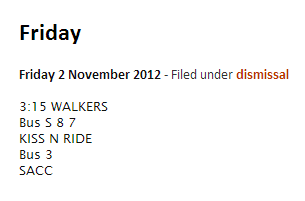
Every day they call out "Buses 2 and 7 are dismissed!" (or sometimes "Buses 5 and 7" depending on their perspective). Next week we're going to have to look at this carefully. It turns out we have a Bus S. I didn't know that. Not surprisingly my kiddos clearly don't know that.
As I do occasionally have to be out of the classroom I have two students who go to one of our computers and tell us when any new group is dismissed. My two little guys do a great job at this. At first I had dismissal open on my computer too, just to check. They've got it down now.
There is one small snag. Right there, under the '3:15 WALKERS' is the bit that throws them each day.
Every day they call out "Buses 2 and 7 are dismissed!" (or sometimes "Buses 5 and 7" depending on their perspective). Next week we're going to have to look at this carefully. It turns out we have a Bus S. I didn't know that. Not surprisingly my kiddos clearly don't know that.
Friday, November 02, 2012
Digital Halloween Costumes
Instead we created our own costumes, digitally at least. I put their faces into Pixie and they drew their favorite book character's body with their head. I modeled this with The Pigeon, which may have led to so many other Pigeons in my class. Or, they might just like The Pigeon that much.
We have spent a lot of time lately talking about characters in books we read and books we write so it was fun to use those characters in a new way.
I was especially impressed with the kiddos who added details around their face rather than just below it.
As an aside, one of the Pete the Cats looks an awful lot like the dinosaurs that child draws during writing workshop each day...
Thursday, November 01, 2012
The Benefits of Labels
Quick caveat: I don't feel a great urge to label students. I'm lucky to work at a school where the support students receive is based on their need, not their labels. It does matter when it comes to accommodations for standardized testing and it might matter more when kids get to middle and high school however. (I don't know enough beyond elementary to say.)
As a first grade teacher I have worked with students with special education labels every year. Those little darlings all had been identified in preschool. It's easy then to keep that label and support those students and give them those accommodations.
A student who gets to kindergarten or first grade without identified learning disabilities has a lot more trouble getting that label. I completely understand that we do not want to willy-nilly slap labels on students. I truly do.
That said, the testing that is done in the process of identifying learning disabilities gives so much information about how a child learns. It gives insight into visual or auditory processing difficulties for example. Unfortunately when a young child is up for discussion, the most frequent response is, "They are so young. Let's give them more time."
I don't really want the label. I want the testing. I want to understand what is keeping a student from learning the way all their peers are doing. But if you are testing a lot of students and not finding labels that is questioned. So we don't test. We don't learn. We don't understand. We don't help as well as we could.
I have reread this numerous times tonight trying to ensure my language actually conveys my thinking. I hope it does. I'm sure there are places here where the language I have used illuminates biases I have. If you notice any, please point them out to me. We are often blind to our biases and could use help from others identifying them.
Monday, October 29, 2012
Reason #732 Why I Love My school
Here are two notes I received this past week. The first was written at the bottom of a permission slip about a student's participation in a social skills group with our counselor. The parent gave permission and added this note:
"I don't know how to thank School Management because of all these hard work. Elementary is the best school."(I changed the italicized words so that they don't name my school. I did the same with the following note to not name the student.)
This note was to me from a parent after his son received a postcard from me.
From Awesome Student- Father -I did not change the language in these notes because it impresses me so much that these parents are so invested in their children's schooling that they will write these notes with whatever English language ability they have gained so far. I love working at my school. Our students and families are fabulous.
To Mrs. Orr Jennifer.
Thanks for the wonderful card that we received last week, Awesome Student is so lucky to have you as a great teacher, he loves you so much:
one more thing, Awesome Student he will miss you this Friday October 26th for a special holiday.
Thanks again
Awesome Student Father
Thursday, October 25, 2012
How Children Succeed (even if I can't)
How Children Succeed is sitting beside my bed, as it has been doing for weeks. I have many flags stuck in it, waiting for me to process my thinking here. But life has gotten a little out of my control in the past couple of weeks and this has slipped on the priority list.
Fortunately, others are doing a better job than I am. Diane Ravitch wrote about the book with a summary. Deborah Meier's comment is worth reading as well.
Valerie Strauss, of the Washington Post, interviewed Paul Tough about the book.
I will get my stuff together and get back to my thoughts about this book soon. I have to admit that I think Tom summed up my thoughts about the book in just one sentence in his comment on this previous post. That won't stop me from writing more though.
Wednesday, October 24, 2012
Gaining Street Skills
Last week our daughters were playing outside, as they often do. We're lucky to live on a pretty quiet cul-de-sac surrounded by a bunch of neighbors who know each other and enjoy spending time outdoors chatting and being together. There are quite a few kids in the neighborhood as well.
As we were getting dinner ready one daughter rushed in to tell us that there were police cars outside. We didn't think too much about it until we heard more information from the girls. Apparently the police officers were talking to all the kids. We went to investigate.
It turns out that a kid (probably 14 years old or so) had called the police because another kid's parents had screamed at him. I don't have the details from anyone who saw the incident so I can't really speak to details.
It lasted about 15 minutes and then things returned to normal.
Except for the fact that my daughters gained a lot of knowledge in that short time. They learned about what it means to be threatened (the boy was telling the police he felt threatened). They learned about some curse words. They learned what it means to interact with police officers.
They got a lot of streetwise knowledge in a really short time. They are nine and five. I didn't feel a great need for them to have that knowledge yet.
Recognizing that got me thinking about the many kids who live in neighborhoods where this sort of incident, a visit from the police, threats, curses, happen frequently. What does having knowledge of that world, of those types of behaviors mean for young children? When that is normal how does that impact their learning, their relationships, their life skills?
Friday, October 19, 2012
Library Goddess Emails
Background information:
I have spies
And they tell me there are books in your blue crate.
Are you hording them? Selling them on the black market? Using them as ransom for library pockets? These are just some of the options I have considered.
Happy Hour in the Library
This is for books only. Please do not be a spoil sport and not let your books come.
Blue crate all call
It is a blue crate party. Don't be the meanie, let your blue crate join in the glitter, cupcakes, and soda.
Running on empty (blue crates)
Looking out at the books resting under my crate
Looking back at the stories gone by like so many ice cream cones
In 3 hours, it will be noon and I will be running reports
I don't know what I am reading now, I'm just reading on.
(This means return your blue crates because I am running reports at noon.)
Peer Pressure
Return your blue crates, everyone is doing it.
Also, I am running overdue notices at noon for students. Prevent heartache! Prevent unneeded stress! Return blue crates.
library open
Cries me with silent lips, "Give me your baskets, your books, your huddled masses yearning to read today...The lamp is lit next to the library door."
Things that are welcomed in the library and the opposite
1. Blue crates with books
2. Students in groups of 3 to check out books
3. Cupcakes
And the opposite:
1. Empty blue crates
2. Ants in any group size
3. Zucchini
Multiple Choice Question
If the day's testing is over in the library, then I should
a. Stash my books in a fallout shelter for the Next Big Day
b. Give my books to the wild animals in the park
c. Return blue crates of books to the library
d. Sing songs about books in the library
Status Update
Library: Still Messy
Accepting Now: Blue Crates
Accepting After Noon: Students for checkouts who know how to spell their last name.
Mountain of blue crates
Let's see if we can create one this morning with all your book returns.
This is Just to Say
I have read
The books
That were in
The blue crate
And which
You were probably
Saving
For later
Forgive me
They need to be returned
So soon
And so today
Thanks WCW!
It's Raining Blue Crates
Reading level is rising - Shelves getting low
According to all sources, the library's the place to go
Cause today for the first day
Just about half-past ten
For the first time in history
It's gonna start raining blue crates.
The overdue notices are running at 10 this morning.
Get ready by:
- Making signs to cheer the notices on
- Set up water stations around the school
- Return your blue crates by 10
Coach
There's something due any day
I will know right away
Soon as it shows
Blue crates come canonballin' down through the sky
Gleam on the spines
Hot as a trend
Please send
The air is hummin'
Blue crates commin'
Please send,
They're only just out of reach,
Down the hall, while you teach
Maybe right now?
Maybe right now?
Maybe right now!
(Brownie points if you can guess the song.)
- Our librarian is the greatest in the world.
- Classrooms all have blue crates for collecting returned library books.
- What follows is the text from emails sent by our librarian to the rest of the school. I found them brilliant and hilarious and felt a need to share.
- Clearly she is inspired by literature, show tunes, and more.
I have spies
And they tell me there are books in your blue crate.
Are you hording them? Selling them on the black market? Using them as ransom for library pockets? These are just some of the options I have considered.
Happy Hour in the Library
This is for books only. Please do not be a spoil sport and not let your books come.
Blue crate all call
It is a blue crate party. Don't be the meanie, let your blue crate join in the glitter, cupcakes, and soda.
Running on empty (blue crates)
Looking out at the books resting under my crate
Looking back at the stories gone by like so many ice cream cones
In 3 hours, it will be noon and I will be running reports
I don't know what I am reading now, I'm just reading on.
(This means return your blue crates because I am running reports at noon.)
Peer Pressure
Return your blue crates, everyone is doing it.
Also, I am running overdue notices at noon for students. Prevent heartache! Prevent unneeded stress! Return blue crates.
library open
Cries me with silent lips, "Give me your baskets, your books, your huddled masses yearning to read today...The lamp is lit next to the library door."
Things that are welcomed in the library and the opposite
1. Blue crates with books
2. Students in groups of 3 to check out books
3. Cupcakes
And the opposite:
1. Empty blue crates
2. Ants in any group size
3. Zucchini
Multiple Choice Question
If the day's testing is over in the library, then I should
a. Stash my books in a fallout shelter for the Next Big Day
b. Give my books to the wild animals in the park
c. Return blue crates of books to the library
d. Sing songs about books in the library
Status Update
Library: Still Messy
Accepting Now: Blue Crates
Accepting After Noon: Students for checkouts who know how to spell their last name.
Mountain of blue crates
Let's see if we can create one this morning with all your book returns.
This is Just to Say
I have read
The books
That were in
The blue crate
And which
You were probably
Saving
For later
Forgive me
They need to be returned
So soon
And so today
Thanks WCW!
It's Raining Blue Crates
Reading level is rising - Shelves getting low
According to all sources, the library's the place to go
Cause today for the first day
Just about half-past ten
For the first time in history
It's gonna start raining blue crates.
The overdue notices are running at 10 this morning.
Get ready by:
- Making signs to cheer the notices on
- Set up water stations around the school
- Return your blue crates by 10
Coach
There's something due any day
I will know right away
Soon as it shows
Blue crates come canonballin' down through the sky
Gleam on the spines
Hot as a trend
Please send
The air is hummin'
Blue crates commin'
Please send,
They're only just out of reach,
Down the hall, while you teach
Maybe right now?
Maybe right now?
Maybe right now!
(Brownie points if you can guess the song.)
Thursday, October 18, 2012
Cranky, Cranky, Even Crankier
For reasons completely unrelated to Jay Mathews I'm in a pretty cranky mood this morning. Reading his newest post in said cranky mood probably did not set me up to be impressed by what he had to say. However, starting off with
Is he serious? That's one of the most disturbing facts?
Every year we test a different bunch of 17-year-olds as the bunch tested the previous year are now 18-year-olds. Somehow each bunch of 17-year-olds should be smarter than the ones that came before them. How does that work?
Are 17-year-olds now significantly better drivers than 17-year-olds were in 1980? Do we expect them to be? Are 17-year-olds significantly kinder, more generous now than 17-year-olds were in 1980? Should they be? Why should students now be smarter than students 30 years ago? Are we suggesting that those students 30 years ago weren't so bright?
We should set high expectations for our students and for our schools. But those expectations shouldn't be based on students doing better each year than the students before them.
Are the young journalists smarter, better writers, more thoughtful than the older journalists? If they were the 17-year-old in 1980 should they be losing their job to the 17-year-old coming up who should be a significantly better reader than they were. Watch out Jay Mathews!
Mathews goes on to write about the Common Core State Standards. (Virginia has not adopted them so I honestly haven't paid too much attention to them.) He manages to really get me riled up again when he says:
As an elementary school teacher who spends a lot of time thinking about the texts I share with, read to, or assign my students, both fiction and nonfiction, I am highly offended by this idea.
With only a few minutes left before getting my students from art class, I am now going to focus on something much happier and more hopeful - planning reading groups.
Among the most disturbing facts about U.S. schools is that 17-year-olds have shown no significant improvement in reading since 1980.certainly did not help.
Is he serious? That's one of the most disturbing facts?
Every year we test a different bunch of 17-year-olds as the bunch tested the previous year are now 18-year-olds. Somehow each bunch of 17-year-olds should be smarter than the ones that came before them. How does that work?
Are 17-year-olds now significantly better drivers than 17-year-olds were in 1980? Do we expect them to be? Are 17-year-olds significantly kinder, more generous now than 17-year-olds were in 1980? Should they be? Why should students now be smarter than students 30 years ago? Are we suggesting that those students 30 years ago weren't so bright?
We should set high expectations for our students and for our schools. But those expectations shouldn't be based on students doing better each year than the students before them.
Are the young journalists smarter, better writers, more thoughtful than the older journalists? If they were the 17-year-old in 1980 should they be losing their job to the 17-year-old coming up who should be a significantly better reader than they were. Watch out Jay Mathews!
Mathews goes on to write about the Common Core State Standards. (Virginia has not adopted them so I honestly haven't paid too much attention to them.) He manages to really get me riled up again when he says:
Supporting the new standards is a movement to improve children's reading abilities by replacing elementary school pablum with a rich diet of history, geography, science, and the arts.(I will admit to checking a dictionary to be sure that my feelings of offense by the term 'pablum' were warranted. They most certainly were.)
As an elementary school teacher who spends a lot of time thinking about the texts I share with, read to, or assign my students, both fiction and nonfiction, I am highly offended by this idea.
With only a few minutes left before getting my students from art class, I am now going to focus on something much happier and more hopeful - planning reading groups.
Tuesday, October 16, 2012
Such a Lovely Kurd
 |
| Dear. Ms Orr Dik. you. for. the kurd I. hop. you had a good wekn |
A little darling brought this to me yesterday morning as a thank you for a postcard. (I try to send postcards to my students throughout the year saying how proud I am for something they did. I mail them to the children because I know the parents will also see them but it's so fun for kids to get mail. I sent my first batch of the year out last week.)
I love that she wrote me a thank you note. In multiple colors. With lovely decorations. On special paper. We don't see that much of this sort of thing at our school. It is wonderful.
I also love all the awesome things she's doing as a writer here. She has so many words she knows how to spell (dear, you, for, the, had, a, good). That's a great list for a beginning first grader. Then she clearly listened to sounds in other words (kurd for card, hop for hope, wekn for weekend). She has periods throughout her writing here. They aren't used correctly but she knows they should be there and she's trying them out. She's on her way to using them properly. I can also tell she reread this because she noticed she had forgotten the Ms. in my name and added it in later (in blue so I'm guessing after she had written the last line).
Honestly, something like this with all its wonderfulness can get me through some really rough times in the classroom.
Sunday, October 14, 2012
Edscape Reflection

The day opened with a keynote from Vicki Davis. I was familiar with Vicki's work before yesterday and had seen her in passing at ISTE but had never heard her speak. She was phenomenal. She talked about how the only one we can change is our self. There was a lot of detail about ways to focus our own change and then, how powerful our own change can be. At one point she talked about the importance of attitude but did say that her attitude is the one that matters most. Vicki was funny, passionate, and inspirational. I walked away thinking that I will not do something in my classroom that I would not want done to my own children (or at least, I'll try not to).
The first session I went to was led by Lisa Thumann (one of the few people at Edscape I already follow on twitter and knew from conferences but I picked her session because it was the most intriguing). She led a conversation about tradition vs. innovation. It began with a brief intro from Lisa and then all of us brainstorming ideas or practices that are traditional or innovative. We then took sides on a few of them and had an interesting debate about the best way or content to teach. I love having these conversations with educators at all levels and from many different schools and districts. Those varied perspectives help me process things and better understand my own thinking. (I'm still thinking about teaching handwriting and/or keyboarding...)
For the second session I went to see another twitter friend, Paul Bogush. Again, his session was the most interesting to me. Paul is a middle school social studies teacher who does a lot of live streaming from his classroom. I have watched his students perform music, poetry, and listened to their podcasts before. He talked about how he does all of this. I'm not sure how this would look with first graders, but given how easy USTREAM makes it I am thinking about how to give it a try.
After lunch I went to one of the sessions presented by Teq, a company that was involved in sponsoring Edscape. This one was about digital storytelling, something I have been excited about since participating (to some extent) in ds106 early in the summer. Teq's session was not so much about the creative side as it was about the technical bit. Oddly enough that was really helpful for me. It clarified for me how to get started with all the pie-in-the-sky ideas I have.
I ended my day with Samantha Morra, another middle school teacher. Her session was about gaming, something I have little knowledge of. I have now downloaded Scratch onto my computer and am excited about the Scratch cards. I think my nine-year-old and I may have to bond over Scratch. I did walk away from this session feeling like I have a better foundation for gaming than I had thought. Gaming always makes me think of something big and serious but Samantha reminded me of all the games I do use with kids, including Turtle Art.
Every session and the keynote gave me things to think about and to try. I had great conversations with educators (most of them from the NJ, NY, CT area). Next year the conference is on October 19th. I don't know that I can do 500 miles round trip in one day again, but it may be worth looking into taking the train...
Friday, October 12, 2012
The Importance of Expectations
A study from 1964 was mentioned on NPR recently and caught my attention (in connection with a much more recent study). The half-century old study reminded me of the story educators often hear about a teacher who sees numbers beside her students' names and assumes they are their IQs. These IQs are quite high and, as a result, she works hard to challenge these students. Turns out the numbers were actually their locker numbers. But she doesn't learn that until the students have succeeded beyond everyone's expectations. (I believe this story is apocryphal but the message behind it seems pretty sound.)
So, this study from 1964 involved telling teachers that a test their students were taking predicted which students were about to make large intellectual gains. They were then given random names as students who had been identified by this test. Shockingly enough those students went on to make great gains.
The more recent study is being done at the Curry School at the University of Virginia. Researchers there have realized that past attempts to change this dynamic have involved trying to change teachers' beliefs.
So, this study from 1964 involved telling teachers that a test their students were taking predicted which students were about to make large intellectual gains. They were then given random names as students who had been identified by this test. Shockingly enough those students went on to make great gains.
As Rosenthal did more research, he found that expectations affect teachers' moment-to-moment interactions with the children they teach in a thousand almost invisible ways. Teachers give the students that they expect to succeed more time to answer questions, more specific feedback, and more approval: They consistently touch, nod, and smile at those kids more.This did not surprise me at all (maybe because this study was done nearly 50 years ago?). I recognize how I respond, in small ways, differently to students based on what I expect from them. It is something I try hard to control.
The more recent study is being done at the Curry School at the University of Virginia. Researchers there have realized that past attempts to change this dynamic have involved trying to change teachers' beliefs.
But Pianta has a different idea of how to go about changing teachers' expectations. He says it's not effective to try to change their thoughts; the key is to train teachers in an entirely new set of behaviors.I know I am actively trying to change my own thoughts and beliefs about students. Is it possible for me to do so in a way that would not be possible for an outsider? I am, also, trying to change my behavior whether or not I can change my beliefs. I think UVA has it right here, the behavior is the key. Possibly changing the behavior of the teachers will result in changing beliefs.
Thursday, October 11, 2012
A Bad Night, Huh
When checking my Yahoo email recently (mostly used as the email of choice when ordering online and such) I noticed this headline: Obama Vows 'Determined' Performance at Next Debate. For reasons that I cannot explain, I clicked on it.
The article mostly focuses on Obama's comments during an interview with Diane Sawyer. The critical quote from him, to me at least, was this one:
Sadly that's not true for our public school students. They take that standardized test and if it's a bad day that can carry some powerful implications. A string of bad days can mean placement in remedial courses or not graduating.
If Obama is bad at debating (which I don't think is true based on past experiences, but roll with me here...) he has other ways of showing the voters why he should be reelected. He gives public speeches, has campaign commercials, and more. Students don't have this option. If they are bad at standardized testing, and some students must be, they don't have any other options. They just have bad day after bad day after bad day.
The article mostly focuses on Obama's comments during an interview with Diane Sawyer. The critical quote from him, to me at least, was this one:
Governor Romney had a good night. I had a bad night. It's not the first time.He continues (at least in the article) with:
This was one event. We've got four weeks to go.In this context I completely agree. I don't think one debate makes or breaks a presidential campaign. There are too many other factors, too many other chances to shine or falter.
Sadly that's not true for our public school students. They take that standardized test and if it's a bad day that can carry some powerful implications. A string of bad days can mean placement in remedial courses or not graduating.
If Obama is bad at debating (which I don't think is true based on past experiences, but roll with me here...) he has other ways of showing the voters why he should be reelected. He gives public speeches, has campaign commercials, and more. Students don't have this option. If they are bad at standardized testing, and some students must be, they don't have any other options. They just have bad day after bad day after bad day.
Tuesday, October 09, 2012
Get Thee to a Writing Project!

Those are some of my favorite people in the entire world. That's the group of Teacher Consultants from the Northern Virginia Writing Project's Invitational Summer Institute, 2012.
If you have a National Writing Project site in your area (find out here) and have not checked it out yet, do so! While you may not be able to commit to a summer institute there are often workshops and conferences offered. Many sites also have workshops and things for students.
Looking at this picture makes me smile as it brings back so many wonderful memories from this summer. My writing group has met once since the summer institute ended and we have another meeting coming up. I have grown so much as a writer and a teacher thanks to the Northern Virginia Writing Project.
Monday, October 08, 2012
Learning Lower Case Letters

In past years I have noticed that one of the greatest challenges for my first graders is that some letters are small, some are tall, and some hang down. They tend to make all the lower case letters fit in the exact same space.
When I stopped to reflect on this I realized that upper case letters do work that way. My students are quite proficient at writing their upper case letters. I shouldn't be surprised that they assume that lower case letters work the same way.
This year we spent one lesson just looking at the lower case alphabet. I asked students what they noticed was the same about different letters. I tried to highlight what they noticed in different colors but they were noticing so many things! They noticed the little tail on the 'a' and the 'o'. They noticed the round, circular parts of 'a', 'b', 'd', 'g', 'o', 'p', and 'q'. They noticed the tall, straight lines on 'b', 'd', 'f'', 'h', 'k', 'l', and 't'. They noticed the long tails on 'g', 'j', 'p', 'q' and 'y'. It was a great way to start.
Each day as we learn and practice a new letter we inspect it closely. What does it have that is the same as other letters we have learned? What makes it different?
I don't know yet whether or not this will transfer into their independent writing. It's a lot to ask six-year-olds to think of great ideas for writing, stretch out their words to spell them, and form their letters correctly. But they certainly have internalized more about these lower case letters than any of my classes in the past.
This sort of thinking comes from the Patterns of Thinking. When I am thoughtful about my teaching and learning those patterns are so clear.
Sunday, October 07, 2012
Seeing All the Trees in the Forest
Our fabulous counselor came by the other morning to ask for names of students for various small groups she will support. As I talked to her about my students and their needs I was struck by how different my focus is this year from years past.
That change in focus does not have to do with any change in me.
I have a truly delightful bunch of students this year. They are not all sit-on-the-carpet-silently and follow-every-direction-to-the-letter kind of kids but they are fabulous. They are interested in learning and being in school. They like each other and treat each other well the majority of the time. They are thoughtful and kind and happy. Just delightful.
I do not have anyone who has significant behavior problems. I have a few who are stubborn and willful. I have at least one who has trouble following directions and listening and sitting still and keeping hands to oneself. But nothing major.
This is my fifth year in first grade and it is the first time I can say that.
In years past conversations with our counselors focused on those children with significant issues. They were the ones in groups or meeting one-on-one with a counselor. In comparison the other kiddos seemed to be doing just fine.
This year I am free to think about those others. I can identify ones who would benefit from a group about school readiness. I can think of those who could use a friendship group. I can name little friends who need help advocating for themselves.
With significant behavior issues these smaller things got lost in the wash. Even if I recognized them, which I don't think I always did, I didn't have the time or energy to seriously address them.
That said, I still want those children with significant behavior issues in my classroom. They are young and benefit greatly from being with their peers and learning from them, both academically and about appropriate choices. In the future (which could be next week given the mobility at our school) I need to figure out how to not get so caught up in one or two students that I am not giving the others what they need and what they deserve.
Friday, October 05, 2012
Lazy Spammer
I have managed to get on a lot of spam lists over the years I have been blogging. Every once in a while I am grateful as I learn about something new or intriguing. Mostly, however, I just delete the email and move on.
This morning I received one that actually made me laugh:
This morning I received one that actually made me laugh:
Oddly enough I'm not interested in a guest post.I enjoyed your recent article on [RE: POST TOPIC] and was wondering if I could submit a guest post on your blog? Here are two suggested topics that I think your readers might find interesting. Let me know what you think.
Tuesday, October 02, 2012
Not My Bandwagon
My school is completely on the common assessment bandwagon. My team spent half an hour this morning (not an immense amount of time, I know, but still...) creating a common assessment for our major first quarter math standards.
One teacher recommended three questions/activities to do one-on-one with students, in an interview format. I balked. Not because I disagreed. I completely agree. In fact, I've done two of those questions/activities with my students already. I balked because I'm not convinced that, as a common assessment for this purpose, it is worth the time involved.
This has been on the back of my mind all day. I, like many, many other teachers, do a lot of interview type of assessment. When I work with students I am asking them questions, listening as they explain how they worked through a problem, or simply observing their process. As I do so I am gaining a lot of assessment data. A lot.
But that's not common. I don't mean it's not something a lot of teachers do. It is. I mean it's not a standard assessment that all seven classroom teachers on my first grade team can do. It's not even standard for all seventeen kids in my classroom. It's constantly changing and adapting based on the student.
So, in addition to that constant assessment I now have to do a 'common assessment' with my team. We could use a really quick assessment but we want something that will actually give us meaningful information. That requires, typically, something that is a bit more time intensive.
We have to do a pre-assessment and a post-assessment each quarter. (We are allowed to do more. Isn't that generous?) A quarter is nine weeks long. A meaningful assessment in first grade very likely requires that I administer it individually or in small groups. That means it will take several days, possibly a week. So now I'm spending close to two of my nine weeks assessing my students in this formal manner. That's time I lose from small group or individual instruction.
I'm simply not convinced that this is worth the time we are investing in it.
And don't even get me started on common pacing.
Monday, October 01, 2012
Mail Can Be Exciting
My two daughters (ages 9 and 5) think getting the mail is a very exciting part of the day. For the record, my husband and I do not feel this way. When it is up to us we're lucky if we get the mail two or three times each week. Now when I get home I hand the keys to one of my girls (they take turns with this exciting task) and they carefully check our quiet cul-de-sac for traffic before walking across to get the mail.
Anyway, the point is that we are actually getting our mail every. single. day. As a result I opened the newest issue of Educational Leadership today rather than a week from now. So far I've only skimmed through it but, near the end of the issue, there is a section with small bits from readers titled What You Learned from a Challenging Student. To my great delight, the first bit is mine. You can read it here.
It should be noted that I've told this story before so it may seem familiar.
Subscribe to:
Posts (Atom)