Monday, September 16, 2013

Dot Day!

Last week we read Peter H. Reynolds' The Dot for the first time. I don't think my class found it too different from any of the myriad other books we've read in the first two weeks. We read it again before the week was over and then again this morning. Today I asked them about Vashti (the main character) and they talked about how she was brave in the book because she didn't think she could draw but she tried anyway. (Be brave is one of the class rules they created this year.)

So we tried to be like Vashti in a lot of ways today. We made individual dots using watercolors, markers, or colored pencils. Or even all three!

We made our mark on our white board in the hallway (and invited the class across the hall to do so as well).

We created a dot all together. I covered a round table with white paper and we rolled paint on it. Honestly, I had hoped we would cover even more of the white space but it looks pretty nifty as is.

We used FableVision's Big Screen Books to put pictures from The Dot in the correct order. The final time we did, when the whole class was involved, there was much cheering at the end of it.

We made pictures by stamping dots with pencil erasers.

We tie-dyed dots (drew on fabric with permanent markers and then dripped rubbing alcohol on it to bleed the colors).

By the end of the day we had made dots, made our mark, been creative, and taken risks. As an added bonus, we grew more as a community as well.

When we gathered on the carpet for dismissal I asked the students how they had been like Vashti today. Some gave the expected answer that they had made dots like she made dots. Others said they had been brave because they had tried things that were hard for them - with specific examples, no less.

It was a beautiful Dot Day and the beauty from it will continue to shine on display around our classroom. I love it!


Sunday, September 15, 2013

Favorite Friends

Oh my goodness the first two weeks of school have knocked me out. Completely. There are at least eight ideas bouncing around in my head that I've had no time to write about. It's wrecking my whole reflection plan.

Last year I wrote speech bubbles for a bunch of Mo Willems' characters hanging around our classroom. This year, thanks to the brilliant suggestion from our librarian, I had the kids do them instead.

I shared the ones I had created last year that couldn't be erased with the students. I talked about how I had looked at the characters and thought about what they might be thinking that would be about first grade. Then I sent them off in groups of three to do the same. I was concerned that this was a bit of a stretch. I was completely wrong.


I'm an especially big fan of the mom and Trixie from Knuffle Bunny. In case it's hard to read, mom is saying, "Why don't you like first grade?" Her facial expression is perfect. 


Trixie looks exactly like a younger sibling who is desperate to go to school with her older sister. 


It took a bit for us to get the spelling, upper and lower case letters, and punctuation correct, but they stuck with it and worked together. It was a highlight of the start of our year together. 


Monday, September 09, 2013

First Grade Photography


I did it! For a couple of years now I"ve wanted to give a camera to a different child each day and have them document our day. But something has held me back.

This summer, at the Northern Virginia Writing Project summer institute, we kept an ethnographer's report throughout the four weeks. Each day a different person wrote what we were doing throughout the day. It was such fun to read and an inspiration to me for my classroom.
So, these are all pictures taken by my student photographer today (except the top one of him taking a picture).

I'm really excited about the possibilities here!


Tuesday, September 03, 2013

First Day Reflections

First of all, I'm exhausted. Every year I always forget what the first day of school is like. I think that's a good thing.

On the whole, we had a fabulous day. We read six books (two Elephant and Piggie, two Froggy, one Black Lagoon, and one David). We learned names and favorite colors. We explored crayons and pattern blocks. We played Freeze to practice the chime signal for attention. We ate snack and lunch and played on the playground. We went to art class. For first graders everyone was pretty focused and respectful. (If you want to know more, check out exploreorrs.terracetimes.com.)

The day ended, my daughters arrived in my classroom, and I began the process of wrapping up my day. Then I heard my name on the intercom. I had sent one of my students on the wrong bus. Not only one of my students, but the worst possible student for such a challenge. Trust me when I say that this is the child least able to self-advocate.

To make it worse, somewhere along the wrong bus route this child got off the bus. All three administrators and several office staff worked so hard to figure out what happened. We immediately started calling the other children in my class who ride that bus. We prepared to drive both the wrong and right bus routes to look for this child. In the midst of this, the mother called to say that my little darling had made it home. The relief...

It's still not clear how this kiddo got home. I'll be curious to see what I can learn tomorrow. But I'll also be sure everyone gets home the correct way in the future.

The parts of my job that wear me out the most are rarely about instruction and content. They're about kids.


In my defense, I sent this child home on the bus I know this child rode last year. This child has not moved. Our bus routes do change and I somehow missed this one.

Monday, September 02, 2013

Sweet Sixteen

Tomorrow is the first day with kiddos. It will be the sixteenth time I've had a first day of school as a teacher. You'd think I'd be better at it.

We have a week full of teacher workdays before kids begin. There are plenty of meetings and professional development but also lots of setting up of my classroom. That's my big stress every year. Will I have the room ready? I go home on Friday exhausted, but feeling pretty good about the classroom. Then, at some point, usually Sunday or Monday, it would hit me that kids would be there on Tuesday. Planning for that had not happened during the teacher prep week. This happens every year.

This year, my sixteenth, I actually thought about this last week. But I'm still not prepared. I finally realized I can't truly be prepared. I don't know the nineteen kids who will arrive in my room tomorrow morning. I recognize some of them. I knew some last year because they were in my daughter's class. But I don't know them the way a teacher needs to know students in order to prepare.

By the end of this week I'll feel differently. I'll still have so much to learn about them, but I'll know them infinitely better than I do right now. I'll know about their families, things they like, things they don't like, how long they can sit still, where they want to be in our classroom, how well they can solve problems with their peers, and more. By listening and watching I can learn about them. But I can't yet. So I can't really prepare for them.

This evening I logged into our attendance program. I needed to create a class list to share with the special education teacher who will be teaching in my room with me. It was shocking to see nineteen little faces I don't really know. At first glance I wondered if there had been a mix-up. That couldn't be my class. I don't know those kids.

This also happens every year. I loved my students last year. Every single one of them. Even the ones who drove me crazy. We were a family.

I know that will be true again. It's been true more than a dozen times (I looped twice and got to keep my family of kiddos). In a week we'll be a family. But right now it seems like an insurmountable mountain. These nineteen faces, smiling sweetly, terrify and challenge me.

But give me a week. Then I'll open my attendance page and smile at those exact same faces smiling back at me.

Saturday, August 17, 2013

Prepping for a New Year

I headed back into my classroom yesterday for the first time since June. It looked like this. That's how it usually looks in August. My typical reaction to it is anticipation, thoughts of how to organize and what will make our year the best it can be.

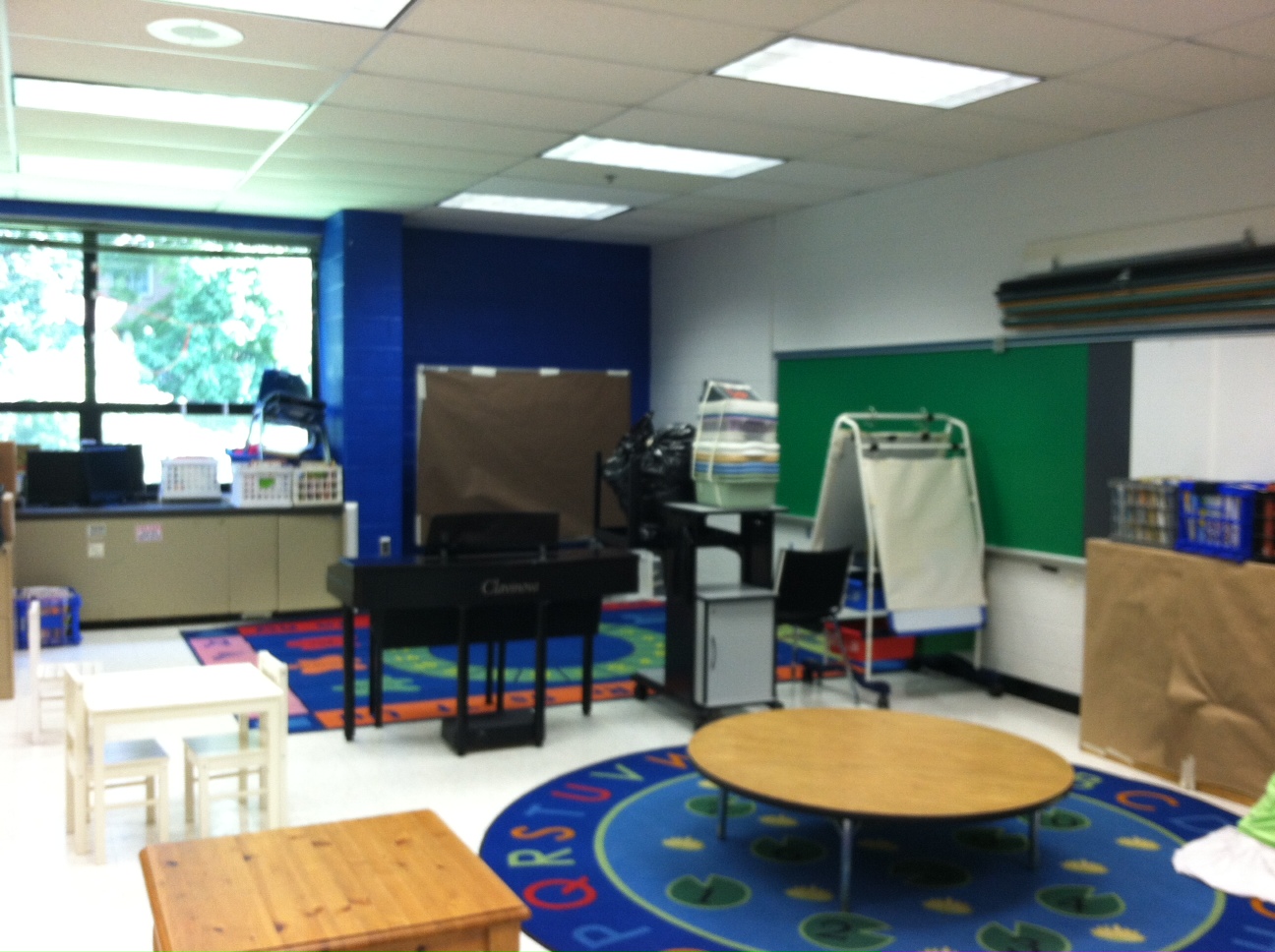
This year I walked in with a broken elbow and my thoughts were more along the lines of, "How on earth am I going to get all this furniture in the right place?"

Luckily my daughters (10 and 6) were with me. They were amazing. In under two hours we had all the furniture and carpets in place. 

I'm back to feeling anticipation...


Thursday, August 15, 2013

Arts & Crafts - A Challenge to Me

As a first grade teacher I feel I have many strengths. Unfortunately, arts and crafts types of things are not on that list. As a fourth or fifth grade teacher this didn't really bother me. As a first grade teacher it does. A least a bit. Arts and crafts types of things are fun and great for building motor skills. That matters at first grade.

So when SmileMakers offered me their Art Starter Kit it seemed like something I should try. School hasn't started for me so I took it with us on a visit to our niece. My two girls (10 and 6) and my niece (5) were thrilled by it. In fact, my niece requested (quite adamantly) that we leave some materials for her when she had to leave for a birthday party. We practically had to tear her away from her art.

As you can see, it comes with googly eyes, pom poms, pipe cleaners (although they go with the more modern name of chenille stems), feathers, spangles (different shapes and textures of paper), colored pasta, and buttons.

The three girls immediately set out with scissors and glue. The pipe cleaners were a favorite and they strung pasta and buttons on them and glued pom poms and spangles to them. Sometimes they had a plan for what they were creating (a necklace) and sometimes they were just exploring. Both were fabulous.

Luckily I still have quite a bit of the materials to take with me to school in a couple of weeks. For me, this is perfect. Having a variety of items in one set is great for someone who doesn't really know where to start.

I think I'll offer these materials to my students as an option during our exploring time (when we play with blocks, magnets, puppets, etc.). Watching that I will see which materials most interest them and should be replenished. Hopefully, I'll also be able to get some ideas of ways to incorporate these materials into more academic parts of our day.

I firmly believe in allowing and encouraging students to explore with things and to be creative. I hope this kit will push me to do that in some new ways.


Thursday, August 08, 2013

Perspectives

I learned last night some potentially devastating news about friends (potentially because it's too early to know what it will really mean). It made me think of a piece I wrote during the Northern Virginia Writing Project summer institute last month. I feel like it still needs work but mostly says what I want it to. Here it is:

The radio comes on as I head to the gym and my morning begins with the story of asylum seekers – men, women, and children – taking to the sea as their leaky vessel sinks to the bottom. I watch the road but in my head I see open water full of tired, ragged, hungry families struggling to stay afloat, struggling to keep their children safe. I try to imagine what their lives had been like to make such a risk worthwhile. I’m sure their frustrations were much greater than a microwave with a door that tends to stick, Legos left all over the living room floor, packages from Amazon that sat out in the rain, or children who can’t find their cleats for soccer practice.

On the way back into the house I grab the plastic sleeve that contains the daily paper. As I drop it on the floor in the kitchen a headline catches my eye. Women being gang raped at protests in Cairo, Egypt. With just those few, big, bold-print words I can imagine these women believing so strongly in the possibilities for the future of their country, leaving their homes to join the throngs, raising their voices alongside their neighbors and friends. Then being quickly and quietly grabbed or lured just a bit away from those clamoring for freedom and democracy. Just a bit away from safety and into hell.

As I review the options on our TiVo the evening news rambles on in the corner of the screen. It catches my attention when I hear a bit about child soldiers in the Democratic Republic of the Congo. Images flash, thankfully small in that picture-in-picture spot, of young boys and girls, some my own daughters’ ages. Children holding intimidating weapons, weapons as big or bigger than themselves. I can’t help but think about their families, their mothers and fathers. Are they alive? Do they know what has happened to their child? Will they ever see each other again?

These intrusions on my daily life make me pause. I look around in each moment, at the road through our suburban neighborhood, at my dirty kitchen, at my cozy bedroom. I send up thanks for being born here, in this country, rather than in Indochina, Egypt, or the Democratic Republic of the Congo. I take just a moment to recognize how blessed I am for something over which I had no control – the place of my birth.

Others born here are not as lucky. One morning I learn that thousands of children age out of the foster care system in my state without being adopted. Half of them end up incarcerated, a quarter end up homeless. That gives a foster child only a 25% chance at any type of success. I try to envision their lives. Moving from foster home to foster home, adapting or not at each change. Being the new kid at school again and again. Wondering what they did wrong to not have a mom or dad who loves them unconditionally, not to have a stable home, not to have guarantees of meals, a place to sleep, the very basics.

A student talks about his baby brother’s hospital visits. It’s unclear how serious the problems are, at least when learned from the perspective of a six-year-old. Then he isn’t at school one day. We learn that his baby brother, only ten months old, died. Their mother had to be hospitalized after she collapsed, refusing to let go of his tiny body. A few teachers attend the funeral service, letting the Spanish words wash over us as we stare ahead at the grieving parents and siblings and the painfully small casket. Could this little one have had a chance if his family had health insurance? Would regular doctor visits have given him a better, longer life? Would an earlier diagnosis have given him more time on this earth?

Numerous friends on Facebook share an article, describing the SNAP (supplemental nutrition assistance program) challenge. It encourages people to live for just a week only spending as much money on food and drink as they might receive on food stamps. That comes out to $4.50 per day. Per day. The next time I walk through the grocery store I try to picture what would go into my basket with that budget. I certainly wouldn’t need a cart. No fresh produce, much too expensive. No sodas or alcohol. Nothing organic. Even milk or cereal would be questionable.

I realize how lucky I am to have been born here and born into a family with enough. Lucky to have never questioned what I was going to eat, who would take care of me, whether or not I could see a doctor.


The next time the microwave door is stuck or I step on a Lego, I need to pause. To think, in that moment, of those so much less blessed than I. Of those, who simply by their birth, have so many more struggles and challenges. 

Tuesday, August 06, 2013

Outsider in Charge

I've subscribed to The Washington Post for as long as I can remember. It was delivered to our home from the time we moved from Texas. I continued to subscribe all through college. We still subscribe now, in spite of the fact that the paper mostly moves straight from its plastic sleeve into the recycling. I like newspapers and I like this one in particular.

I was surprised to see yesterday's announcement about the sale of The Washington Post to Jeff Bezos. I've listened to a lot of conversations and reports on NPR about it and read some interesting commentary. On the whole, I'm on the side of believing this to be a good thing. The newspaper industry is struggling and no one seems to know how to fix it. So, here's a new attempt. Sounds good.

I do wonder how newspaper insiders feel about this. There are plenty of school systems being run by non-educators. I'm rarely even willing to give them the benefit of the doubt. Does this make me a hypocrite?

Can a fresh new perspective be a good answer? Can an outsider really make a meaningful difference? Or does experience in the industry matter? Does that vary by industry?

This sale has me attempting to look at education through outsiders' eyes. I'm not sure I like where it takes me.

Thursday, July 25, 2013

School Year Successes

I have taught for 15 years and so, for 15 summers I have spent quite a bit of time thinking about all the things I did wrong or did not do in the previous year.

I want to break that habit and spend some time reflecting on the things that I did well. Some things, as I think back, are very small and some are pretty significant. But regardless, it's fun to celebrate the successes!
  • Classroom Set Up
I've taught three different grade levels in the past fifteen years, in four different classrooms, including a trailer. Classroom set up has always been fascinating to me. This year, for the first time, I got rid of my teacher desk. Looking back I can see a slow evolution as the classroom became less mine and more my students. They own the space and feel comfortable in all of it. I have a hard time keeping them out of my little corner where I keep my purse and lunch and stuff! I do need a little space that's just mine.

We've got lots of little tables, a low table, a high table, different kinds of chairs (including some bean bags), a couch, and various nooks and crannies. I hope the room is as open as it feels to me and as welcoming and comfortable.


  • Use of Pens
In many ways, this is really small. When I made the switch to first grade I also switched from pencils to pens for my students. My reasoning was that I didn't want them erasing all of their thinking. With pens I teach them to just cross out something and keep going. That allows me to see their thought process. That does work. But I found that pens have an added bonus - they don't have to be sharpened. The sharpening of pencils used to drive me crazy. It was noisy and distracting if done during the day. If I set a rule against that we would often run out of pencils because we didn't remember to sharpen them before the day got going. Now I trade the pencils my kids bring in with their supplies to other teachers for their pens. (This is getting harder to do as more and more teachers are discovering the joys of pens.) One tip, I do not buy pens that click and I remove the lids and get rid of them. I found them to be distracting.
  • Communication with Families
This is an area that I never feel I do well. Lucky for me, I had a parent this year point out all the positives here. I taught her older daughter a few years ago and had her son this last year. She told me that when her daughter moved on to second grade they had "Ms. Orr withdrawal" because they did not know what was going on in her classroom. She went on to detail for me all the ways they knew what was happening in my classroom.
  1. For homework every night my students must share about something from our day. I tell them what to share about (although they are welcome to share about more, of course!). Their homework is always three things: read, S.A. (share about) a part of our day, bed by 8. So they should be talking to their families about school every day. 
  2. Our class blog. I, and the students, try to write on the blog and post pictures about three times per week. That doesn't always happen but we're pretty consistent. I take pictures all the time, including art, P.E., music, library, lunch, recess. So this should give a pretty clear sense of our days.
  3. Postcards home - I try to write to every student once each quarter. When they do something fabulous, academically or socially or whatever, I grab a postcard and write to them about it. I write to the kid because getting mail is super fun when you're six and I'm sure the parents will see it too. It's a win-win.
This was fun! I'm sure there are other things that were good and I may write more later. I'd love to hear what you did well in the past school year. What was a strength? What will you definitely be doing again?

Sunday, July 14, 2013

Week One in the Rear View Mirror

I'm back again at the Northern Virginia Writing Project's Invitational Summer Institute. How many times does one have to do something before it is a tradition? This is my third summer spending four weeks writing and talking about teaching writing with teachers from elementary through college.

At the end of this first week I have a few reflections:

  • I adore my students. It's easy for me to lose sight of this during the school year and easy to get caught up in the chaos, the go, go, go, easy to focus on all the SBIs, SIPs, PLCs, MRAs, DRAs, and SOLs and lose sight of the kids, the actual living, breathing people in my classroom. Removed from them, removed from all that, I can see them clearly. Of course I'm seeing them in my mind but there they are, brilliant, hilarious, stubborn, quirky, frustrating, darling, amazing. There they are, such...people. It saddens me to think about how easy it is to lose sight of their peopleness.
  • I love being with other teachers. There is no question they are my tribe. The teachers I spend time with here, at conferences, online, are all dedicated, thoughtful educators, striving to continually improve. I hope that describes me as well. Time, like this, spent with teachers like these always gives me hope for the future of American education.
  • I like to write. That's another thing that frequently gets lost during the school year. Be it the freedom of morning pages (the 30 minutes we spend writing in silence to start each day) or the assigned writings during demonstration lessons, I truly enjoy it. I believe I write more during the four weeks of the ISI each summer than I do through all the rest of the year. The only challenge is rereading it all and doing something meaningful with it.
  • I enjoy presenting. I've done it twice in the past week and while I'm always nervous, I'm also always excited and enjoy it. In some ways it's like planning a great lesson, laying it out to build the way you want it to. It also means I get to have conversations with all these brilliant people about my teaching passions, the things I am excited to discuss. Plus, I get to show off my amazing students.

Saturday, July 06, 2013

The Most Brilliant Math I've Seen Lately

My gratitude to Bill Ferriter for this slide is immeasurable.

I'm grateful for it as a teacher and as a parent.

In some ways it's easier for me to remember this as a teacher.

I know my students, their strengths and challenges, their amazing talents, their senses of humor, their annoying habits, THEM. I know what they can do as readers, writers, mathematicians, scientists, historians, thinkers. Sometimes their test scores match what I know from our work in the classroom. Sometimes their test scores surprise me in a positive way and I take a closer look. Sometimes their test scores surprise me because they don't show their strengths as I would expect. I take a closer look at those too. I can learn from the test scores.

But they are not my students. They do not define them.

Why is it harder for me to remember that as a parent?


I feel confident that my daughters do not have any idea that this is a struggle for me. We, as parents, work very hard to ensure that our kids understand that we care about their learning, their effort, their thinking more than we do their grades or test scores.

Friday, June 28, 2013

I'm Just a Teacher

I'm ashamed and pained at how often I think that. "I'm just a teacher." I firmly believe my job is a challenging one. I firmly believe I work really hard at that job. I firmly believe I'm reasonably darn good at that job.

So why do I so often think, "I'm just a teacher."? That word, that 'just,' says so much, doesn't it? It says I don't value the job I do the way I believe it should be valued. It says I consider myself inferior to others because of my job.

A brilliant teacher wrote recently about hitting the ten year mark as a teacher (something I reached five years ago):
And yet, I have the same job that anyone right out of college could have. Although I've personally made huge gains professionally none of these really matter. I hold the same job 22 year olds are qualified for. We have the same voice, are treated the same professionally, and are considered the same in the eyes of the district. For that matter, we're treated the same in the eyes of society. Or maybe not. Maybe the 22 year old is given more respect because there is still time for her to get out. This isn't her career yet - it's just a stopping place.
(There's a lot more brilliance there and I highly encourage you to read the entire post.)

Do you hear some of the 'just' in her words? Maybe it's just me, but I do. The difference between me and a new teacher is how much we are paid. That matters, I'll grant you, but is that really all there is?

Deborah Meier, in her Bridging Differences blog, wrote about young people feeling a need for more than 'just' being a teacher:
So many say they are interested in teaching, and then imagine they will go on to more earthshaking occupations that influence more than 25 to 100 youngsters a year. Like making policy and/or becoming entrepreneurs of some sort. I recognize it—and it isn't bad. But it also worries me.
I don't want to leave the classroom. I love what I do and feel no need to more on to 'more earthshaking occupations." But I also don't want to 'just' be a teacher. Is it me? Do I need to change my attitude? Or is there something bigger here?

Thursday, June 27, 2013

Jay Mathews Gets Me Again

I think I might be a glutton for punishment sometimes. I keep reading Jay Mathews' Class Struggle in the Washington Post in spite of how often I get angry as a result. (I do have to admit that he's had some recent posts that surprised me in quite a positive way.)

Recently he wrote about end of year math tests in Montgomery County. Apparently half of the students fail these tests. These aren't state standardized tests, these are county created. Montgomery County students are doing significantly better on the state tests than on the county ones.

Mathews sees this failure as a positive thing.
Those big failure rates prove that Montgomery is one of the rare school districts that administers end-of-course tests challenging enough to flunk, thereby exposing poor student preparation and weak state standards.
I don't buy it.

An end of the course test covers a ton of material. Material students may have been quite successful with back in October, but can't recall as well by June. (Quite possibly, these tests cover too much content.) It's also a test that is given at a chaotic time of year. The end of a school year is full of events, fun and stressful, that impact students and teachers in many ways. One impact is that students may not be at their peak for attention, focus, and recall. That could impact end of course test results.

In addition, has anyone considered that these students may be all tested out? How many state, county, school, and classroom tests have they taken before these end of course tests? How much energy do they have left by the end of the year?

And if these students had phenomenal pass rates for these end of course tests would that prove that they are smarter than other students? Would it prove they learned more? Or would it prove they are good at cramming and taking tests?

I might have let all that go and moved on with only minor irritation if Mathews hadn't brought up one of his favorite stats near the end.
Graduation barriers are similarly low in most other states, even though in the past 30 years there has been no significant increase in average reading and math achievement for 17-year-old Americans.
Are my children (my daughters and my students) expected to be smarter than I was at their age? Am I expected to be smarter than my parents were at my age? Why do we expect that average reading and math scores will go up each year? Why must the next group of kids do better than the ones before them? When do we cap out? When do we say, "We did it. We achieved our goal."?

Monday, June 24, 2013

Why I Teach

I don't know about you, but I get asked why I became a teacher quite often. It's not a bad question, but I don't have a ready answer. I can't remember a time when I didn't want to be a teacher. (Although I had a brief period during which I was determined to be private detective thanks to my fascination with Nancy Drew and the Hardy Boys. That went away not because of the danger but because I eventually realized how much of a private detective's time is spent in terribly boring ways. Teaching is far from boring.)

Today, I found my answer. Diana Laufenberg, an idol of mine in education, wrote about the past year she has spent out of the classroom. I've been lucky enough to see Diana a few times in period so I had some sense of her thoughts before reading this post. Then I was smacked upside the head.
But, I will also share that nothing is as good as teaching kids.  Teaching is like a puzzle that just keeps needing solving, everyday.  It made my brain spin, inspired hope and anger and frustration and joy and heart break at times. 
That's it. That's why I am a teacher. Thank you, Diana, for saying it so well.

Teaching is a puzzle. And a puzzle that is so worth working hard to solve. Every time a piece fits in it is astounding. So often we try a piece, it looks so close, but it doesn't work. But it still gets us closer. It's never finished but that's just fine. We're lucky enough to get up tomorrow and keep trying to solve that puzzle. What an amazing thing to get to do.

Thursday, June 20, 2013

Reasons for My Exhaustion

There are about a dozen drafts waiting here from the past couple of weeks. Most of them are slightly cryptic one or two sentence drafts. Things I didn't want to forget in the chaos of the end of the school year and really wanted to ponder more. In the next week or so I'll have to see if I can figure out exactly what it was I wanted to reflect on and write about. We'll see how well that goes.

For the moment, I thought I'd share some of the reasons those are all drafts and not actually posts. As is so often the case with me, I had several big, time-consuming projects going at the end of the year. In math each student created a movie about graphs and a movie about a number sentence. For the graphs one they had to survey their classmates, create the graph (from a template), and describe it. For the other I had put a number sentence (an addition or subtraction problem) in for them and they had to tell and illustrate a story to match the sentence.


During our language arts time we had two projects going. One was creating a scrapbook of our year. I put pictures from the year into Word and the students captioned them. They managed to caption 73 (I think) pictures. Some are, not surprisingly, better than others. Often their captions do not capture what I remember from the moment. It gives me a new perspective on our year. 


Our final project involved the books we have read this year. Whenever I read a book aloud to the class I take a picture of the cover and post them all on a bulletin board in our room. It's a great visual reminder of all the books we have read. Here it was very early in the year.


Rather than just throw all these covers away at the end of the year, I take them down and the kids make a book of reviews from them. They pick a title they liked, glue it on a page, and write a review of it. Then we have a book for next year's first graders to enjoy.

Between those projects, school and grade-wide end of the year activities, and packing up my classroom (which is about 98% complete), my brain and body are wiped out.

Sunday, June 09, 2013

Reputations

I'm a bit behind in my comic reading, as this Foxtrot comic by Bill Amend, is from June 2nd. (I only manage to read the Sunday comics and I can still fall weeks behind.)


I've noticed my own interactions with students lately and they resemble this panel. One child goofing off during language arts block might get a quick, gentle reminder to focus on becoming a better reader and writer while another student doing the exact same thing might get moved off on their own with a stern reprimand.

One child pushing another in line gets a brief eye contact reminder to stop while another child gets to walk the rest of the way holding my hand.

One child defiantly ignoring another teacher gets a one-on-one talk about respect, with time to share their thoughts and work through the issue, while another one gets removed from the group without any discussion.

When I'm not in the moment of these situations I want to always react in the first way. I want to always give gentle reminders, give children second, third, fourth chances, give them the benefit of the doubt, and give them a chance to talk through the problem.

In the moment, however, their reputations (not from others but based on my year with them) weigh too heavily. I respond quite differently to children who have been defiant to other teachers again and again, to children who regularly push others in line, and to children who are often not focused on becoming better readers and writers. 

Stepping back I understand why I respond in the way that I do. The problem is, I don't think it's helpful. I think most children, no matter their reputation, will respond better to gentle, kind reminders and redirections and will be more thoughtful in the future if they are given the opportunity to talk through an issue rather than simply being removed.

As this post percolated in my drafts folder, this video came across my facebook stream.


The power of reputation, being one you have earned or one that has been thrust upon you based on race, ethnicity, geographic location, gender, whatever, is powerful.

I don't have an answer to this. I try to be hyper-aware of how I respond to students, regardless of their reputation, and still struggle with it. Any advice would be greatly appreciated.

Wednesday, June 05, 2013

Cramming

I can remember doing this in college (maybe high school, too, I'm not sure), staying up late, reviewing notes, rereading as much as possible. Then taking a test the next day. Sometimes it helped. Sometimes it didn't.

I don't think anything I accomplished in those late night sessions was actually learning however. I don't even remember some of the classes I took in high school and college, much less what was on those exams. What did I gain by cramming? A better grade, I guess. But not much more.

I'm seeing this happen a lot, at all grade levels right now. Kids with flashcards for all subject areas, Jeopardy games being played on a daily basis, rapid fire questions shot at kids whenever possible. Cramming isn't just for high school and college students anymore.

As we live in time of testing, testing, testing, that can impact our jobs and our school funding, we are doing all we can to ensure kids score well.

Are we doing all we can to ensure students are learning as well? Learning that will last?

Update:

Valerie Strauss posted this one sentence from Cognition: From Memory to Creativity by Robert S. Weisberg and Lauretta M. Reeves:
Rote repetition can result in some information being retained, although it is not  a particularly effective method of encoding information into memory.

Saturday, June 01, 2013

We Need to Be Together

Larry Cuban has a new post about online learning in K-12 education. If you aren't familiar with him, he's worth following. He was a teacher, superintendent, and college professor through the years. He's written quite a few books on education reform. (I was first introduced to his work in graduate school when I read Tinkering Toward Utopia.)

He is clearly skeptical of online learning, in general and in K-12 education.
Regardless of the quality of research on new technologies, cheerleaders continue to trumpet online learning as the “disruptive innovation” that will replace regular schools. 
While I don't always agree with Cuban about technology in schools, I think we're on the same page here. Maybe it's because I'm looking at this from the perspective of a primary teacher or even an elementary school teacher. Maybe if I taught middle school or high school I would have a different perspective on online learning.

It's hard for me to imagine my little six and seven year olds spending anywhere near half their time with online learning. Not only for the various reasons Cuban lists, but also because there is so much more to learning than content. What can be done online misses a lot of what happens in a classroom.

I fear that education is becoming solely focused on content. We are losing sight of the rest of what makes up the human beings that are our students.

In my classroom my students are learning to read, write, work with numbers, observe the world around them, share what they are learning, classify information, etc. I think that could probably all be done online (how well is still uncertain, in my mind).

My kiddos also learn to talk to other people, make eye contact, problem solve together, speak in front of a group, collaborate on projects, advocate for themselves and their needs, etc. I don't think these things can be done online, much less done well.

Maybe I'm missing something or unwilling to see the change that is coming, but it is hard for me to envision a time when face-to-face-with-peers education is gone. Time with other human beings is too important to the development of human beings.