Tuesday, February 19, 2013

10 for 10 nonfiction

Some fabulous bloggers organized a 10 for 10 nonfiction event. Picking my 10 favorite nonfiction books was a challenge. Partly because I struggled to define nonfiction. I decided not to include poetry or folk tales, even though those show up in the nonfiction section of the library. I stuck with a more traditional idea of nonfiction books. Even then it was tough to narrow it down. Once I decided each book had to be by a different author it got easier! Otherwise you might see 10 Steve Jenkins' books here.

Move! by Steve Jenkins
I absolutely adore all of Steve Jenkins' books. I have read at least a dozen of them to my class this year and not been disappointed once. (I call them Steve Jenkins' books but many of them are written by his wife, Robin Page, and illustrated by him. I do not give her enough credit.) Move! is my favorite though. I love all the verbs describing how different animals move and we return to this book and move in those ways around our classroom when we need to get some wiggles out.


Handstand Kids Cookbooks
There are a few different books in this cookbook series, the Mexican cookbook, Chinese cookbook, and Italian cookbook, at least. We bought these for our oldest daughter, starting when she was about 7 and wanted to be cooking. They are easy to follow and we have found the recipes to be delicious. There are also tidbits about the different cultures in each cookbook which add a bit of fun.


Knucklehead: Tall Tales and Almost True Stories of Growing Up by Jon Scieszka

This one isn't really for my students (first graders) but is fabulous for those a little older. It is absolutely hilarious and a book that upper elementary students will quickly identify with. According to one of my colleagues, the audio book is read by the author. We've read this one at home but I think we may have to check out the audio book just to hear it in his voice. Scieszka also read one chapter of this book to President Bush and his wife when Scieszka was named the first National Ambassador for Young People's Literature. I love that this is what he chose to read.


Baby Animals by Seymour Simon
I am not as big of a Seymour Simon fan as I once was, but his See More Readers series is one I love. The photographs, typical of Simon, are stunning. The way this series is laid out works for me better than his traditional books. There are now quite a few books in this series, about all kinds of topics including animals, space, machines...Still, Baby Animals remains my favorite.


An Egg is Quiet by Dianna Hutts Aston, illustrated by Sylvia Long

This one has been out for a while now and I still return to it often. The pale colors and gentle illustrations are just right for this. The book offers a lot of information, but can be read without getting into all of the details. Sometimes we read everything and sometimes we just read the basics. It gets kids thinking about something as simple as an egg in new ways which helps them look at other things in new ways.


Faithful Elephants: A True Story of Animals, People, and War by Yukio Tsuchiya, illustrated by Ted Lewin

This is another one that isn't appropriate for my first graders. I loved using this book when I taught fourth and fifth grades. It is such a sad story but is so well written it offers myriad possibilities for discussions and questions. It's a book that sticks with you long after you finish (clearly it has stuck with me because I haven't read it in more than four years).


Me ... Jane by Patrick McDonnell

Patrick McDonnell also wrote the wonderful, wordless picture book South which I use at the start of every year. He is able to tell stories in such a welcoming way. His illustrations, so similar to those of his comic strip Mutts draw you in as well. This biography of Jane Goodall is an amazing text to use with young children. So many biographies written for young children are stilted and dull. This definitely is not.


Just One Bite by Lola Schaefer, illustrated by Geoff Waring

This book always reminds me of Steve Jenkins' books. In fact, every time I see it in the library I think it is one of his. It's big, which helps with a read aloud, and it's about animals and food. Kids find parts of it gross but that's never a bad thing with young kids. The grossness just makes it that much more interesting.


Wax to Crayons by Inez Snyder

We spend a lot of time in first grade wondering about things, anything. We wonder about things outside our window, on our wonder table, at recess, or in our classroom. I love books that offer us answers to our wonders while giving us even more to wonder about. Crayons are such a common item that kids are usually fascinated to see how complex they can be.


Why Do Snakes Hiss? and Other Questions about Snakes, Lizards, and Turtles by Joan Holub

We ask a lot of questions when we wonder so a book like this is a great mentor text for us as writers. Seeing how an author takes a question and writes about the answer helps us. Plus, these questions are ones that fascinate my students. So they love it as readers and writers.


All images from amazon.com.

Sunday, February 17, 2013

Needing Space

I've been away from this space for a week, a long time for me. I'm not short on ideas - there are several beginning of drafts waiting as well as a host of new ideas percolating. It's not even that time has been too tight because of other commitments. I just haven't had the brain space for this space.

This space is important to me. It helps me reflect on my classroom, my school, and education in general. It is a place to vent frustration at times and to celebrate at others. It offers connections to many from whom I learn. I miss it right now.

All aspects of my life feel swirly and out of control at the moment. I'm hoping that at least some of those will get back to behaving soon. Then I will get back here.

Sunday, February 10, 2013

Updated Encienda 2013

After some messing around and googling, I managed to record my Encienda from Educon this year. It's titled, Walk in Their Shoes, and fits with one of my great passions right now, seeing kids as people. They may be younger, less experienced, but they are amazing, brilliant, thoughtful, and funny. Just like adults. We (including me) miss that a lot.

(My daughters can be heard in the background. Oh well. It seems appropriate that there are some kids' voices here, at least a little bit.)


(For reasons I don't understand, when uploading this the images get ahead of the audio. I can't seem to fix it. Sorry about that.)

Thursday, February 07, 2013

New Book Discovery

I read a lot of blogs about children's literature. A lot. Some really fabulous ones. As a result, I'm often the first one in my school to know about or have new books.

So color me surprised this morning when we went to the library and our phenomenal librarian read Chloe and the Lion to my class.

I'm not familiar with Mac Barnett but I've greatly enjoyed some of Adam Rex's previous books.

This one is brilliant. The author is there in the book and the author and illustrator end up arguing. The main character has to step in.

I'm not doing justice to this book. Not by a long shot. The kids laughed out loud. I laughed out loud. Our librarian and I exchanged looks many, many times throughout as we enjoyed humorous tidbits that the kids completely missed.

One of my students suggested this would make a great play. He's totally right.

So, where were all my kid lit friends on this one? Did I just miss it? Or is no one talking about it? Did no one else find this book fabulous?

Monday, February 04, 2013

More on Perception

Post-Educon I had conversations about the conference with numerous people, often about my thoughts on the power of perception. One such person is a brilliant educator I am lucky to know who works in a variety of capacities. The one that is relevant at the moment is her work with our district's interagency schools. These are the schools that work with our court system and detention centers, mental health supports, and transitional services. These schools support students and families in various stages of trauma, stress, and challenges. They can do amazing things.

This educator was describing to me two of the schools that work with the court system. One is very much what you would expect of a school working with a court system, tough rules, high expectations, etc.

The other does some interesting things. For one, they take a picture of their incoming students the day they arrive. This typically means a picture of them looking very run down, maybe tired, dirty, ragged. They then take a picture of the student on their graduation day, the day they complete their time at that school and return to their base school. This picture typically shows a well-dressed, clean, poised young person. At the graduation they show both pictures. These graduations happen regularly as students arrive and leave at different times. This means that throughout their time at this school students see these images side-by-side again and again. They see the possibility their future holds, what they can be. They are pushed to perceive themselves in a new light through seeing their classmates change.

I don't have any data but my guess would be that students coming out of this school are more successful when they return to their base school, and to regular life, than students returning from the more traditional court-affiliated school. Changing negative perceptions matters.

Sunday, February 03, 2013

Power of Perception

A week ago I was in Philadelphia, freezing but doing some fabulous talking, learning, and thinking about education. Interestingly enough some of the best of all three happened around 11 pm on Saturday night.

A bunch of us were standing around outside City Tap House (I got it right Becky!) because that is where you can actually hear each other talk. Luckily, this year they had fires in the fire pits. Last year that was not true. There are now railings around the fire pits which was apparently what was needed for the fire marshal to approve their use.* As a result, the top halves of our bodies were warm while the bottom halves were freezing. This isn't really relevant, but is included because I find it fascinating that this is where I had one of the most interesting and thought-provoking conversation of the entire weekend. That's the beauty of Educon. The talking and learning doesn't stop.

Chris Lehman, Jeremy Spry, and Doug Herman, all of Science Leadership Academy were part of the crowd, as were Becky Fisher, me, my husband, and a couple of guys from Ohio who I don't know. The SLA crowd was discussing some students who were struggling to complete assignments, maintain grades, and basically be successful at the game of school. (This is mildly shocking to those who attend Educon and meet so many fabulous SLA students and then assume they are all doing quite well.)

The more we talked the more it became clear that (some of) these students are fulfilling their self-perceptions. We discussed one student who works awfully hard to earn Ds. My impression was that he could probably earn higher grades with less effort, just effort expended in different ways. I was reminded of one of my little darlings who will state, "I'm a loser!" and then work hard to fulfill that statement.

As teachers we recognize these struggles, the challenge of learning to read, the challenge of finishing assignments, etc. but often we miss the underlying cause, the child's self-perception. We can work as hard as we can to teach a child reading strategies or strategies for perseverance or other strategies, but unless we work to change their negative self-perception it is unlikely that any of those strategies will have sticking power. Perception is very, very powerful.


* There's another example of perception, but from the outside. The fire marshal has a perception of those who spend time at City Tap House that they are likely to 'accidentally'' fall into a fire pit. It's possible that's an accurate perception. I don't have enough experience there to say for sure.

Saturday, January 26, 2013

Educon Encienda

Today at Educon were most of the Encienda presentations. These are 5 minute presentations with slideshows of 20 slides each, auto-advancing every 15 seconds. This is the fourth one I've done and I love it (for reasons I have not been able to identify yet). Here is my slideshow and I'll upload video of the Encienda when I get a chance. (My dad wants to watch it. No one else has to!)

My big idea is to try to see through children's eyes before making decisions that impact them.

Thursday, January 24, 2013

Thank You Donors' Choose & Generous Folks

Donor's Choose has been fabulous for my class. I've put up four projects and they've all been funded (usually pretty quickly). We've gotten cameras, copies of The Dot for Dot Day, awesome chairs, and now books by Jan Thomas and Mo Willems.

I pulled the stack out and showed them one-by-one to my students. There were many gasps, cries of "I've read that book!" and much making of the connection sign (thumb and finger out pointing at yourself and then the other person, back and forth to show a connection between you). I wish I recorded that part.

After we oohed and aahed over the books I put them all out on a table and kiddos grabbed one and found a place to read. When they finished one they put it back and got another. They could have done it all day. It was a book celebration. I did record a bit of that.

(The video doesn't show up in Google Reader. Sigh.)


Wednesday, January 23, 2013

L.A.B.

That's what we call our Language Arts Block. I love that it abbreviates to L.A.B. It just feels right to me.

My school has worked hard over the past 15 years to establish powerful reading and writing workshops. Folks come from other schools to observe what we do. I love it. I'm really proud of it.

But in the past few years I wanted to take it further. So three years ago I tried an integrated block, reading and writing together. I had a few reasons for doing this:
  1. Time - with only one focus lesson and one share we have more time for the real work of our reading and writing - reading groups, independent reading, independent writing, guided writing groups, writing conferences, work stations to practice various literacy skills
  2. Student independence and responsibility - in the reading and writing workshop model we are telling students what they should be doing and for how long - write until we tell you to stop for share - work at your work station until we call you for guided reading - it didn't matter if kids felt finished before that or if they wanted more time
  3. Linking reading and writing - with separate reading and writing workshops students begin to see those two skills as separate - I wanted them to see all the ways reading and writing are linked and support one another
Setting up this integrated block is no small task. We start the year with separate reading and writing times to solidly establish routines and expectations for both. Just before we begin integrating the two we spend a couple of weeks looking at what we are doing during our reading and writing time and how those activities help us to become better readers and writers. We really dig into this. Not just, "I was writing." or "I was reading." We end up with a great list that includes things like, "I reread." and "I thought about what I wanted to write." and "I used the word wall." and "I talked to a friend about my book."

In the first few weeks of L.A.B. students have a half-page with three sections: Guided Reading, Independent Writing, and Work Station. When they finish one of those tasks they write about what they did there to become a better reader and writer. After a few weeks we phase out the paper as they begin to internalize these ideas.

Of course, there are times when I need to talk with a student about spending all their time at their work station and not doing any writing. Or vice versa. That's fine. We have those conversations, as often as we need to. Throughout the year we also revisit expectations and routines. Of course we do that in other parts of our day as well.

A few upper grade teachers have also given this a try and now our administration is interested in learning more. So our literacy coaches, a couple of us classroom teachers, and our administration will meet next week to talk about this idea.

In talking with a fourth grade teacher I found one comment really interesting. I was saying how much time I spend early in the year establishing routines and pushing students to think about what they are doing and how it is helping them become better readers and writers. The other teacher said that this seems to be harder in fourth grade than in first. After four years of school, four years of teachers telling students what to do and when and for how long, students have a rougher time being responsible for this themselves. It just makes me more determined to keep doing this with my students and making it better all the time.

Arming Teachers

Back in December I wrote a few posts about the various parts of my job and what they really look like. After the horrific events in Newtown, Connecticut I did a bit more reflecting on my job. Yesterday I wrote about our lockdown drill, our practice in case of such a terrifying possibility.

In related news, one of the blogs I enjoy reading is The Educated Reporter, from the National Education Writers Association. It helps me keep up to date on policy issues and other educational issues around the country.

Earlier this week Emily Richmond wrote about the current interest in arming teachers. My state, Virginia, is one of the states with bills proposing something along these lines (of course).

I find this possibility terrifying. I have fired guns before, skeet shooting with my mom when I was younger. (She used to hunt quail with her father, if I remember correctly.) I enjoyed that but I've never felt a need to shoot regularly or to own a gun. In fact, the idea of a gun in my house gives me nightmares. I have two daughters and the risk, in my mind, is just too great. A school with 700 students is even worse.

There are many aspects of my job I do not greatly enjoy. Some aspects I actively dislike. But if being armed becomes a part of my job it will be time to find a new job.

Tuesday, January 22, 2013

Lockdown Drill

We had a lockdown drill today. For those not in the know (and lucky you), this is the drill we practice in case of a dangerous person(s) in our building. We close and lock all doors, cover any interiors windows with dark paper, turn off the lights, pull down all blinds, gather in one corner, and be as quiet as possible.

When we told our little darlings about the drill some remembered doing this in kindergarten. That helped. We presented it in comparison with fire drills and tornado drills - drills that I don't think cause a lot of stress for our students. We explained what we would need to do without any drama (I hope).

Our principal announced the drill over the loudspeaker and the kids (mostly) quickly and quietly moved to the carpet. My intern and I took care of the lights, doors, and windows. Then we joined the kids on the carpet.

I pulled a book from nearby to whisper read to them. It seems unreasonable to ask first graders to just sit together silently. With my back to the door and a great distance between it and me I felt comfortable no one outside would hear me reading. I did pass on some really funny books though because I didn't want gales of laughter. I picked a sweet story.

On the whole my little darlings were fabulous. They were quiet the whole time. Even when someone knocked on our door as a test.

I felt a surprising level of stress given that it was a drill. I knew it wasn't real, but I still felt anxious. (I'm not a naturally anxious person.) I'm not sure how my students felt but I observed and overheard some things that were both concerning and humorous.

Two little girls sat beside one another on the carpet holding hands. I think they needed that physical reassurance of their safety. One child remarked after the drill about how scary it was. Another boy decided it was a drill in case zombies came. After we opened the door and pulled up the blinds he said, "Oh no, the zombies will come! Go hide!" and ducked off around the corner of our couch. I don't think he was really worried but it's hard to be sure.

I'm not a fan of this piece of my job. I don't think our students feel more reassured by the practice of these drills. That doesn't mean I question the importance of them. But I think students either feel anxiety as a result or don't really feel anything about them. I don't like doing anything that raises my kiddos' anxiety levels, even when I know we need to.

Saturday, January 19, 2013

I'm Not Too Busy

Last year I wrote about getting my own box of grapefruit from my grandparents and my mother's offer to cut it for me. She was concerned that I was too busy. (I did manage to cut up my own grapefruit and did so again this year.) I am also often concerned that I'm too busy.

But I've been thinking a lot about this lately. A post Dean Shareski wrote a couple of years ago came to mind. (I don't know how many blog posts stick with me over multiple years but this one did.)

The language we use is something I am acutely aware of these days. This may be a result of reading both Choice Words and Opening Minds last summer. I'm working on changing my language about this issue. Instead of saying "I don't have time for that." I'll say "I'm not prioritizing that."

I may not say that directly to other people in certain instances, such as when I am unwilling to help with something, but I will still make the effort to recognize it for myself.

It is easy to feel overwhelmed with tasks and busyness. When I remember that I am so busy because of things that matter to me it is easier to take. Being busy also quickly becomes an excuse. It's the reason I don't get up and go to the gym. It's the reason I haven't unpacked the boxes that sit in our dining room from the holidays. It's the reason I haven't worked with our oldest on some strategies for stress we've thought about. I'm just too busy.

But I'm not. I have time to watch an hour or two of tv each evening. I have time to go to dinner with friends. I have time to read books I want to read. I have time to sit at the piano with my girls and play and sing.

It's not busy. It's priorities. Remembering that may also help me ensure that I am prioritizing the things that truly matter to me. This week will be a busy week. But it will be that way because it is full of things I very much want to do.

Tuesday, January 15, 2013

Give Me a Good Reason, Please

I know it is sweeping the nation and we are far from alone, but I still don't understand the idea of common pacing. Planning together I get. I've been doing that for years and it is wonderful. Multiple brains talking about ways to teach and what different students need is much better than just one brain. Collaboration is an amazing thing in education.

But common pacing? We're doing this in math right now - to some extent. We're planning as a team once a week. No one is checking in to make sure we are following it and we've talked about the fact that we won't all be teaching the exact same lesson on the exact same day. This makes a lot of sense to me. We're benefiting from the co-planning piece, all the brains working together, but we can adapt to student needs and changes in schedules.

We're also working on planning a unit together about writing reports. Again, we're talking about what our students need, how to support them as they learn, what resources are helpful, and some ideas about assessment. All useful conversations. But it's unlikely we'll be teaching it all at the same time. Or in the exact same way.

In a meeting today it was said that we should know that the expectations for common pacing will be tighter as we move forward. Why? What is the benefit? What am I not seeing?

My perspective on common pacing is that it is focused on content rather than on students. That is wrong to me. Our learners should drive the learning they are doing, not the other way around.

Please, please, please tell me if you have another view. I cannot see another perspective here.

Wednesday, January 09, 2013

Firefighter is to Teacher as...

My morning commute takes me past a volunteer fire station. It's a place we've come to know well in recent years as we've taken our daughters there for the open house during Fire Safety Week and to a pancake breakfast with Santa each December. One of our neighbors drives an ambulance for the station.

There have also been a number of firefighters in the periphery of my life for many years. A family friend was lucky enough to be on duty one evening to answer a call at our home after a minor bathroom fire. His son, a boy I babysat as a teen, is now a firefighter. One nephew of ours is trained as a firefighter, although I don't think he is actually doing that work at the moment.

For the reasons above or for reasons I don't understand, I've been thinking a lot about volunteer and career firefighters. After a bit of research I've learned that often they have the exact same level of training.

Now I have more questions than I had before. Why do we as a society need volunteer firefighters? We don't have volunteer police officers. What would it cost us to have all career firefighters? Are there reasons other than financial that explain all of the volunteer fire stations across the country?

Of course, I can't help but compare this to education. Volunteer firefighters have the same level of training as career firefighters. They may not get paid for the job but they are still expected to be fully competent to do it. The analogy to groups like Teach for America seems obvious to me. Not only do those teachers not have the same level of training as career teachers, they also cost their school districts more because of the costs involved with Teach for America. Why is it possible to require full training for volunteer firefighters but not for teachers?

Sunday, January 06, 2013

Complexities of Learning to Read

This morning I headed down to our phenomenal book room to find some new books for my guided reading groups. I was looking for titles at pretty early reading levels (about end of kindergarten, early first grade benchmarks).

In spite of the wealth of titles in our book room, I struggled to find good books for my little readers. Many of my students speak English as a second language (or 3rd or 4th). They are still gaining vocabulary and a firm understanding of the language structure. As a result, some books are much more challenging than their level would suggest.

When kids are learning to read there is so much going on, so much that we take for granted once we learn to read. They are thinking about how the words look, how the sentences are formed and organized, and the meaning behind the text. It's a bit overwhelming when you step back and analyze it.

Learning to read is much easier for students who have a lot of vocabulary, lots of background knowledge about things, and have a solid understanding of the structure of the language.

I rejected books today because they had unusual animals in them, like slugs or because they called animals by less common names, hen rather than chicken. These words are unlikely to be known by my students.

I rejected books that rhyme because creating that often involves using words or language structures that are not typical in our spoken language.

I rejected books because they involved activities or places that my students are unlikely to know anything about, such as riding a train or New York City. The vocabulary and ideas become challenging when one has no background knowledge.

These are not bad books. (Well, some of them are but not really for these reasons.) They are not even books that are impossible for my darlings to read, they are just much easier for some kids to read than others. My little first graders are pretty brilliant. They have a lot of background knowledge about certain things but not always the things that are valued by publishers of early reader books. They can speak multiple languages, something I, sadly, can't do. They will learn to read, I have no doubt of that. I'm just acutely aware of all the challenges facing them in that process.

Thursday, January 03, 2013

Gratitude

Cause and effect are often difficult to determine. When I think about who I am as a teacher I wonder what caused certain things. Am I a reflective educator because I went through the National Board for Professional Teaching Standards process in my fourth year teaching? Am I more thoughtful now about living the Golden Rule with my students because I have my own children and I want to be the teacher I want for them? Am I willing to share materials and ideas because I have always taught at a school where that is the norm?

I find myself somewhat at odds with many of my colleagues in recent months because I seem to question everything. Our school is adjusting to new leadership at many levels (our own administration as well as that of our cluster in our district) and that has meant many changes. For whatever reason I push back about pretty much all of these changes. It isn't that I am unwilling to change. At least I don't believe so. I just want to be sure that what we are doing is best for our students. And best for them beyond simply their test scores. Best for them as people and learners.

Am I pushing back while others don't because I am in my 15th year at this school and I feel comfortable not just going along? Am I pushing back simply because I'm ornery? Am I pushing back because I fear change?

Honestly, I believe this space and those of all the other teachers, administrators, and educators online are the reason I push back. I believe the reading of others' reflections, questions, and thoughts and the conversations that have ensued from those is the reason. I believe my time spent here (online in the education sphere) has pushed me in ways no one school could ever do.

Thank you to everyone who continues to share of themselves as educators here online. Thank you for your thoughts, your conversations, and your openness. I'm sure I am not alone in believing in the value it has for me and for all of us.

Wednesday, January 02, 2013

Terms I Hate: Classroom Management

One of my recent reads, thanks to the recommendations of several people, was Imagine: How Creativity Works by Jonah Lehrer. Just a quick aside, I ended up abandoning the book even though I was intrigued by it because I found it impossible not to question everything I read based on the author having fabricated quotes. Not knowing what was truthful and what was not made it too hard for me to get anything from the book. I'm sorry I didn't read it when it first came out, before learning all this. Had I done so, I would have had to rethink some things when the truth was revealed but I wouldn't likely have dismissed it all out of hand as I seemed to do when I read it.

Anyway, my point in mentioning the book had nothing to do with the above ramblings, although it does involve a quote from a source so take it as you will. There is quite a bit in the book about 3M, the company that makes post-it notes as well as a plethora of other products.
"It's a little amusing that people think Google invented this idea," Wendling says. "We've been doing it here forever. At first, people thought we were crazy. They said employees need to be managed. They said the scientists would just waste their free time, that we'd be squandering all our R and D money. But here's the thing about the fifteen percent rule; it works." (p. 30)
While I love the idea of the 15% rule, or 20%, or whatever, that's not what struck me. "They said employees need to be managed."

I struggle so much with the term 'classroom management' because it seems to suggest a level of control over other people that I have no interest in having. I use the term, hesitantly, when I talk about choices I make in the classroom to improve flow in our space and our time as well as ways I try to help students make positive choices and grow in their independence. But I don't like it. The connotations in education today simply give me the heebie-jeebies.

I appreciate the fact that this company believed in their employees and trusted them. Show people that you have faith in them, be they students or employees, and the majority of the time they will live up to that faith.

I think I may be back to the idea of treating students like people. Of course, if we feel a need to manage adults it's possible we aren't treating them like people either.

My nine-year-old loves to remind me that I am always lecturing her about the Golden Rule. She brings it up when someone else is treating her badly as her reasoning for doing the same. It never holds water with me but it's an interesting argument. Regardless of her take on it (although I am still working on that one) the Golden Rule is always there for me. If I would not want to be treated in a certain way then I should not be treating my students, my daughters, my coworkers, anyone else in that way. It's not a standard I live up to by any means, but it is a worthy goal.

Sunday, December 30, 2012

The Brilliant Donalyn Miller

Just before the winter holidays I had the opportunity to hear Donalyn Miller speak. There are so many reasons I enjoyed my day - she is a classroom teacher, right now, she was in her classroom with her students the day before she was with us - she is a Texan with just enough of an accent to remind me of my home state but not so much that it drives me nutty - she sings the praises of twitter and online networks - she loves books and reading and teaching.

Donalyn is highly reflective, a quality I believe to be critical for educators. She asks herself why about everything she does. If there isn't a good reason for doing it, she stops. Sounds simple but it truly brilliant.

She's also highly reflective about her students. If a child is not reading during their independent reading time, she spends a few days observing closely. She looks for why the student is not reading and what they are doing instead. Then she is able to talk with them and work with them to create a plan for reading. She watches what students are reading in order to help them find new books, books similar and books that will stretch them.

While the basics of Donalyn's book, The Book Whisperer, should be in place in classrooms everywhere, they aren't. Sadly. However, even if all classrooms allowed book choice and instituted significant amounts of independent reading time at school there would still be much to learn from Donalyn. I just finished rereading The Book Whisperer and found myself reflecting on ways we use our time in my classroom and my expectations for my first graders. It's certainly got me thinking.

Saturday, December 29, 2012

Children are People Too

A kindergarten teacher friend was chastised by an administrator because a couple of her kindergarten students were talking about Christmas rather than whatever their task was at that given moment. This was in the week before Christmas. I can't put into words how absurd and surreal this feels.

My frustration with this is immense. I am left with the sense that either this administrator does not have an understanding of five-year-olds and/or does not respect them as people. Is the expectation that students can only discuss topics of their choice during recess and lunch? Is that how human beings function?

We began our school year with the StrengthsFinder. The idea is to recognize and build on the strengths of our staff. Every teacher, instructional assistant, and administrator took the survey and identified their top five strengths. We charted those across teams and school-wide. We found similarities and areas we lacked as a staff. We talked about ways to use our strengths to grow individually and as teams and as a school.

We do just the opposite with kids. From stamping out their natural excitement about things, including Christmas, to seeing them only as test scores on whatever sort of assessment we are using at that time, we do not recognize or build on their strengths. Why on earth do we do one thing for adults and exactly the opposite for children? Do we truly think that they are a completely different species and need completely different treatment?

Children are people. They are younger than the rest of us but still people. We need to put ourselves in their shoes.

Friday, December 21, 2012

Parents are Always Teachers


Today is my parent’s 44th anniversary.* I have been blessed to grow up with a model of a marriage worth emulating. I’m not saying that my parents have a perfect marriage. I don’t believe such a thing exists. They have been through difficult times in those 44 years but they are together and they are happy. This is clear because they just spent a good amount of the past four months traveling together around the U.S. in a Prius. That's a pretty good test of a marriage in my mind.

The saying goes that parents are their child's first and most important teacher. From personal experience I know that to be true. Even now, at nearly forty, I can see everyday things that I learned from my parents. Some of that is because I am now a parent and I watch and hear my parents in myself. I hear my father as I tease our stubborn, stubborn five-year-old. I hear my mother as I work through homework with a frustrated nine-year-old. 

I hear my parents in my interactions with my husband. This, too, is not surprising. Aside from my own marriage there is no marriage I know as well as I know my parents'. I am lucky to have that marriage be one that I want to look to rather than one to fight against. It's easy to continue a pattern that exists. I'm also lucky, I believe, to have seen some of the rough patches (likely not all of them) and seen my parents come through them. I expect rough patches in my own marriage but I also expect we will come through them together.

My mother has long been someone worth copying. I've watched her organize people at church to help one person going through a rough period or to help entire families and groups. She was, by profession, a nurse and I saw her in emergency rooms and nursing homes, patiently listening, gently caring for both patients and families. She can be hot headed and quick to anger when someone weaker has been wronged or hurt. She will make phone calls and write letters and speak out loudly and clearly. She can be stubborn (maybe we see a trend with the little five-year-old) in all the ways I hope my own daughters can be. Holding one's ground and standing up for what she believes in. 

My father has been my model as a reader (although my mother reads nearly as much). For years he took three different newspapers - mostly for the comics - and more magazines than I can count. He has cut back on those things but still has more reading material delivered to his home than some entire communities do. He will read anything you put in front of him and give you his honest opinion about it. He is also a natural teacher (as is my mother). Watching him with my daughters I see in him the reasons that all three of his siblings are teachers. He is not, at least not by profession. When my girls ask questions he responds with questions. When they say things that don't make sense he questions them, gently, carefully, pushing their understanding.

As a teacher I am grateful to have learned questioning rather than telling and reading widely and often from my father, and patience and care and speaking out and standing up from my mother. I am a better teacher for having grown up with them. I am a better wife, a better mother, and a better person as well.


*Yesterday was my 15th anniversary and tomorrow is my grandparents’ 67th anniversary. In case that’s not crazy enough, the other grandparents shared my anniversary.

Sunday, December 16, 2012

I'm an Elementary School Teacher


Last week I wrote about what my job entails. One of my posts focused on the academic pieces, another on the students, and one more about the flotsam and jetsam that must be handled.

In all of my thinking and writing about my job, safety never crossed my mind. I’m not sure why that is, especially since I've had many conversations with my first graders in the past week about keeping bodies and selves safe (there has been a lot of very physical play at recess and some unkind words at other times).

Even when I do think about what I need to do as a teacher to keep my students safe it is focused on their emotional well-being and managing minor bumps and bruises. Life and death situations do not cross my mind.

I sincerely hope that will continue to be true in the future. After the horrifying events at Sandy Hook Elementary on Friday I don’t know. It’s not that I have any question about what I, my colleagues, and every teacher would do in such a situation, it’s simply that it has never occurred to me that such a need would arise.

I learned of the tragedy during lunch and spoke with two colleagues about it before having to teach again. I was in shock and I believe that one of the first things I said was, “This happens in high schools. This is a high school thing.”

Believing that has allowed me to live as though this could never happen to me, to my daughters, to my students. I can live that way no longer.

Tomorrow I will follow our regular routine. We will read, work on word study, go to P.E., play, and get through our day. Those routines will help all of us to believe that things are normal. But I will also be hyper award of my students’ sense of safety, physical and emotional. I will be prepared to have tough conversations if they bring up questions, worries, or stories they have heard. I will do everything in my power to keep them safe and to ensure they feel safe.

I've written twice about how September 11th impacted me as a teacher. My most vivid memories are not of that day but of September 13th, the day we returned to school. Based on those memories I am expecting tomorrow to be exhausting and emotionally draining. In spite of that, I'll just be glad to be together.

Wednesday, December 12, 2012

Behind the Scenes

Here comes day three of me babbling on about what a teacher's job entails. Day one was about societal views of said job, day two focused on more up close expectations (parents and such), and now we'll look at realities that most folks may not realize happen.

Now that we've covered the basics of instruction and the work involved in knowing our students we can talk about what a teacher's daily life looks like. Those first two parts of my job are what I love. I love figuring out each individual student so that I can help them find books they want to read, topics they are excited to write about, and make connections to math and science and history with them. I genuinely love digging into the skills and facts they have to learn to understand what that means for a six-year-old and how to help them understand it. Those things are challenging and exciting and keep me going everyday.

These others are not. Some are just time consuming. Just coordinating schedules with an occupational therapist and a speech teacher can get complicated. Then actually supporting the student in using the skills he is learning with those teachers is a struggle. Mentoring new teachers and working with pre-service teachers is wonderful to me because it pushes me to be the best teacher I can be. But it also consumes precious planning time and requires me to think about what those teachers need as well as what my students need.

Some of these items are both time consuming and of questionable worth. Administering the myriad of required assessments takes many days out of each year. The reading assessment we use is given two to three times a year (depending on the student) and is done so one-on-one. It is, however, a pretty useful assessment so I don't begrudge the time. The math assessment we give twice a year (I do it in small groups) feels much less useful to me. I don't feel as though I learn much about my students from it so it doesn't help me as a teacher. Then there are the other random assessments for which I see little to no value for different reasons - we don't get the scores back in a meaningful time frame or the assessment doesn't seem to be developmentally appropriate (often a problem with young children).

Many meetings also fit into the time consuming and questionable worth category. Not all, some are well worth the time, but many. I'm lucky enough to be at a school that only holds school-wide staff meetings once a month and our team meetings are once a week for an hour. There are plenty of other meetings however. Plenty of these meetings are now focused on PLCs which require extra assessments and paperwork at other times.

Finally there are the tasks that I wish I had a secretary for: collecting picture or field trip money, collecting forms, stuffing Wednesday folders, hanging up artwork around the room and in the hall, and such.

I'm sure I'm forgetting plenty of what teachers do. It's a complex job that requires one to be constantly on their toes, thinking back and ahead at the same time while still being patient, thoughtful, and compassionate. I wouldn't have it any other way.

Tuesday, December 11, 2012

My Job When It Matters

Yesterday I wrote about what society expects of me as a teacher. What I didn't mention there, but came to mind as I reread what I wrote is that those societal expectations all come down to getting my kiddos to pass standardized tests.

However, when society comes in contact with schools, because they have children there or volunteer or something that brings them in, their expectations change. Those instructional expectations remain, although they may not be quite as powerful, but they are joined by other expectations.

When school stops being purely theoretical, as it is for most newscasters and politicians, different things matter. Students are people rather than standardized test scores. Parents want me to care about their children. This looks different for every parent and child. It might be supporting a shy student to help them find their voice in the classroom. It might be making sure a child is wearing their glasses everyday. It might be reminding a student to make eye contact as they talk to me. It might be making sure they don't get anything with meat in it at lunch. It might be listening to their stories when they walk in each morning.

Some of these expectations are ones parents specifically ask about, such as the glasses or eye contact or meatless meals. Other expectations are never voiced aloud, may not even be conscious thoughts for the parents. But they are there and they are important.

This part of my job is about really knowing each student. Not just what they can and can't do academically, but who they are. Without this the academics don't happen.

More tomorrow...

Monday, December 10, 2012

One Facet of My Job

Lately I've been thinking a lot about what is expected of me in my job. In my mind it seems to be broken into three parts: what society in general sees as my job, what society more specifically sees as my job, and what my job really seems to look like when you're up close and personal.

For today I'm going to focus on the first one. Expectations for teachers, as seen in news report after news report, seem pretty clear. We must ensure that our students meet specific academic benchmarks. Sounds pretty simple.

When I look at it more closely it is a lot more complicated. Let's just take reading, a critical piece of first grade. There is a very specific benchmark for my kiddos in reading. Getting them there requires a cycle of assessment and instruction.

In case those words don't conjure up specific images for you, this means continually assessing what each student knows. In reading this means listening to students read out loud and then talking to them about what they read. Knowing where they are as readers allows us to then teach. The assessment tells us what skills they need more support in so we can teach for those. Then we have to assess to see if they have learned them. Assess, instruct, assess, instruct, assess, instruct, ad infinitum.

We're doing this for each student on and on. Plus, we're doing it in each subject area.

Teaching well requires knowing what students do and don't know at all times. That's no small task. Then creating instruction to meet those specific, individual needs. Another big job. Just standing up and telling students something does not, in any way, guarantee they have learned it.

Of course, this doesn't begin to cover what a teacher does each day. Tomorrow I'll tackle the more specific societal expectations, the ones that come when society actually comes in contact with school.

Sunday, December 09, 2012

Weathering the Storm

As teachers (and maybe just as people) we struggle when it comes to sharing the good vs. the bad. While there are folks who seem to enjoy complaining, most of us often sugarcoat things. Teachers especially tend to celebrate the positives, even as they note and inwardly cry over the failures.

I believe recognizing the positives, talking about them, and, yes, even celebrating them helps. It's too easy for teachers to obsess over what isn't working, progress that isn't happening, and lessons that went wrong. It can wear one down.

This is on my mind as a result of reading John Spencer's post about ways to handle a tough period. Not everyone is as willing to share the hard parts and that got me thinking. (As always his thinking and writing are worth reading.) I'm not having a rough year with my class (as I've mentioned they're pretty darn darling) but we're in a bit of a rough patch as a school.

It's not something people want to talk about openly. Our problems are discussed in whispers, while eyes dart back and forth. We don't really like to admit that we're having such a tough time.

I'm in my 15th year at this school. I've been lucky enough to be a part of growing this school into a powerhouse, a well-respected school with a fabulous staff. We're feeling that slipping away and we don't know what to do.

Part of the reason we stay mostly quiet, I think, is that we aren't sure where the problems originate. Teachers are feeling micromanaged and disrespected in a variety of ways. Is that something our administration could remedy or is this coming down from our cluster or even a district-wide problem? An insane amount of our time is spent in meetings, meetings for which we have minimal control over our agendas. Who is dictating this? It's not clear.

Maybe some openness about the tough times we are in would go a long way towards improving the situation.

Friday, December 07, 2012

So Emotional

Back at the end of October Clarence Fisher tossed out an idea. I wasn't sure how to do this with my students. For whatever reason I had trouble wrapping my head around it. In spite of that I joined in. My inability to picture this (along with life in general) made me hold off for a while. This week I finally got started. Each day I sent home three flip cameras with kids to record whatever they wanted that afternoon/evening.

My reactions to this (which is not yet complete as I have more students still to participate) have varied but all been strong. Initially I was astounded by how excited they were when they returned the cameras to school the next morning. I didn't have to ask for them. They pulled them out of their backpacks with a flourish, ready to share their lives.

Then I watched a few and loved seeing what six-year-old filmographers do. The joy was so obvious and infectious. I wanted to just sit and watch but had to pick the kids up from music.

Finally when I had the chance to really dig into the videos I was overwhelmed by the generosity of my students' families. They allowed my students to record their homes and their lives. I watched them reading bedtime stories, making dinner, playing with siblings, and giving tours of their homes. My perception may be off, but I feel like I know these students so much better now than I did before watching these.

Here's a brief taste:

I did not edit that in any way. That's what you get when you give first graders a video camera and set them free. I am in love.

Wednesday, December 05, 2012

VSTE Highlights

I spent the past three days down in Virginia Beach with a bunch of amazing educators talking about technology (and, shockingly enough, teaching and learning) at the annual VSTE conference.

As is so often true for me lately the best moments in the conference were the conversations I had between sessions, during meals, and in every free moment. Virginia is not a huge state but it is full of wise, thoughtful, often witty educators. (Some of my favorites from around the state are Tim Stahmer, Tim Owens, Paula White, Becky Fisher, Jon Becker, and Tom Woodward.) Plus, VSTE folks don't take themselves too seriously, something I greatly respect. One more thing, I've never attended a conference with this much food.

One of the highlights this year was the first keynote. Last year that role was played, exceptionally well, by Chris Lehmann. This year it was Steve Dembo. I have followed Steve on twitter and read his blog for some time but had never heard him speak. After Chris last year, I was a bit unsure. I should not have worried. Steve was phenomenal. At 8:00 am, after traveling into the wee hours, he was far beyond high energy, inspiring, funny, and the time flew. One of the most impressive things about Steve is his ability to look at the world, notice things, turn them around in new ways, and find the humor. I would love to work in a school with him. (Of course, that's also true for everyone listed above...)

The deeper thoughts from VSTE are still rolling around in my mind. More to come.

Wednesday, November 28, 2012

Learning from Co-Teaching

For the majority of the fifteen years I've taught at my wonderful school I have been lucky enough to spend at least part of my day co-teaching. During that time I've co-taught with at least a dozen different people (some years I co-taught with more than one person at different points of the day). I have learned from all of them.

This year my administration partnered me up with someone new. She's not new to our school but I have never co-taught with her. She is due to have a baby any day now and today should be her last day for this year. Unfortunately I had to be out of school today. I'm sorry to have missed the last day we had as a team, at least for this year.

She has a lovely long-term substitute with whom I will work for the rest of the year. That will be fine. I will learn from her and we'll have a great time with the kiddos.

But I'm sad to lose my current partner. She has more experience with first graders than I do and has a wealth of wonderful ideas.

Even more, though, I will miss her calm, quiet nature. I listen to hear talk to the students and am reminded of how I want to sound. I watch her facial expressions and body language and try to mimic it. She has a gentle way with children that I envy.

I wish her a wonderful maternity leave with her precious baby. I truly do. At the same time, I hope I will have another opportunity to try and soak up the way she interactions with children and continue to learn how to do a better job of it.

Tuesday, November 27, 2012

Banning Fluorescents

Thanks to the inspiration of some fabulous colleagues in my building I have been slowly moving toward never turning on my overhead lights. A few years ago I bought a couple of small, table lamps from Ikea for cheap.

They didn't light up the room but did add some nice ambiance. The silver lamp up front in this picture was passed on by a colleague when she decided it wasn't working the way she wanted in her classroom. It gives off some great light.


This year I decided to buy a floor lamp like many teachers in my building and see how that works. When I went to get one they were on sale so I bought two. Of course.


I've got one on each side of my room and they do a pretty good job, even this time of year with our dark, dreary days.


This weekend we put up the Christmas decorations at our house and I decided to bring some lights to school. They were bought post-Christmas one year because I couldn't pass up the discount but they have never been used. (We have lots of white lights because we got married in late December and decorated the reception hall with Christmas trees as well as lights on the stairwells and bushes outside.) These lights made my class ooh and aah today when I plugged them in.

There are still two boxes at home and I think I'll bring them in to put up on the other side of the room. The inspiration for this came from another wonderful teacher whose white lights I see as I pass her room regularly.

Now our lighting seems complete.


We almost never have all of our overhead lights on. Typically I flip one of our two switches but at times we don't have either on. Hopefully we can do that even more often. Our room feels so much cozier, calmer, and more welcoming this way.

Saturday, November 24, 2012

Prohibitions

Every week everyone in our school district (and that's a lot of us) gets an email newsletter with various information. It includes several sections, including About Our People (a place to highlight employees' accomplishments), Call for Coaches, and a list of employees or former employees who have died. I skim through most sections every week. I do skip the coaches one as it doesn't interest me in any way.

This week's newsletter caught my attention in a new way.

In the midst of all this fairly mundane information is the quick fact that sexual harassment is prohibited in my school district. Did we need to state that in our weekly newsletter? Is this a new policy?

Now I'm wondering if other things I assumed were prohibited might be perfectly acceptable...

Tuesday, November 20, 2012

So Many Great Moments

As I thought about what I wanted to post on Facebook tonight for my "Great school moment" from today I realized there were so many I couldn't possibly condense it enough for an update there. Instead, it becomes a blog post here.

First thing this morning a student came up to me asking about a coat I had promised him. A colleague offered her son's old coat to this little boy who doesn't have a winter coat. I grabbed the coat and was reminded by this fabulous colleague to tell my little guy that the coat is reversible (orange on one side and camouflage on the other). I demonstrated this for my student and his face lit up. Not two minutes later he comes up to me, hugging his coat, and said, "My coat is so soft." On the way out to recess later he stopped me to say, "I really like my new coat." I introduced him to the teacher who had provided the coat and he was excited to meet her (although that would not have been obvious to anyone watching - but I swear it's true).

The next great moment was actually many moments. As a first grade team we did special Thanksgiving rotations today. Two classes team up to do something fun and the kids rotate through the different rooms. A teammate and I had the kids making butter (you put heavy whipping cream in a container and shake it until it thickens into butter - it should only be done if you have many kids to help). The whole process was pretty exciting to the kids, but when we opened the container and showed them the butter the gasps and exclamations were astounding. (This is from the 3rd and final group when I got with it enough to record their reactions.)


In the short time we had after lunch before our next set of rotations a fifth grader came to read to us. She had earned the chance to do something special and picked reading to a younger class. She introduced herself, read the book, showed the pictures, and answered questions. She was poised, patient, and just fabulous with the kids. It also seems that when she returned to class she was really excited about what she done. A win-win for sure.

There were so many other little moments, that on plenty of days would have been my focus. Today was just so fabulous I can barely begin to recount it.

Monday, November 19, 2012

Introducing David

As I may have mentioned (ad nauseum to those who see me daily) I have a truly delightful class this year. My kids are interesting and have great personalities. They aren't vanilla ice cream kiddos, by which I mean kids who just sit quietly all the time and follow every direction. We have snags and challenges just nothing major.

One little guy sort of shows it all about our class. I'm going to call him David after the main character in David Shannon's books. We spend a lot of time being driven crazy by him but adoring him all the same.

His kindergarten teacher, in the first week of school, asked me if I'd seen his grouchy face. She said I would love it. I do. He gets upset and huffs and puffs, stamps around, and scrunches up his face. His two favorite phrases are "That's not fair!" and "Not again!"

Another teacher works one-on-one with David everyday for half an hour and she has the greatest stories to tell about their time together. She is an astounding teacher and has infinite patience with him. I'm amazed by it. Recently she picked him up one morning and he was cranky. She did everything she could to build him up and keep him going.

He got really stubborn and told her that he wasn't going to read the S's at the end of words (something they had been working on). He read an entire book without the S's. If he messed up and read the word correctly he would go back, reread, and leave it off. He worked harder to read the book incorrectly than he would have done if he had read it accurately.

He, like the rest of the class, challenges me, keeps me on my toes, and keeps me smiling. Thank goodness for them all.

Friday, November 16, 2012

Testing Us All

Administering a standardized test to first graders is as painful as it sounds. On Wednesday we did a little bit of prep so they had some idea of what to expect and what to do. Thursday morning was the main event.

I set my kiddos up all around the room to give them each enough space. Passed out the test books and freshly sharpened pencils. Read the directions and went through the sample questions. So far, so (mostly) good.

The test is non-verbal and timed. Both positive things for first graders. My role was to make sure students didn't skip questions and that they were quiet throughout. Both were a challenge.

One little friend (about whom I already have so many stories) talked to himself throughout the entire 30 minutes (shockingly he was the only one who didn't finish all the questions). I mostly tried to keep him at a whisper but did have to crack down when he actually called out to the girl closest to him. He can't not talk to save his life. I believe if he were standing behind a lion he would still not be able to be silent. (This lion has no sense of smell, obviously, or the talking thing would be irrelevant.)

When kiddos finished we checked to be sure they had an answer for every question and then gave them their book box, with a reminder to remain silent. First graders with boxes full of Mo Willems, Froggy, and Jan Thomas books can't be silent. No matter how hard they try. 

I worry about what all this testing is doing to our children. I genuinely have concerns about that. But right now, I'm much more worried about what it's doing to the teachers. My whole team was wiped out after administering a half hour test. It is absurd.

Thursday, November 15, 2012

Begging for Money

Watching one of my squirmiest little guys sit in our 'meeting manager' chair (we only have the one so that's how we know who gets to use it each day - if you're the meeting manager it's your day with the chair) has me here asking for money. Sigh.

(This is not one of my little friends - just a buddy grabbed in the library one morning in order to get a picture with the chair when it was brand new.)

These chairs are amazing. They rock just enough for my squirmy kids to move a little without really distracting them. Sitting in this chair actually seems to help many of my kiddos focus more. The others, the ones who can focus without the chair, also love to sit in it. It's just fun for them. I don't blame them. I kind of want one in my size.

Today's meeting manager used the chair throughout most of the day. As he grabbed his backpack to go home he said, "I'm going to miss that chair."

If you're looking for a place to spend a few bucks and want to help out some squirmy first graders, check out our DonorsChoose project for a few more of these fabulous chairs. And thanks.

Wednesday, November 14, 2012

Changes

Too many kiddos can really strain a school. It means overcrowded hallways, teachers working one-on-one with kids in every nook and cranny, lunch starting at 10:15 am and lasting past 1:00 pm, long waits for bathrooms (for students and teachers), and trailers taking over every flat spot of land. Special education and ESOL teachers, literacy and math coaches, and other specialists share offices in trailers or storage closets.  That's been our reality for a number of years.

This year a new school opened. Sixteen of our darlings headed over to that brand new school. About two hundred others were redistricted to another school nearby. Losing sixteen wouldn't be noticeable. Losing two hundred definitely is.

We expected to notice a difference this year. Quieter hallways, shorter waits for a bathroom, less chaos with fewer classes on the playground - that sort of thing. That has all come true.

We've also found some other, less obvious, but significant changes. The two hundred students who no longer attend our school all live in one apartment complex. It's not a great place to live in many ways. There are adults, mostly male, standing around outside at all hours, smoking, drinking. Some are waiting/hoping for day labor work. Others are just there. A ton of kids live there but are rarely seen. Parents don't let them play outside because they don't believe it is safe. It is right on an access road for a very busy road, but I would guess that's not the main concern. Many apartments hold multiple families. These students were, in many ways, our neediest students. 

Now that they are gone we are finding a different atmosphere in our building, our Parent Center and classrooms.

Parents who come in still have questions and need help. We still provide clothes, shoes, and winter coats to students. We still translate for parents at meetings and parent coffees. So much has not changed. 

At the same time, so much has. I wrote about this before without really understanding what I was seeing and thinking. Parent-teacher conferences really made it hit home for me. I had two no-shows out of fifteen students. That's an astoundingly great rate of participation for our families. One of my two no-shows is a little boy who lives in that same apartment complex. His brother is a fifth grader (our last grade) so they had the option to remain here this year. Other teachers were saying they've never had such high attendance rates at parent-teacher conferences. 

Many of our students are still living in poverty. Many are still learning English. Yet they seem to come from families with a better skill set for school and society.

Many of us have been discussing these changes, in hushed voices tinged with shame. We feel guilty because our lives seem to be easier now, our school calmer. But we worry. How are those kiddos doing? The school they attend now has no Parent Center, no parent liaisons to translate or coordinate with families. They cannot walk to their new school. Are they getting any support?

Sunday, November 11, 2012

Contradictions

I hate it when I realize that I'm getting frustrated with my students because I'm sending them mixed messages.

During guided reading groups I tend to get really irritated when students are struggling with a word and keep looking at me rather than at the word. On a good day I can remind them once before I get too annoyed. But it keeps happening and I keep telling them they need to look at the word in order to read it.

On Friday it hit me that one of the life skills we work really hard on all the time is making eye contact. I greet them at the door each morning and keep telling them good morning until they are making eye contact as we speak. We greet each other during morning meeting and work hard on our eye contact. When I conference with students about their reading or writing I work on eye contact as we talk. It tends to be difficult for many young kids to make eye contact regularly so it is something we practice often.

Then they sit down to read with me and I chastise them for making eye contact. Sigh.

This week I will work on encouraging them to look at the word they are struggling to read without frustration and without suggesting that looking at me is a bad thing to do.

Thursday, November 08, 2012

Naivete

I wrote previously about my naivete in high school. I can remember talking to my best friend when we were in college and being shocked to find out so many of our classmates were having sex and drinking during high school. (How she was so aware and I was so clueless is astounding.)

Even twenty years later I remain pretty darn naive. I am aware of some horrible things in my students' lives over my fifteen years of teaching. My first year I had a boy whose mother had abandoned the family. Another student's mother had died not long after the girl's baby brother was born and the father was believed to be sexually abusing the daughters so the children were all removed from his custody. One girl's mother tried to commit suicide. One boy had a baby brother die. Another girl was raped multiple times by a family friend living with them temporarily. At least two girls had lost their fathers during their elementary school years. A couple of students were being raised by family members because their mothers were in mental institutions. Plenty of students fled their home countries out of danger to their families.

All of these things were explicitly told to me. They may have been shared by the families or read in a family history done by our school social worker or told to me by the child's previous teacher. In some way I was given notice of these traumas.

How many other traumas have I missed because I am too naive to believe these things happen? Have I had students who were abused and I missed the signs? Were there ones suffering from depression or other mental health challenges?

Children are amazingly strong and resilient. They overcome things that make me want to curl up and hide under the covers for days. I hope that I have given them the love, support, and safety they all need and deserve even if I was unaware of turmoil in their outside-of-school lives.

But the more I think about this the more I wonder. I'm familiar with statistics on abuse and mental health disorders. I know that some of our students face these problems. I know that some of the strangers I pass do as well. Which ones? Why them? How can we know? Only then can we do anything to help.

I don't want to become cynical instead of naive. Somewhere there must be a middle ground that allows me to carefully watch for concerns or signs of trouble while still believing in the inherent goodness of people...

Sunday, November 04, 2012

Fair Warning: Not about Education At All

This post is much more personal, political, and religious than I tend to be here. Feel free to skip it.


I don't know how the elections will play out on Tuesday and I don't know if specific comments will impact the chances of those who made them, but I have been so bothered by them I finally had to do something. When I am struggling in this way, writing is my solution.

As a woman, as a Christian (mostly, at least), and as a rape survivor I am shocked by comments made by some politicians lately. Religion plays in here because that seems to be at the root of these men's reasoning about rape and abortion. Typically my responses to media reports about rape are not impacted by my religious/faith/spiritual beliefs.

If these men had stated that they did not support abortion in the case of rape because they believe that murdering a fetus is a crime and one crime in response to another is not acceptable, I would not agree but I would accept their reasoning. Based on their Christian values (that I am assuming are in play) that would be logical.

My religion is also a factor, and a critical one in my response to these statements, because of my specific story. It's not a story I tell often. But I feel a need to tell it now.

I was sixteen years old and a youth delegate to my denomination's annual state conference. I traveled with one of our pastors and another respected member of our church to the conference. The youth delegates stayed in the dorms on the campus where the conference was held.

The conference lasted several days. There were a lot of fabulous activities for the youth delegates and we participated in the general conference sessions as well. Our time was pretty well structured and planned for the entire time. I vaguely remember meeting some wonderful teens from across the state. One of my favorite hymns I learned at that conference.

One of the other youth delegates was a recent high school graduate who, according to what he told people, wanted to become a minister. He was two years older than I and we spent a lot of time together. The last night of the conference he snuck down to my dorm room, something I probably thought was flattering and fun at the time. He tried to convince me to have sex with him and when I refused he raped me. 

My memories are blurred by time and pain but I remember crying and saying no, no, no again and again. I was terrified of what was happening but also afraid of getting in trouble because he was there in the first place. I told no one. 

The next morning, at the large, closing ceremonies, he came to see me as though everything was normal. He even made a comment along the lines of, "That wasn't so bad, was it?" 

I was at a church conference. He was a youth delegate who was going to become a minister. How could that have been rape? For two years I convinced myself it wasn't. I knew I was no longer a virgin, I wasn't that naive. I also spent a tense few weeks terrified of being pregnant. I got lucky there. I never had to make the decision about whether or not to abort a child conceived through rape.

More than two years later a chance question prompted me to defend my sexual history and choices (limited though they were) and confront the reality of what had happened. I was lucky enough to have someone in my life who forced me to get counseling and who supported me through months of pain, nightmares, and fear. 

The shame I still feel more than twenty years later is surprisingly strong. I was naive and had no idea how to handle such a situation. I believed in the goodness of others and found it hard to imagine anyone would do such a thing, much less a youth delegate to a church conference.

If you are not one of the 1 in 6 women to be raped in their lifetime it can be hard to truly understand the long-lasting trauma involved. For anyone to suggest that rape could be, in any way, intended by God is horrifying.


If you made it this far, please remember that this was my way of dealing with my frustration over these comments. I am not looking for sympathy. I am much stronger at 39 than I was at 16. In my perception rape is seen as less shameful now than it was twenty years ago. Mostly I think that is a good thing. Mostly I think that helps us move forward, in spite of comments like these made by certain politicians.

Saturday, November 03, 2012

Number? Letter? Hard to Say

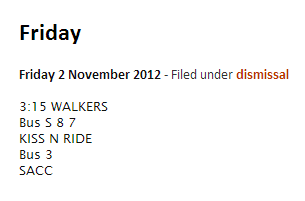
We do our afternoon dismissal online. Personally, I love it. It's silent so it doesn't disrupt anything we might be doing (usually me reading poetry to the kids) and it's in print so I can look back if I'm not sure a bus has or hasn't been called.

As I do occasionally have to be out of the classroom I have two students who go to one of our computers and  tell us when any new group is dismissed. My two little guys do a great job at this. At first I had dismissal open on my computer too, just to check. They've got it down now.

There is one small snag. Right there, under the '3:15 WALKERS' is the bit that throws them each day.


Every day they call out "Buses 2 and 7 are dismissed!" (or sometimes "Buses 5 and 7" depending on their perspective). Next week we're going to have to look at this carefully. It turns out we have a Bus S. I didn't know that. Not surprisingly my kiddos clearly don't know that.


Friday, November 02, 2012

Digital Halloween Costumes


We missed Monday and Tuesday of this week due to Sandy. It was probably a wise decision as plenty of folks (and schools) lost power. It did mean that our first day of school this week was Halloween. Surprisingly none of my first graders showed up at school in costume. I was somewhat disappointed.

Instead we created our own costumes, digitally at least. I put their faces into Pixie and they drew their favorite book character's body with their head. I modeled this with The Pigeon, which may have led to so many other Pigeons in my class. Or, they might just like The Pigeon that much.

We have spent a lot of time lately talking about characters in books we read and books we write so it was fun to use those characters in a new way.

I was especially impressed with the kiddos who added details around their face rather than just below it.

As an aside, one of the Pete the Cats looks an awful lot like the dinosaurs that child draws during writing workshop each day...

Thursday, November 01, 2012

The Benefits of Labels

Quick caveat: I don't feel a great urge to label students. I'm lucky to work at a school where the support students receive is based on their need, not their labels. It does matter when it comes to accommodations for standardized testing and it might matter more when kids get to middle and high school however. (I don't know enough beyond elementary to say.)

As a first grade teacher I have worked with students with special education labels every year. Those little darlings all had been identified in preschool. It's easy then to keep that label and support those students and give them those accommodations.

A student who gets to kindergarten or first grade without identified learning disabilities has a lot more trouble getting that label. I completely understand that we do not want to willy-nilly slap labels on students. I truly do.

That said, the testing that is done in the process of identifying learning disabilities gives so much information about how a child learns. It gives insight into visual or auditory processing difficulties for example. Unfortunately when a young child is up for discussion, the most frequent response is, "They are so young. Let's give them more time."

I don't really want the label. I want the testing. I want to understand what is keeping a student from learning the way all their peers are doing. But if you are testing a lot of students and not finding labels that is questioned. So we don't test. We don't learn. We don't understand. We don't help as well as we could.


I have reread this numerous times tonight trying to ensure my language actually conveys my thinking. I hope it does. I'm sure there are places here where the language I have used illuminates biases I have. If you notice any, please point them out to me. We are often blind to our biases and could use help from others identifying them.