Friday, April 16, 2010

Top 100 Books

I can't help myself. I had to jump on this bandwagon for my own knowledge. Here are Fuse #8's top 100 books, based on nominations and voting. The ones I've read are in bold. It seems I've read just over half. I did err on the side of caution so if I can't be sure I've read it I didn't mark it. There are quite a few here I've been meaning to read. I'll have to start my summer list.
  1. The Egypt Game — Snyder (1967)
  2. The Indian in the Cupboard — Banks (1980)
  3. Children of Green Knowe — Boston (1954)
  4. The Miraculous Journey of Edward Tulane — DiCamillo (2006)
  5. The Witches — Dahl (1983)
  6. Pippi Longstocking — Lindgren (1950)
  7. Swallows and Amazons — Ransome (1930)
  8. Caddie Woodlawn — Brink (1935)
  9. Ella Enchanted — Levine (1997)
  10. Sideways Stories from Wayside School — Sachar (1978)
  11. Sarah, Plain and Tall — MacLachlan (1985)
  12. Ramona and Her Father — Cleary (1977)
  13. The High King — Alexander (1968)
  14. The View from Saturday — Konigsburg (1996)
  15. Harry Potter and the Chamber of Secrets — Rowling (1999)
  16. On the Banks of Plum Creek — Wilder (1937)
  17. The Little White Horse — Goudge (1946)
  18. The Thief — Turner (1997)
  19. The Book of Three — Alexander (1964)
  20. Where the Mountain Meets the Moon — Lin (2009)
  21. The Graveyard Book — Gaiman (2008)
  22. All-of-a-Kind-Family — Taylor (1951)
  23. Johnny Tremain — Forbes (1943)
  24. The City of Ember — DuPrau (2003)
  25. Out of the Dust — Hesse (1997)
  26. Love That Dog — Creech (2001)
  27. The Borrowers — Norton (1953)
  28. My Side of the Mountain — George (1959)
  29. My Father’s Dragon — Gannett (1948)
  30. The Bad Beginning — Snicket (1999)
  31. Betsy-Tacy — Lovelae (1940)
  32. The Mysterious Benedict Society — Stewart ( 2007)
  33. Walk Two Moons — Creech (1994)
  34. Jeremy Thatcher, Dragon Hatcher — Coville (1991)
  35. Henry Huggins — Cleary (1950)
  36. Ballet Shoes — Stratfeild (1936)
  37. A Long Way from Chicago — Peck (1998)
  38. Gone-Away Lake — Enright (1957)
  39. The Secret of the Old Clock — Keene (1959)
  40. Stargirl — Spinelli (2000)
  41. The True Confessions of Charlotte Doyle — Avi (1990)
  42. Inkheart — Funke (2003)
  43. The Wolves of Willoughby Chase — Aiken (1962)
  44. Ramona Quimby, Age 8 — Cleary (1981)
  45. Number the Stars — Lowry (1989)
  46. The Great Gilly Hopkins — Paterson (1978)
  47. The BFG — Dahl (1982)
  48. Wind in the Willows — Grahame (1908)
  49. The Invention of Hugo Cabret — Selznick (2007)
  50. The Saturdays — Enright (1941)
  51. Island of the Blue Dolphins — O’Dell (1960)
  52. Frindle — Clements (1996)
  53. The Penderwicks — Birdsall (2005)
  54. Bud, Not Buddy — Curtis (1999)
  55. Where the Red Fern Grows — Rawls (1961)
  56. The Golden Compass — Pullman (1995)
  57. Tales of a Fourth Grade Nothing — Blume (1972)
  58. Ramona the Pest — Cleary (1968)
  59. Little House on the Prairie — Wilder (1935)
  60. The Witch of Blackbird Pond — Speare (1958)
  61. The Wonderful Wizard of Oz — Baum (1900)
  62. When You Reach Me — Stead (2009)
  63. Harry Potter and the Order of the Phoenix — Rowling (2003)
  64. Roll of Thunder, Hear My Cry — Taylor (1976)
  65. Are You there, God? It’s Me, Margaret — Blume (1970)
  66. Harry Potter and the Goblet of Fire — Rowling (2000)
  67. The Watsons Go to Birmingham — Curtis (1995)
  68. James and the Giant Peach — Dahl (1961)
  69. Mrs. Frisby and the Rats of NIMH — O’Brian (1971)
  70. Half Magic — Eager (1954)
  71. Winnie-the-Pooh — Milne (1926)
  72. The Dark Is Rising — Cooper (1973)
  73. A Little Princess — Burnett (1905)
  74. Alice’s Adventures in Wonderland / Through the Looking-Glass — Carroll (1865/72)
  75. Hatchet — Paulsen (1989)
  76. Little Women — Alcott (1868/9)
  77. Harry Potter and the Deathly Hallows — Rowling (2007)
  78. Little House in the Big Woods — Wilder (1932)
  79. The Tale of Despereaux — DiCamillo (2003)
  80. The Lightening Thief — Riordan (2005)
  81. Tuck Everlasting — Babbitt (1975)
  82. Charlie and the Chocolate Factory — Dahl (1964)
  83. Matilda — Dahl (1988)
  84. Maniac Magee — Spinelli (1990)
  85. Harriet the Spy — Fitzhugh (1964)
  86. Because of Winn-Dixie — DiCamillo (2000)
  87. Harry Potter and the Prisoner of Azkaban — Rowling (1999)
  88. Bridge to Terabithia — Paterson (1977)
  89. The Hobbit — Tolkien (1938)
  90. The Westing Game — Raskin (1978)
  91. The Phantom Tollbooth — Juster (1961)
  92. Anne of Green Gables — Montgomery (1908)
  93. The Secret Garden — Burnett (1911)
  94. The Giver — Lowry (1993)
  95. Holes — Sachar (1998)
  96. From the Mixed-Up Files of Mrs. Basil E. Frankweiler — Koningsburg (1967)
  97. The Lion, the Witch, and the Wardrobe — Lewis (1950)
  98. Harry Potter and the Sorcerer’s/Philsopher’s Stone — Rowling (1997)
  99. A Wrinkle in Time — L’Engle (1962)
  100. Charlotte’s Web — White (1952)

Thanks teacherninja and MotherReader for getting this rolling.

Monday, April 12, 2010

The End

I've been quite cranky lately (just ask my husband). I blamed it on a bad night's sleep Saturday night, I blamed it on feeling overloaded with some last minute things, I blamed it on crazy children, and who knows what else.

Today, I finally figured out the real cause. Today is the last day of our last intersession.

Due to serious budget cuts everywhere, our school is losing our modified calendar status. Next year we'll go back to being like everyone else. This saddens me (and obviously makes me cranky) for numerous reasons.
  1. Many of our kids will lose a lot over a long summer. Especially our beginning readers in kindergarten and first grade. Many will not speak English for the entire summer, much less have opportunities to practice their reading.
  2. Intersessions offer our students myriad opportunities to learn about different things. This is a perfect chance for us to help expand their background knowledge. They learn about different sports, foods, hobbies, etc. all through skills they need. Losing that is going to hurt them in reading, writing, and being able to make bigger connections in their learning.
  3. These times build significant community in our school. We have over 800 students and there is no way to get to know them all. However, we get to know other kids during intersession and that is good for everyone. We can share our thoughts with other teachers, offering a fresh eye on their students. We can greet those students throughout the year and continue to build relationships.
  4. As our old principal used to say, "We are running sprints instead of running a marathon." If a teacher needs a break s/he doesn't have to teach intersession. If families want (and are able) to keep kids home or to travel during that time they can. It gives us fresh starts throughout the year rather than running ourselves ragged by March (or December some years).
  5. Personally it gives me a chance to clean some things up. Intersession is less intense than the rest of the year and kids can work on projects or activities while I spend a bit of time cleaning out some of my teacher closet or a filing cabinet drawer or just sorting through the piles that grow on my desk in no time.
It doesn't seem that our test scores have reflected any positive impact from our modified calendar. I find that both hard to believe and not surprising. It's hard to believe because the benefits to kids seem so clear to me. It's not surprising because we have a 40% mobility rate and we've nearly doubled our population since we began on this calendar. It's hard to get meaningful test scores when the kids are different all the time.

As I write this our intersession coordinator is beginning the final dismissal process. The students are wrapping up their last big art project created out of repeating, growing, and number patterns. And I'm ready to cry.

(Some of us did make an effort back in the fall to gather DRA, Developmental Reading Assessment, scores for first and second graders. In previous years we have not done this assessment in the fall, we have simply used the spring assessment from just a few weeks before. We gathered the data this year in order to compare it to next fall when the students will have had a much longer summer. It will be interesting to see if this gives us a smidgen of hard data to show our district.)

Thursday, April 08, 2010

Proactive Policies

I stopped last night for a quick trim of my bangs. The salon I use has a policy that they will trim their customers' bangs for free. Their reasoning is that they would rather spend two minutes trimming bangs than fifteen minutes fixing them after someone tries to trim them on their own.

My husband and I have been thrilled with our family's health insurance. All through both pregnancies all my appointments were free. With our oldest daughter this was a lot of appointments as they were concerned about the pregnancy and it even included an amniocentesis. All of it cost us nothing. Our daughters' regular appointments have also always been free. Again, the reasoning is that they don't want people to miss appointments because they can't afford them. The 'well baby' appointments are too important.

This all got me thinking about education (of course). We are not proactive in our public school system. I'm not sure this should all fall to the schools. I believe our society should be more proactive when it comes to children.

I look at my own daughters (who by no means have perfect parents) and think how lucky they are to have all they do. The exposure to books and language from day one, the time to visit museums, nature centers, science centers, and such, child care providers who are loving and knowledgeable about stimulating their minds and exercising their bodies, grandparents, aunts and uncles who lavish love and attention on them, etc., etc., etc. I feel the same way about my own childhood.

When I compare this to my students I feel sad. Not that they don't have parents who love them and do many things for them. They do. However, their parents often don't have the financial resources to offer their children some of this. They may work two or three jobs and not have the time to do these things. They may not have a car and therefore have limited options for getting around. Due to circumstances beyond their control these children don't have the opportunities for learning that my daughters do.

Why aren't we more proactive? Why do we wait until children are in elementary school before we begin supporting their learning and intellectual development? In the long run wouldn't it be cheaper (and better) if we started sooner?

Tuesday, April 06, 2010

Afraid of Change?

A recent post from Dean Dad has me mulling over some of my past. I noticed signs today at a central office in my district about interviews for instructional coach positions. Some years ago I applied for one of these positions and went through the second round of interviews. At that point I decided that I wasn't ready to leave the classroom and the environment wasn't quite right for me. A few years later a position opened up in the social studies central office. Again, I went through the process up to (almost) the bitter end before pulling myself out. I was pregnant with our first child and didn't think I could handle two major life changes at the same time.

Now I'm left wondering if I'm afraid to move on to something new. I have taught three different grade levels, worked with classes full of English Speakers of Other Languages students, special education students, and gifted students, and done a variety of extra activities for my school and county.I've earned a master's degree, achieved National Board Certification, added an endorsement in gifted education and nearly finished an endorsement in supervision and administration. I would have said I push myself and take risks professionally. Now I'm not so sure.

I don't know if this matters. It is something I feel I need to be thinking about. My parents have long told me that I will regret more those things I don't do over those things I do. I don't want to miss opportunities out of fear, especially if I don't recognize it as such.

Update: Apparently I shouldn't write blog posts as I'm doing other things. This clearly came across as me wondering if I should attempt a new path right now and I didn't intend that at all. I was simply ruminating over options from my past. Right now I am perfectly content where I am. I just want to be sure that I don't let fear rule my decisions in the future.

Tuesday, March 30, 2010

Penny Drive for Haiti

Just after the earthquake in Haiti our school decided to do a penny drive. This is a school with about 65% of our students receiving free/reduced lunch. The money poured in for the week and a half we ran the drive.

Lucky for us, this happened just as we were studying coins. So we brought in donations from other classes and figured out how much money was there. We started by sorting the coins (great practice for those students who were still struggling with identifying the different coins). Then we counted each type. We used hundreds charts to figure out how many of each coin was there. Students then had to figure out how to count (by 1s, 5s, 10s). It was an interesting challenge for some.

The few quarters were saved for groups up for the challenge!

This was an amazing learning experience for my class. Eventually they did count groups of pennies, nickels, and dimes. I was quite impressed with them.

Also, the school brought in about $2,200 for the relief efforts in Haiti!

(The penny drive was suggested by a third grade class and my first grade daughter. Honestly, I couldn't be prouder.)

Thursday, March 25, 2010

Reason #829 Why I Love My School

I've got a student who is pushing me and I'm failing in my responses to her. She's made such progress since pre-school, but that isn't helping me as much as one might hope.

I've started the paperwork for child study/local screening to get some help because I'm at a loss. But that's a long process. It will be a month before we meet.

So, I pulled together my own 'child study' committee. I sent emails to some fabulous primary teachers and asked if they would be willing to meet with me to talk about this little one. One morning, in the brief half hour we have before kids arrive, three teachers sat down with me to brainstorm about this child. It was fabulous.

These are teachers with their own classrooms, their own students, their own responsibilities. However, they were generous with their time and energy. They had brilliant ideas and we've been trying some new things. I feel so lucky to work with such amazing folks.

Wednesday, March 24, 2010

New Golden Rule

There are students who drive me crazy. That's not something that teachers are supposed to admit, but it's true. However, I've been mulling this over quite a bit.

I respond differently to those students who annoy me. If they are tapping a pencil I assume they are doing it on purpose. If they are humming I assume they are trying to disrupt those around them.

But, when I stop to think, I don't believe these things are intentional. I teach first graders. They tap fingers, hum, whistle, wiggle, squirm, etc. It's not intentional, at least not the great majority of the time. They are simply being first graders.

When I recognize that students are doing these annoying things subconsciously without an attempt to annoy or disrupt I respond to them in a very different way. I respond with patience and care. Not surprisingly they then react with respect.

My reminder to myself is to respond to students as I would want my daughters' teachers to respond to them. (I think that's my new golden rule of teaching.)

Put a Fork in Us

Spring break is next week. We all need it.

I teach first grade and I am the mother of a first grader. I see the lives of six year olds all day. I know they are tired. Of course they are tired. We work them. We make every second of every day count.

But here's the thing. I'm tired, too. Making every second of every day count is a bit exhausting.

When I'm on top of my game I can help students who are tired to find strategies to cope. I can modify and accommodate to keep them learning and get them through the day.

I'm not on top of my game when I'm tired.

When we're all wiped out, how do we keep first grade going?

Monday, March 15, 2010

Failure

Maybe it's that I'm still tired from losing that hour of sleep this weekend. Maybe I'm cranky because it's Monday and I have a 3 hour class tomorrow night that amounts to jumping through a hoop. I don't know.

Regardless of all that, I'm sick of hearing about how our public schools are failing.

I do believe our schools can do better. I do not believe they are failing.

There are areas in which we desperately need to improve. We must do more for children living in poverty. We must help students learn to problem solve and be creative rather than follow directions and conform. We must be willing to question the status quo. I believe schools could work better with significant changes.

However, I'm a product of public schools. Bill Clinton, Ronald Reagan, Richard Feynman, and Katie Couric are all products of public schools. Most of the people crying that our public schools are failing are products of those same public schools. Most people are happy with their local public school. It's 'public schools' they don't like.

We educate everyone (not always perfectly but we take them all). We attempt to offer options to meet the needs of gifted students, students with disabilities (physical, emotional, learning, etc.), and those who just don't fit in.

We're not perfect, but to say we're failing (and to say it from the highest offices in the land and on the covers of magazines and newspapers and on the daily news and on and on) is a slap in the face. So far we're turning the other cheek, but at some point we're likely to give up, give in, and walk away. Then our public schools will fail.

Sunday, March 14, 2010

We're Not Diagramming Sentences, Part II

Our fascinating discussion of sentences continued on Friday. After talking about what sentences are and what they are not and then the parts of sentences and what sentences can be a part of, we moved on to how sentences are related to other things.

As I mentioned I was a bit nervous about this piece. It's hard for me to make clear connections about relationships in abstract ideas so I'm never sure what the kids will do.

However, I'm always willing to throw it out there and see if we sink or swim. And, almost always, we swim, thanks to the kids. This was no exception.

They started with some basic relationships - sentences are related to books because books have sentences. Sentences are related to words because words are in sentences.

Then they began to stretch a bit. They mentioned that sentences are related to names because both have letters in them. Then, sentences are related to what we say because they both have ideas. They were genuinely thinking about sentences in the world around them to consider the relationships.

Every time they would mention something they believed sentences to be related to, I would hold my breath. Usually the idea sounded absurd to me, until they explained their thinking. Then, as usual, it sounded brilliant. I try so hard not to underestimate my students and I think I fall short everyday.

Saturday, March 13, 2010

TEDxNYED Reflections

There have been so many thoughts flying around the blogosphere about TEDxNYED I'm not sure where my own thoughts begin. I'm not going to get involved in the critiques of the format; I can accept that different conferences have different set-ups and leave it at that.

When the videos get posted on the TEDx channel on YouTube I'll watch most, if not all, of them again. Trying to process 14 live talks and 2 videos in an eight hour day is beyond my capabilities. Add to that the excitement and joy of talking with and meeting folks I've only known virtually or not known at all and the day was exhausting. In the best possible way.

Michael Wesch's presentation was fabulous. I have to admit that having seen the videos his classes have created I was a bit hesitant about him. I had some fears of his being cheesy or condescending or something (I'm not really sure what). My fears were completely unfounded. He began with a hilarious story that will make watching his video completely worthwhile for it alone. My big take-away from him is the idea that we need to honor students' interests and passions. It was intriguing to feel such a connection regarding goals for our students when he is a college professor and I teach first grade. It suggests that the differences between the various levels are not as significant as we may think.

David Wiley was someone with whom I was completely unfamiliar. Of all the new-to-me faces at TEDxNYED he may have been my personal favorite. He spoke on the idea of 'openness' in education. This section of the conference was the most challenging to my thinking. In theory I agree wholeheartedly with the idea of openness. In reality I'm not sure where we should draw the line or how we make this work while still honoring everyone's efforts. It's something I will be thinking more about. Wiley also said, "Technology always plays opposite its nemesis, policy." I thought last weekend that I needed more time to think about that sentence and I still do. I think it's the 'always' that makes me uncertain.

George Siemens
was another I did not know before TEDxNYED. He spoke about connections and transparency in education. This is another talk I need to watch again (and maybe again). I was really struck by this, "We want to disrupt what it means to be a teacher and to be a learner." I don't think we will be able to enact any sort of meaningful change without disrupting that. Siemens also earned immense respect for me when he said, "We drop so much on the educational system it's amazing it functions as well as it does."

The final batch of presenters was one I had been really looking forward to. It began with Dan Cohen of the Center for History and New Media at George Mason University (just down the road for me). I had never met Dan but was familiar with him through my husband, a college professor who has worked with Dan in a variety of ways. Dan's talk was fun, interesting, and exceptionally well done. I highly recommend watching it when these are posted soon.

Dan Meyer was another in this final group. I have read his blog for some time now and appreciate the ways he pushes himself and others. His talk was not new to me (for which I was actually pretty grateful by this point in the day). That said, it's the first talk I'll be pushing people to watch. He's a high school math teacher with the mantra, "Be less helpful". I've been talking about his presentation all week with others at my school. He's an engaging presenter with an important message. At one point in the talk he said, "I'm going to retire into a world my students run." That's something teachers need to remember everyday (as does everyone, really).

Finally, the day ended with Chris Lehmann. I've been familiar with Chris since attending Educon last year and I am convinced he is one of the brightest, most charismatic, important voices in education today. Again, this was a talk that was not new to me. Chris had mentioned concerns that many folks in the audience had heard him say these things. I firmly believe they are worth hearing often. Everyone at TEDxNYED spoke with passion, but no one is quite like Chris. He can barely contain himself when he begins talking about education and it is inspiring. Watch this one.

There are many great reflections on TEDxNYED out there. Shelley Krause has wisely and generously set up a wiki collecting them. There are a few I highly recommend:
Chris Lehmann
Will Richardson (Reading this one will give you a real sense of what the day was like.)
Sheryl Nussbaum-Beach
Jose Vilson

My reflections just cover the talks, and only a few of those. I met and talked with so many amazing educators that day from breakfast through to dinner. I hope to spend some time thinking deeply about that aspect as well, because it was equally important to me.

Thursday, March 11, 2010

We're Not Diagramming Sentences

In thinking about our focus for writing my co-teachers and I decided to look at sentences. This is a surprisingly difficult concept for first graders.

We decided to tackle the idea through the patterns of thinking. Yesterday we talked about identity/other, what is a sentence and what is not a sentence. It was a pretty basic discussion. The most interesting piece of it, in my mind, came when one student said that one word is not a sentence. We put in a thinkblock, charted it, and moved on. A minute or two later another student took us back to that, saying, "I think one word can be a sentence. Sometimes we just say hi." So we added a thinkblock to what is a sentence and added the idea that one word could be a sentence to our chart.

Today we discussed the parts of a sentence. (In the picture I was trying to draw a thinkblock to include the parts we were putting in our actual thinkblock. I'm not an artist.)

The students came up with the things we would have expected: periods, words, letters, question marks, etc. They also mentioned spaces, an idea that is still challenging to some first graders and one that had not occurred to me. The idea that pictures can be a part of sentences was mentioned in reference to books for young children that often use pictures for some of the more difficult words (think Highlights magazine).

Finally, we talked about what sentences can be a part of. This is always a bit of a challenge at first. But, pretty quickly, students began spouting ideas: books, stories, poems, paper, speech bubbles, etc. The surprise for me was a student saying boxes. When I asked him to tell me more, he pointed at a box with instructions on the side. I was thrilled. If my students begin noticing sentences everywhere then we are making good progress! They also mentioned the idea that sentences are a part of talking. Success!

Tomorrow we will discuss how sentences are related to other things. I'm always a bit hesitant to tackle this pattern because it's not as easy for me to see. This could be fabulous or it could crash and burn, we'll see.

I have thoughts about TEDxNYED but not enough time to put them into any meaningful order. Maybe this weekend I'll manage it.

Saturday, March 06, 2010

TEDxNYED

At this moment I'm sitting in the auditorium of The Collegiate School in Manhattan awaiting the first speaker of TEDxNYED. The past couple of weeks have been so busy I haven't even had time to get excited about this. I am now.

You can watch the live stream at the site. There are many great folks presenting today. Enjoy!

Thursday, February 25, 2010

Parent Support is Critical

One of my more challenging students has really been giving us a run for our money recently. A couple of us went to her home to meet with her folks a few weeks ago. It was a good talk and, while I didn't think it would cause an overnight change, it felt hopeful.

Since then I've been writing a note in her homework agenda about her day each afternoon. Yesterday was a rough day and she was really rude so I wrote about that. She takes the note home and returns it to me the next day with a parent signature.

This morning it came back with a note. It says, "She promised me that she is going to be rude again."

I hope this is an issue with English not being the native language. If not, we're in trouble.

Tuesday, February 23, 2010

How Long is Too Long?

During a class this evening I chatted with a teacher from another school in my district. I asked about her principal because I was uncertain if he was still there. He is. He has been for 20+ years. She had mostly good things to say about him, although she did admit he is not much of an instructional leader.

My principal has been in place for about seven years and was an assistant principal at our school for four years before that. I'm in no hurry to see her leave.

Why does a principal being in one position for twenty years strike me as a problem? Should we expect principals to change more often than that?

Do I like having my principal remain because change is hard? Or is it because she is helping us do great things? Both?

I'm surprised at how much this brief conversation got me thinking about the role of the principal and how it does/should change over time. I've come to no conclusions at this point and I'd love to hear others' thoughts on principals and their tenure at a school.

Thursday, February 11, 2010

Really? Seriously?

This picture was taken on the way to school about a month ago. We pass this strip club everyday. In the afternoon (even as early as 4:30) the parking lot is full and the bouncers are out. In the morning it's just another spot in a quiet strip mall.

However, on several mornings over the past few months this bus has been there. It's from an elite private school. One morning there was a BMW there as well and it appeared that a child was moving from the car to the bus.

Wouldn't one expect a family that drives a BMW and sends their offspring to elite private schools to have a better plan than meeting the bus in a strip club parking lot? There's a bank just two doors down.

Wednesday, February 10, 2010

Educon 2.2 Reflections

As always I've gotten completely caught up in life and not taken time to reflect on the wonder that was Educon (it's really pathetic because we're on our fourth snow day in a row, so I have no good excuse).

For me the overwhelming take-away from Educon was passion. The importance and value of that word and idea started for me at the panel on Friday night at The Franklin Institute. The panelists, a fabulous, diverse group, were asked to answer the question, "What is smart?"

Initially the answer that struck me least was the one from Loren Brichter. He spoke about helping students get motivated to find their passion. The more I thought about the different responses the more this struck me as critically important. However, I think students find their passion just fine. We need to figure out how, as educators, to get out of their way.

The idea of passion continued to resonate with me throughout the sessions on Saturday and Sunday. Even if the word was never mentioned, the idea was there. These presenters were there, leading discussion, because of their passion around education and a specific question or issue (the value of play, technology and teacher education, leadership, etc.).

I think that is the power of Educon. Everyone is there because of their shared passion for improving education. There has been much talk since the conference about action. Many folks are concerned that we are doing a lot of talking but not making any change. Those concerns are valid. But I'm grateful for the conversations and for the opportunity to see so many passionate educators gathered together. It gives me hope.

If you are interested in others' thoughts post-Educon, Shelley has collected many here.

Saturday, January 30, 2010

Drowning at Educon

I'm at Educon 2.2 this weekend. I went last year (see here and here) and found it to be just about the best, most thoughtful, most thought-provoking conference I have been lucky enough to attend. This year I've dragged my husband along.

Yesterday we toured Science Leadership Academy and attended the panel discussion on "What is Smart" at the Franklin Institute. It was fabulous and I've overflowing with thoughts, ideas, and questions. Hopefully, I'll actually manage to post some of that. I'm sure I'll be tweeting frequently at least.

Thursday, January 21, 2010

Disclaimer: Not Directly Related to Education

NPR had a story this evening about the absurd number of people sitting in jails because they can't make bail. These people are poor; they may only be needing to pay a bail of $150 but they don't have that money. Studies have shown that people who make bail serve much less time than those who must remain in jail. On the outside they have the chance to show they can do the right thing or to get into rehab. Biding their time in jail they can do nothing. Most of these people committed non-violent crimes.

I'm reminded of the opening of Les Mis. Is it really possible that this is how we treat people?

Not long after hearing this story my daughters and I spent $70 at Target, $45 to fill up our minivan, and $12 to go through the car wash. I didn't have to think hard about any of that. How can I live such a privileged life while others lack so much? How can we as a society accept this?

(My husband's immediate response to my comments about this at dinner was, "What can we do about it?" I'm not clear on anything we can do about it, but I appreciated the question.)

Who Would You Put on a Coin?

My students are learning about money and coins. The first grade next door is doing the same. The other teacher and I were looking at some large, paper coins to use in lessons and the set included a Sacagawea dollar coin. This teacher sighed a bit and I asked about her reaction.

Basically, she said that she felt a better choice could have been made for a woman on the coin. Or at least a better image could have been used than one of her and the baby. She felt it presented a very specific view of what a woman can be.

I'm not sure I completely agree with her, but it did raise a really interesting question for me. If you could choose an American woman to be on a coin who would you choose? How about an African-American to place on a coin?

I'd love to hear folks' thoughts on this. I'm also interested in why. How we prioritize individuals in history fascinates me. And, so far, I haven't been able to decide who I would choose. I'll have to get back to you on that.

Wednesday, January 20, 2010

Don't Ask Questions if You Don't Want to Know the Answer

I sat in our team meeting this morning aware that there was some teasing comments and quiet giggling about something I had completely missed. I don't like to be left out (I figure that sort of personality flaw helps me better understand my students).

After the meeting I couldn't help myself and had to go and bug another teacher to find out what was causing all the rumblings.

Yesterday a first grader brought a condom to school.

I have no more details than that, except that it was discovered because it was being passed around. I don't know if it was open, but I hope not. I don't know if the child discovered it hidden away and knew it must be exciting or if she had it for less innocent reasons. I have no idea if she has any idea what a condom is. So many questions.

As a result, I feel slightly uncomfortable making jokes about it, but they pop to mind so quick. I want the whole thing to be innocent so that I can joke guilt free.

Sunday, January 17, 2010

Being Bossy

We just read this last week. I have Bossy Bear at home and love reading it. So when I saw Just Like Bossy Bear in a friend's classroom I couldn't wait to read it to my class.

The kids loved it just as much as I do. After we finished they talked a little about Bossy Bear and his best friend and how they changed throughout the book.

Then they started talking about how they want to be bossy when they grow up. I don't think they got the message David Horvath or I wanted them to get.

Thursday, January 14, 2010

Student Teaching & Learning

Our class has an intern (long-term student teacher) for this semester. As a general rule there are things I love about having an intern and things that drive me a bit crazy.

- I love having another set of competent hands.
- I love having someone else who knows my students well.
- I love being forced to think about and explain why I do what I do.
- I love (mostly) having to be my best teacher self all the time (no slacking off).

- I miss having a bit of me time.
- I never like any extra paperwork.

Obviously the positives far outweigh any of my frustrations. This current intern is a career changer and not a young-un. I think this is one of the reasons she is comfortable jumping in, getting to know the kids quickly, and asking lots of questions. I love the questions! I'm always worried that I'm spending my time explaining the wrong things. I also really appreciate another perspective on the students and on the constant choices I make as a teacher.

I hope she is learning a lot in our classroom because I always learn and grow when I work with an intern.

Tuesday, January 12, 2010

Mo Excitement

I can't believe I haven't written about this. I wrote about my students writing a pigeon book, a la Mo Willems.

I did not write about the exciting twist that story took. Somehow Mo found our fabulous book and blogged about it himself! I was so excited when I read it that I emailed it to everyone I could think of.

Later that day I shared it with the kids. I showed them other posts on his blog first to help them understand the medium (they have no understanding of blogs). Then I showed them the post about our book.

Their response was not what I expected. As soon as they saw our title they all started screaming out, "He took our book!", "What's he doing with our book?" and such. I immediately set about reassuring them and telling them they should be excited. After a bit I think I convinced them and they were thrilled.

Later I realized that we had been working all week on writing new books. We were researching topics and trying to put things in our own words. In some small way I feel like they learned a great lesson (which I may have undermined with Mo's blog post).

Saturday, January 09, 2010

Confession

I am inherently lazy. I'm not proud of that fact but I know it to be true. In my classroom I have to constantly fight my natural tendency toward laziness. During intersessions, I indulge it.

I plan my intersession classes to be as little work for me as possible. I do read aloud to the kids everyday. I do have to give directions for activities. But I really aim for most things to be as independent as possible. (It seems wrong that I get paid for this.)

One of the activities we did this week was to trace three-dimensional shapes to try and create a pattern to build our own copy of it. I modeled this for the kids and then gave them all paper and cubes. It was tough. They struggled.

Eventually one or two managed to make it work. The pride and excitement was strong enough to touch. The motivation for the rest of the group was unparalleled. They went at the task.

I put out pyramids and rectangular prisms. They grabbed them up. Those that were still struggling turned to the ones who knew how to do it for help.

My presence was only needed to celebrate the achievements. Kid after kid would bring their patterns to show me that they worked. "Wow! Awesome! Way to go!" And off they go with another shape. This is pretty close to heaven for a lazy teacher.

Friday, January 08, 2010

Open Eyes

I love getting to know other students during intersession. I also enjoy the break from my own students. However, sometimes I get to see something completely new in kids I know well.

I've got one of my own little darlings this week. She is a hard worker and my amazing co-teacher works with her in reading recovery. She is always raving about this little one. While I am glad to hear such news about my little darling I haven't seen such quick learning in quite the same way in the classroom.

This week we looked at two-dimensional shapes for a couple of days. At one point students were discussing shapes based on the number of points each has. This little darling could not accurately count the points. She and I worked together on several shapes practicing. Throughout the rest of the morning she would bring shapes to me and show me how she counted the points. It was great!

Today we are using three-dimensional shapes. The kids are tracing the faces to try and create a net (pattern) to build their own. It's a challenge but they are working hard. My little darling has noticed that these shapes also have points. She has counted them for me. Accurately! I am amazed.

Thursday, January 07, 2010

Insanity & Adoration are Closely Related

Intersession means I work with new kids for a week. Some of them I know from previous intersessions. However, many are completely new to me. By the end of the first day there are some I adore and some that are driving me crazy. (Sometimes those categories would surprise their classroom teachers.)

I often try to learn something about the ones that are driving me crazy as quickly as possible. I only have a week or two with them so I don't want to waste it. If there are effective strategies I should be using or important details I should know, I want to learn it quickly.

This week one boy nearly drove me out of my mind the first day. I spoke to some other teachers after school and learned just a bit about his home life and emotional issues. I was able to be more patient with him yesterday.

Today we are worked with geoboards. I gave them time to play with them, we talked about making shapes and finding other shapes in them, and I gave them shapes to try and copy. They all enjoyed it. This one boy was especially engaged. He showed me shape after shape he created and things he noticed about them. He nearly jumped out of his chair with excitement when I put shapes on the table for them to copy. I sent kids to him when they were struggling to create a certain shape. He was able to be a leader and role model.

I don't think I've changed his life. But he's changed me. I needed the reminder that I have the power to make school successful for kids. I also needed the reminder that kids are so complex. The behaviors that were driving me crazy are not gone but there is so much more to him. He's become one of the kids I adore. And that's my constant goal, to have all the kids be kids I adore.

Wednesday, January 06, 2010

Graduate School and Life

I took two classes in the fall for my endorsement in Supervision and Administration. I enjoyed the classes, but I have to admit that I didn't work as hard as I should have (or, really, hard at all). I'm not very invested in the courses because I don't want to be a principal but I'm almost finished with the endorsement so it seems worth finishing.

I got my grades yesterday and I received and A- and an A in the classes. How is this possible? My husband (a college professor) believes it is because these classes are basically a joke. Some co-workers think it is because an A is the standard and you have to do a really bad job to earn less. I want to think it is just because I am that brilliant. (But I think their theories are more likely.)

There is no way I could do a master's degree or an endorsement full time. I work for financial and emotional reasons. I need to be able to take classes around my work and family life. However, I want those classes to be rigorous enough to warrant the degree or endorsement. Is that possible?

Monday, January 04, 2010

In An Ideal World

We're having intersession this week (explained at the end of this post). I'm teaching a geometry class to first and second graders.

For the past few weeks I have read about geometry in several fabulous books about math (Teaching Student-Centered Mathematics, Grades K-3 and Math Matters and Navigating through Geometry in Prekindergarten-Grade 2). These books gave me a great foundation for geometry and for how children learn and understand geometric concepts.

Next I went through our district's curriculum expectations for first and second graders to begin to determine our focus for the week. Finally, I browsed through a variety of books with activities and ideas to begin planning.

This was all fairly time consuming. However, it is how I would like to plan for everything I teach. I want to have such a deep understanding of the theory and the curriculum and be able to see the big picture. I just can't find the time.

Should I tackle one subject area each school year until I begin to have a handle on them all? Should I work on one area for a few weeks and them move on to another? Should I just keep trying to figure it all out at once?

How do others deal with this?

Saturday, December 19, 2009

A Different World

I know many of my students live in poverty.
I know many of my students' parents work minimum wage jobs.
I know many of my students have second hand clothes.
I know many of my students get holiday gifts from the Salvation Army.
I know many of my students don't have winter coats.
I know many of my students live with multiple families.
I really do know all of this.

However, it still hurt yesterday when a little one was sharing a foam snowflake she had decorated and made into an ornament. The kids asked her about it and she said, "My mom, on my birthday last year, couldn't get me a present so she got me this now."

She was so matter-of-fact about not getting a present on her birthday. She was so excited about this foam snowflake. I hurt for her and was so amazed by her.

Friday, December 18, 2009

First Grade Shock and Awe

The amazing reading teacher who works with my class has pushed us to do readers' theater at the end of each quarter. We've just gotten started with our first round and she suggested we model the wrong and right ways to do it.

Yesterday we modeled the wrong way. We turned in circles, yelled or whispered our lines, climbed on a table, bossed each other around, held the book in front of our faces, and who knows what else. The kids thought it was hilarious.

At the end we had them chart all the things they had noticed. They didn't miss much. However, this reading teacher mentioned to the students that she had not been paying any attention to the punctuation (something we've been exploring for a week or so). On boy immediately yelled out, in great shock, "How could anyone do that?"

Thursday, December 17, 2009

I Can't See the Forest for the Trees

The books my students wrote for the library have got them energized! They are on a book writing roll and I love it. Yesterday I checked out another tub full of books, this time on lots of different topics. I got books about different animals and insects, books about trucks and fire engines, books about cars and space travel. When I showed them the books yesterday they applauded as I pulled each one out of the tub. You can't beat that.

Today they are continuing to work on their books. They are writing about butterflies, guinea pigs, owls, cars, a brother, and themselves. Everyone has a topic and is working on a book.

The problem is that I'm a grouchy teacher (as was made obvious by my last, whiny post). They are so excited by the things they are finding in the books that they have to run around showing each other what they've discovered. They are so proud of themselves for including a table of contents in their book that they want to share it with all their friends.

I keep having to bite my tongue not to tell them to stop. I have to remind myself that this is all completely fabulous.

(I wrote this post ten days ago. Sadly, as you can see below, little has changed for me. I need a break.)

We are doing readers' theaters to wrap up the quarter. It gives the kids a break from the daily routine of guided reading and allows us to really focus on fluency and phrasing. The kids are thrilled! They pull out their scripts every chance they get. As soon as they finish their reading centers they grab the scripts, sit down with others in their group, and start practicing.

I am working with one or two kids on their parts and, inevitably, I find myself scolding these self-starters, telling them to be quieter, go sit somewhere else, something! I should be commending their efforts, encouraging this behavior, seeing the positive. Ugh.

Quick Observation

First graders with:

poor gross/fine motor skills + slight OCD issues = bad combination

Tuesday, December 15, 2009

Guinea Pigs and First Grade Goofiness

In writing my first graders have been writing books. Initially they wrote some to put in the library but they have continued at a record pace. We checked out books on all kinds of topics to help them come up with ideas and get started. As a result, we had to have a few lessons on putting things in our own words and not copying the book.

I conferenced today with a little girl who is writing about guinea pigs. A couple of her pages didn't make sense to me and I was asking her about them. One page she couldn't explain and she decided to cut. Another page she struggled to explain to me. It said, "Guinea pigs are in a circle." (not with that spelling, of course). So she finally ran off to grab a book.

In my head I'm composing the conversation about not copying from the book. She returns with the book and the first thing she says is, "I didn't copy from the book."

Now I'm giggling inside and exceptionally curious. She flips through the pages until she finds one with a guinea pig in an exercise wheel.

She didn't copy. She put it in her own words. I hope the illustration in her book helps readers understand what she means.

Friday, December 11, 2009

EoE spells Mom

My amazing co-teacher shared with me today about a student in another school. This little girl, when asked to write 'mom', wrote 'EoE'. Of course, I looked at this completely at a loss.

She then went on to tell me that the little girl's name is Emma. Think about that for a minute.

Next, she told me that Emma confuses the letters E and M. (Not a typical problem for kids.) Again, think about it.

When Emma says her name, what does she hear? The first sound she hears is the 'm' sound. She knows that her name begins with the letter 'E'. Therefore E must make the 'm' sound.

So, EoE spells mom. Amazing, isn't it? So many of the confusions kids face make perfect sense when one can find the entire context. Kids are highly logical. There are almost always really good reasons for what they think. We, as teachers and parents, become the detectives trying to find those reasons in order to correct misconceptions.

Thursday, December 10, 2009

Administrative Frustration

On the whole I am enjoying the administrative graduate classes I have been taking. The great majority of the people I meet in these classes are wonderful. They are dedicated, smart, thoughtful educators.

That said, there are always one or two that cause me great internal pain. The idea that they could be a principal someday is disturbing.

There are two types of these people. The first is just clueless. These people don't know anything about current issues in education. I'm surprised when they know what NCLB stands for. What suggests to these folks that they have anywhere near enough knowledge to be a principal?

The second type doesn't seem to understand equity issues. They are willing to cut programs and have students and families pay for things. Basically what they say is that everyone needs to be responsible for themselves. Sometimes this is based in racism. Sometimes it is based in 'back to basics' bull.

I wouldn't want to work for either of these types of administrators.

(Just as an aside, I don't think I want to be a principal. It's a very important, very difficult job. I don't think I'm good enough or dedicated enough.)

Thursday, December 03, 2009

Brief Whining Break

I spent Tuesday's specials time (when my kids are in PE or music) with my little mentee. I adore her. She was in my class last year and I'm glad to continue to work with her. Yesterday I met with a couple of other teachers to discuss our plans for prepping the kids to do readers' theater. I spent today's specials time meeting with a behavior specialist to talk about a student who is continually non-compliant. Tomorrow I will spend that specials time observing a reading recovery lesson. All of these things are worth my time. I just want a bit of that time for me.

Teaching in a primary grade is constant, non-stop, always on. I'm ready to be off for a bit.

Saturday, November 28, 2009

Our Brilliant Librarian, Part 2

For background see Part 1.
On our second trip to the library our amazing librarian had things ready for us to explore non-fiction books by looking at their parts. She had a bunch of non-fiction books out on a range of topics and the kids started by looking at the front cover of a book. They described all the parts of the cover they could find.

From there the explorations moved on to the title page and then to the middle of the book. Students noticed the publishing information, the table of contents, page numbers, pictures, and captions. It was fabulous. We moved on to look at the end of the book (index, glossary, more resources) but had to continue the lesson back in our classroom.

For the next week students continued working on their books and conferencing with teachers.

As we returned to reread our finished class book the kids decided we needed to add a table of contents. One girl added a 'Words to Know' section to her book and a bar code, "So other kids can check it out."

Seeing their motivation and engagement in writing these books was really exciting. Both the kids and I are feeling more energized about writing workshop now. I'm so grateful to work with a librarian that does so much to support what happens in our classrooms.

I'm hoping to post some pictures of our class book and some of the kids' books soon. Our next trip to the library will involve a writing celebration as we share all of our books and place them in a special basket in the school library for others to read.

Friday, November 27, 2009

Our Brilliant Librarian, Part 1

Recently my class wrote a pigeon book (Don't Let the Pigeon Eat Candy in the style of Mo Willems) and we put in our school library at the invitation of our librarian. Other classes have been loving it and my kids are super proud of themselves.

Our fabulous librarian decided we should take this a step further and have the kids write some books independently that we can place in the library to share with others. We decided to start with writing about plants. That way their books could be as simple as, "Trees are big. Trees are green. Trees are plants." or such.

The first day in the library the kids looked at lots of books about plants and we made a list of things we learned. This mostly entailed the kids finding pictures that fascinated them and then one of us reading them the caption. We took a bunch of books back to our room and continued our research.

From our research we planned a drafted a class book and the kids began working on their own books. The draft was done on one sheet of paper with about nine boxes. The kids could list the different things about their topic and then choose an order for them. The only requirement was that their book had to be about plants. All of this took place during one week and prepared us for our next trip to the library.

Sunday, November 22, 2009

Math Is Hard

I find helping kids understand the concept of place value, specifically of 10s and 1s, to be a significant challenge. Somehow by fourth and fifth grade these kids totally get it, but I have no idea how their primary teachers taught them! Now that I am one of those primary teachers I'm struggling with this.

We often use these blocks to illustrate the equivalency. But I'm not convinced that it makes it really clear unless you are already accepting of the concept. So last week I decided we needed a bit more obvious of a picture to help with seeing this. I pulled out our 100 chart and we put in blocks to illustrate each number starting at one.

As we got closer and closer to 10 the kids started to see it was getting crowded. When we got to 10 we put in 10 little blocks. Then, thankfully, one of the kids suggested we try the orange block instead. From there it was easy to do 11, 12, 13, etc. We jumped to the early 20s and early 30s (I knew this would be tough to pull off even in the upper 20s and 30s much less down into the 60s or higher). I'm not sure this worked completely, but I do think it got us off on the right foot.


Title is taken from the controversial Teen Talk Barbie who actually said, "Math class is tough."

Photo Gallery

I spend an inordinate amount of time at Target. I have all sorts of rationalizations for it, but it is completely excessive. So, I end up buying numerous things on clearance, just because I can't pass up that price! One thing I bought some time last spring was a set of decals to stick on walls. They are clearly designed to decorate a child's room. I thought they would be great in my classroom.

At the beginning of this year I used a few because I don't like to put out a lot of things before the kids arrive. I want them to help create the classroom. So a few of these small things added a bit of color without being too intrusive.

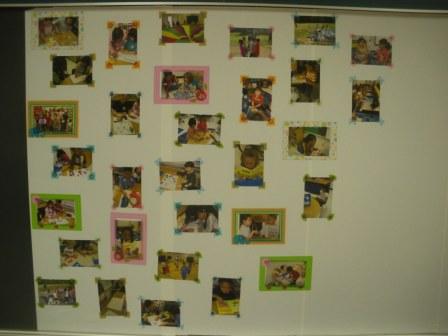
Recently I pulled the package out again as I was reorganizing some things (a constant battle). I realized that there were also picture frames and photo corners there. So I printed out some pictures from this year and created a photo gallery for us. I'll add to it as the year continues. The first day it was up the kids were thrilled. As I add I think they will be excited again and again. Plus, somehow, seeing the gallery makes me smile, even on the worst days.

Agreeing with Dan

Dan Meyer frequently gives me something to think about. A recent post of his stayed in my brain for several days. He is a compelling writer and what he has to say here is fascinating. He is writing about his 'blue students', kids who are struggling.
But graduation, college, and career are all abstractions wrapped in scare quotes to my blue students. So they pummel my flabby pedagogy daily to the point that I'm burger. Lean burger.
Dan is becoming a better teacher on a daily basis because these students need him to be. He can't skate by with these kids.

It took a few days, but I finally realized that his post reminded me of something I had written (and strongly believe).
If you want to see powerful, meaningful instruction taking place, look for schools teaching struggling learners. The students may not be scoring on standardized tests as well as their middle class peers, but I'd bet they're making more progress on a daily basis thanks to their hard work and their teachers' dedication.
One coworker, Mark, agreed with this assessment. He has worked elsewhere and also sees the difference.

Here the teachers keep their eye on the ball, because when they take it off, a kid literally falls through the cracks.

Saturday, November 21, 2009

Blogosphere as Window

Reading blogs of other teachers gives me a window into other classrooms. Teaching is a fairly isolated profession and I rarely have the opportunity to see what is happening in classrooms other than my own. (Although I do think that I are more aware of other classroom practices at my school because of how much planning we do as teams or in small groups.)

I've been wondering why I find other teacher blogs so compelling when all I am doing is reading about their days. I finally realized that I am analyzing their teaching in the same way that I analyze my own and trying to learn more about the best way to help my students.

It is possible that I am just rationalizing to make myself feel better about how much time I spend reading these blogs.

Friday, November 20, 2009

Don't Let the Pigeon...

  • go to town
  • play on the computer
  • cook dinner
  • steal your candy
  • drive a car
  • go trick or treating
  • get a girlfriend
  • go outside
  • steal your car
  • take a picture
  • fall in love
  • take your presents
  • fly
  • come to your birthday party
  • kiss a girlfriend
  • steal the plane
  • have a party
  • eat candy
  • have your toys
  • steal your books
  • ride a bike
  • get married
That's the list of ideas my first graders generated after we read many Mo Willems' books and watched his simulcast. We then picked one item from the list to write a pigeon story together. The top choices included all the ones about girlfriends, love, or marriage. I made an executive decision to not write about any of those because the giggling was out of control. We wrote Don't Let the Pigeon Eat Candy instead.

You can view the VoiceThread of our book here.

Don't Let the Pigeon Eat Candy

Friday, November 13, 2009

Getting It

I am a musician. I began studying the piano in late elementary school. Somewhere in early high school I began taking two lessons a week. One lesson was the normal playing and improving technique. The other lesson was theory. I don't remember a whole lot about those theory lessons but I remember really struggling with the circle of fifths (a basic, important concept). I spent years trying to learn it with my piano teacher to no avail. It never seemed to click.

In college I was a music major and took music theory my first semester. Early in that first semester our professor taught us about the circle of fifths. I can vividly remember immediately thinking, "I get it." I don't think he did anything noticeably different than my piano teacher had done (she was an exceptionally talented, well educated musician) but it clicked this time. In fact, it seemed unbelievably simple and I was astounded at how difficult it had previously seemed.

As a first grade teacher I think of this often. I work with many students who are reading 'below grade level'. I wonder if they just aren't ready yet. Will they sit in a reading group one day and just have it click? Am I beating a love of reading out of them because I'm pushing them so hard before they are ready? Is all of our hard work in reading the foundation for that aha moment when reading finally works for them?

I have no idea. However, I have watched my own daughter, a first grader this year, as she has been learning to read. She finished kindergarten right on benchmark. However, I would not say that she was really reading yet. Recently, around the end of the first quarter of first grade, she just seemed to get it. All of a sudden she wasn't just guessing what word it might be or skipping words that were tough, she was reading. A friend says it's like the reading fairy has come to visit kids. It seems like an overnight change.

I had looked at the circle of fifths countless times for several years without understanding. Then, I looked at it and got it. Did those previous years play any role in my understanding? Do my guided reading groups with very beginning books make a difference? Would it be just as good to spend that time reading to the kids and talking about books until they are ready to get it? Is it possible we are telling parents their children are reading below grade level when they are simply getting ready to read at their own pace? I wish I knew.

Wednesday, November 11, 2009

Teachers Who Teach Me Often

A couple of comments from folks in the last few days have really stuck with me and are filling my brain right now. I was chatting with the best first grade teacher I know recently and sharing with her how impressed I am by how much patience she has with others. Sadly, patience is not a strong suit for me.

She said that when she gets frustrated with people (we're talking about adults, our patience with children is less of an issue) she thinks to herself, "She is some one's daughter." or "He is some one's brother." Looking at irritating people in that light helps her to think more kindly. It's such a simple concept and yet I think it is awe-inspiring.

The other comment came from a blog post by organized chaos. She wrote about the teacher she wasn't. It hit home because it also described me that day. Based on the comments, she and I were far from alone. One reason her post really struck me was because I find myself thinking WWOCD (What Would Organized Chaos Do?) on a regular basis as a guide for good teaching. If I can follow the answer to that question I am often more patient, more caring, more quick to pick up on cues from students: academic, social, and emotional. So, if she has days like that one, somehow it makes it more okay that I do so as well. I will strive against them, but it helps me accept my flaws.

Tuesday, November 10, 2009

I'm full of ideas. Sometimes they even get implemented. Every once in a while an idea seems brilliant. Even more rarely, when implemented the idea actually plays out to be brilliant.

Centers during reading workshop go fairly well. Most of the time I feel as though the students know what to do, are doing it, and are actually learning to be better readers as a result. Success.

However, getting started with centers can be tough, especially by Friday since I explained any new centers on Monday. So recently I took a picture of the various places students might need to go for their centers and put the picture up with the center name. Now at least they know where to start! Centers that are used often stay in the same place so the picture is less necessary, but I include it anyway. The visual cue really seems to help some kids get rolling and makes center time smoother, which means I can accomplish a lot more with my guided reading groups.

Friday, November 06, 2009

Same or Different

My first graders sign in every morning. This was a recommendation from my fabulous reading co-teacher and I love it.

The kids:
  • see each other's names everyday
  • practice writing their own name (neatly on lined paper) everyday
  • practice writing with an upper case letter followed by lower case letters
Plus, it makes it easy for me to see who is absent.

Today, I changed it up a little. For those kids who are consistently writing their names correctly , with upper case and lower case letters I added their last name to the sign in sheet. Many of these kids don't know how to spell their last name and some can't even tell you it. So, this is good practice for them. Also, we're hoping those who aren't consistently writing their first name properly will focus more on it in order to add their last name.

I overheard one little girl, as she was signing in, say to a boy, "Hey, we have the same last name!" I thought, "How fabulous that they'll make these connections now."

Later, when looking at this with my amazing co-teacher, she pointed out to me that I put the wrong last name for this little boy. They do not have the same last name. Thank goodness she caught it early so that he doesn't write the wrong name for weeks! He didn't seem to notice that it wasn't right. Ah, first grade.

Update: When I picked my students up from art this afternoon this boy was so proud to show me that he had written his first and last name on his work. It was not the correct last name. Ugh. On Monday he and I will have to look at the new sign in sheet and talk about my mistake.

I can't decide if I should be so impressed with how quickly he has taken on trying to write his last name or depressed that he doesn't realize it isn't his last name. (They do start with the same letter and are similar, in his [and my] defense.)

Thursday, November 05, 2009

Making the Grade

Our school district is trying out a new elementary school report card. I wrote about it last year when it was in early stages. We've tried it for our first quarter and so far I'm quite impressed. They have made changes from last year and the thinking skills are no longer on the report card. In spite of that, I'm excited about the possibilities.

Dean Shareski recently tweeted about his district's grading policies. These dos and don'ts are very impressive. Like our new report card, these guidelines require us to think about grades in a new way.

These guidelines suggest that teachers should ensure that grades reflect the learning rather than the attitude, effort, or timeliness of assignments. For some time now it has been accepted that these things as well as homework and practice should impact grades. As a result, grades have not typically been a clear reflection of a child's learning. It's exciting to see different districts challenging traditional grading practices.

I know many teachers, including plenty at my school, are struggling with these new ideas of grading. I wonder how isolated these innovations are or if districts across the country (and in other countries, like Shareski's district) are pushing these boundaries as well.

Wednesday, November 04, 2009

Research Shows...Very Little

I'm taking a class, Introduction to Supervision of Instruction. It's actually been a very intriguing course. One of the few assignments has been to choose one skill, competency, or program that you believe has a positive impact on student achievement and look closely at the research on it. (Basically our professor figures we'll find that there is very little valid, reliable research proving positive effects on student achievement for just about anything.)

As a result of this class, Bud the Teacher's recent tweets really struck me.


I am amazed at how often we say that research shows something when there is minimal proof of such things. This is true not just of teachers and administrators in schools and districts but for reporters and politicians. I am finding it shockingly frustrating.

Wednesday, October 21, 2009

Out of Control

I've been thinking a lot about control in my classroom. What do I want to control? Where do I want to let go of control?

Over 12 years of teaching my views on control have changed quite a bit. To an outsider I think it would look as though I control very little (for better or for worse). My first graders do not have assigned seats. In fact, our tables are at different heights so that they can sit on the floor, in chairs, or stand while they work. Clipboards are available to them anytime they want to use them as are various other surfaces (student desk that was planned as a 'thinking spot', a teacher desk that was planned for my fabulous co-teachers, small table our amazing librarian passed on to me knowing of the various options in my room). The students have taken over the physical space in the room. They work where they want and with whomever they want.

I retain control over some obvious aspects. I move kids when they aren't able to work because they are bugging another or unable to stop chatting about karate class during a read aloud. I move kids in line if needed so that we can walk respectfully past other classes. I'm totally in charge of our schedule (well, more than the kids are anyway - I don't have total control here either).

The most important thing I control now is in the shadows. I work hard to offer my students experiences that will scaffold learning for them. I think hard about exactly how to present something or which experience needs to follow which in order to build schema in a way that will set them up for the future. I control this in the hopes of maximizing the time we have together. I don't want to waste a minute.

I think a lot more about this area than I do where kids sit or who they work with in a group. I couldn't do that ten years ago. I'm grateful for the experience that has allowed me to focus on what I think is truly important.

Image from planegeezer on flickr: http://www.flickr.com/photos/10261531@N05/2197822659/

Thursday, October 15, 2009

Probably Thinking

I'm teaching an intersession class to first and second graders right now. (If you need/want more information on intersession, it's at the end of this post.) We're studying probability. I really enjoy this topic in math and thought it would be fun to explore for a couple of weeks.However, I made that decision without doing any real research or planning (anyone who knows me well is not shocked by this). Later, when I did begin to plan, at the last possible minute, I learned that probability is not really in the state standards for those grades. This appears to be because first and second graders aren't really able to comprehend probability (something I learned as I continued my research, somewhat desperately).

So, I turned to the Patterns of Thinking to help me plan. A couple of fabulous folks at Think and Thrive were exceptionally helpful to me and pushed me even further in my thinking. Derek Cabrera has said several times that probability is all about systems, something I had, so far, been unable to wrap my head around. After some time on Thinkipedia and a discussion with Derek this was beginning to make sense. And probability was beginning to seem really complicated.

So far, three days in, things are going pretty well. We started with the ideas of possible and not possible (impossible) and then moved on to likely and not likely (unlikely). Just these concepts were surprisingly difficult for the kids to understand. Surprisingly, at least, to me. Then I added the idea of certain and we looked at these in a line, moving from impossible to unlikely to equally likely (which we haven't really explored yet) to likely to certain. I think the students are beginning to comprehend those concepts.

Today, the third day, we actually spent some time pulling bears out of a bag and recording the data. We'll do more with the bears and some spinners tomorrow. For now, we'll really focus on collecting the data and discussing what we notice. Next week I'll try to bring this data back around to these concepts we've dug into this week. I really believe the kids' understanding of these concepts is much better than if we had simply begun with the activities and data collection. It's really been exciting.


If you understand the concept of intersession or if you simply don't care, you're done!

Intersession explanation: Our school begins 5 weeks before the majority of schools in our district. We have regular classes for the first quarter and then we are 'off' for two weeks. We then do the second quarter, have winter vacation and an extra week 'off'. Then, third quarter followed by spring break and another two weeks 'off'. This puts us right with everyone else for the fourth quarter. During those weeks 'off' we offer intersession classes. These have a math or language arts focus, but are theme based. We have offered cooking, theater, camping, tennis, art, music, and video classes, to name just a few. The kids are in one class for the morning and a different class for the afternoon. Most of the classes contain students from two grade levels. It's a lot of fun for the kids and for those of us who teach.

Friday, October 02, 2009

An Uphill Battle

My first grader is giving her fabulous teacher a ton of trouble. She's defiant, argumentative, sulky, and an all around pain in the tush. Her teacher has tried a huge variety of ways to help her and enlisted the advice of other experts in our building. We've attempted to address this at home through more attention for her and discussions of the behavior (when we aren't furious with her). Yesterday it escalated to the point that she ended up in the principal's office (that principal is, of course, also my boss - just to add to the complication here).

I genuinely don't think my daughter has any real understanding of why her behavior is such an issue. When I talked with her yesterday after things had cooled down, she did not seem to recognize how her behavior impacted her classmates. I can't figure out how to help her see this.

In addition, I'm trying not to let this issue feel like it is all about me. I can't get away from feeling like a failure as a parent. I'm pretty sure that is not helping me handle the situation well. We'll get through this, as many parents have before. Somehow, knowing that isn't as helpful as I would hope.

Thursday, October 01, 2009

More Ruminations from Rafe Esquith's Talk

Another thing Rafe Esquith said during his talk that has really stuck with me was, "My favorite word when teaching children is yet."

He went on to explain that there are many things kids aren't ready for yet. It doesn't mean they will never be ready. I'm finding this seems like a great way to help kids understand when they lose a privilege or opportunity. I explain to students that they are not showing that they are ready yet for the responsibility of new materials or that they are not ready yet for free choice because they have not finished their math work or they are not able to control their body/words/actions. Saying that they are not ready 'yet' suggests that they will be ready soon. I like that implication.

Rafe makes kids explain to him what they need to do to in order to get to do whatever they are not ready for yet. This adds more responsibility for the students to think about what they need to do.