Monday, November 15, 2010

Kids ARE Kids

I did it again. I read Jay Mathews' column (blog, whatever) and got annoyed. To compound my foolishness I commented on the post which means that I feel compelled to follow the other comments. I truly should know better.

This one was Top District Lets Average Kids Lag Behind. Iit reads like an indictment of high school students. Well, not those who are making As, but others.

Mathews wrote this after hearing from a high school teacher who is concerned about the grading policy in his district.
“All I can do is beg my students to study. Ultimately, they know they don’t have to and don’t,” said Stephens, who has taught for 20 years. “I would guess fewer than a handful actually studied for their test last week. No joke.”

I have so many issues with this. But I'm going to stick with just one in this rant. Plenty of research has shown that the teenage brain is not fully developed. Teenagers are not able to make decisions as adults. From the above cited article in Harvard Magazine:

The last section to connect is the frontal lobe, responsible for cognitive processes such as reasoning, planning, and judgment.
But we expect students to plan for tests that have little or no relevance in their lives. Just because we say so. I'm old enough that according to the research my brain has fully developed, but I don't like to do things because someone else says so. I'd be hard pressed to judge teenagers because they don't like to jump through hoops. Let's try to look at our students in light of their years and brain development. Let's not keep acting as though they are mini-adults.

Tuesday, November 09, 2010

Bathroom Walls

A year and a half ago I was debating what to do on the walls of the small bathroom in our classroom. I hated having that wasted space and I felt like the kids could have something there they would enjoy and/or learn from. The comments in response to my request for ideas were wonderful. I ended up just hanging some artwork last year, which I liked. I added more artwork this year (we needed more than just Picasso, Escher, and Khalo). Then, I decided to add the words the kids are expected to learn in kindergarten. Of course they haven't all learned them yet so I figured they might as well see them often.

Now, in those emergency situations when I actually use this bathroom it feels less gross and icky to me. Not un-gross or un-icky, just less so. I did manage to take pictures that avoid anything that shows this is a bathroom. I promise it is.

Monday, November 08, 2010

In the Wild

Last night I joined a friend for drinks. She was in the area for the SEDTA conference. Although I had met another friend for brunch last year when she was here for the same conference, I really had no idea what this conference is. For those equally uninitiated, it is the State Educational Technology Directors Association. If you are interested, you can learn a lot more about the group on the website because that's the extent of my knowledge at the moment.

Anyway, we met for drinks and it was delightful to see her. The evening began with just the two of us chatting in the lobby bar but gradually more and more folks joined us. These folks seemed to know each other, if not in person, at least from conference calls and such. I, of course, knew no one other than my friend.

At one point it became clear that some folks were trying to figure out my place in this. They didn't recognize me and they could tell from conversations that my friend and I have a connection. I explained that I'm a local who just joined them for the evening to see her. When asked what I do, I said that I teach first grade.

Their reactions were fascinating. I felt like an orangutan in the wild discovered by scientists who have studied orangutans for years but never seen one. Telling my occupation has never resulted in such amazement.

My immediate thought was that these folks should make more of an effort to talk to teachers. Of course, I couldn't have felt better than to hear my friend say, "Yes, we should have more teachers at these things."

She, like many others there, has never been a K-12 teacher. But she knows teachers because she makes an effort to be connected with them in a wide variety of ways. We need more policy makers who do that.

Sunday, November 07, 2010

Halloween

Halloween is very likely my favorite holiday. You get to dress up and eat candy, I'm not sure how to beat that.

But, Halloween certainly has the power to make me wonder about our society. This girl is wonderful, I adore her. I have no idea why a costume like this is made in a size to fit a six year old. I can only assume there is demand for it and that is painful to me.

Wednesday, November 03, 2010

THAT Student

Every teacher has THAT kid (or maybe a few) that she will never forget. For me, it's a boy I taught in both fourth and fifth grades many years ago. He was brilliant. When I read books aloud he shared ideas that were far beyond anyone else's thinking, including mine. He could just see some things, they just made sense to him.

Unfortunately, he never believed me about how brilliant he was. He struggled to read and in fourth and fifth grade if you can't read you must be stupid. I don't really understand dyslexia, but letters didn't seem to stay still on a page for him. No matter what I tried I couldn't help him read easily and I couldn't convince him of his intelligence.

He and I kept in touch through at least his eighth grade year. We attended theatrical performances at his middle school (it was so fun to watch other former students perform) and he even came to my house one day and helped me stain my new pantry doors. I wasn't ready to let go. I always felt like I should be doing more for him. His potential was so great.

After eighth grade we lost touch. By then I had two kids and many new students. When I would drive by his apartment building I would wonder what happened to him. I thought about him frequently, more than any other former student.

Today, he walked into my classroom. He is a senior in high school and is volunteering at our school for some of his community service hours for class. When I turned around and saw him walk in with our assistant principal I teared up. I'm not sure what message my current first graders got from the huge hug I gave him and the fact that it took me a couple of minutes to pull myself together before I could finish giving the directions for their math activity. I don't really care.

We didn't have a chance to talk much today. Eighteen first graders working with dice and counters kept us busy. But he'll be back. There will be time for that.

I requested one of these volunteers when the email went out about them. I always do. If there is an extra set of hands available they are always welcome in my room. I even knew that some of these students were alums of our school and I asked if I could have one of them. I thought I'd been around long enough there is a chance I would know them. It turns out that he was the one volunteer who asked about a specific teacher. He wanted to know if I was still here.

Monday, November 01, 2010

Another Washington Post Link

When I have a long teux-deux list I should know better than to take a break with my google reader. Clearly, I don't know better.

Valerie Strauss' Answer Sheet does not usually cause the same response in me as Jay Mathews' Class Struggle. However, Daniel Willingham occassionally writes posts and I often disagree with him. This time however, he says something my mother has told me for years.

My mother is a Registered Nurse. When folks have suggested that sugar will make kids hyper or crazy, she has always spoken up to say that studies have shown that not to be true. I have believed her but not with enough confidence to speak up often.

Daniel Willingham is a psychology professor at UVA. He links to several different studies of sugar on kids' behavior. His final thought sums it up well:
There’s pretty good evidence that there is not a physiological effect of sugary snacks on kids’ behavior, and some of parent’s perception of an effect is probably just that--perception. But there could also be a psychological effect whereby sugary snacks are associated with other factors such as a less regulated atmosphere or kids’ perception of a less well regulated atmosphere.
I appreciate having links to studies to back me up when I quote my mom now.

Raising My Blood Pressure

Jay Mathews has managed to tick me off again and this time he didn't even write anything. Impressive.

The most recent post on his Class Struggle blog is by J. Martin Rochester, a political science professor at the University of Missouri-St. Louis. He rants about the idea that some schools are eliminating spelling tests. Although he quotes one language arts coordinator as saying that "we were developing a lot of Friday morning spellers" suggesting to me that kids could spell words on the tests but not in their actual writing. Who cares if they can spell on tests? Can you get more inauthentic? Time is valuable in any school, we can't afford to waste time on activities that are not impacting students' learning.

I think my favorite quote comes near the end:
In our pursuit of mass excellence, we continue to throw the baby out with the bathwater, abandoning traditional if imperfect practices in favor of new unproven ones.
If we never try unproven practices we never move forward. How can someone be willing to admit that practices are imperfect and not be open to the idea of trying something new to improve?

If I promise not to tell J. Martin Rochester how to analyze international law, do you think he'll stop telling me how to teach young children?

Wednesday, October 27, 2010

Reason #391 Why I Love My School

These pictures were taken in our library before school one morning. Our librarian (Library Goddess, as I like to call her) opens our library for the 30 minutes before school begins each day. Even when meetings happen in the library she lets the kids in. She holds high expectations for them and sends anyone away who can't be polite and respectful. On a daily basis she helps kids learn routines, social skills, and other basic skills in addition to finding fabulous books.

Students can use the netbooks, do puzzles, play games, play with puppets, and check out books. Most mornings the room is packed. Some kids are there every day.

There is no expectation that our librarian (and the also awesome library aide) spend their time this way. It is a choice they made. I find it hard to imagine being willing to give up that time before school - I need it to get ready for the day. But these ladies recognized a need and stepped up. Something we see happening in schools everyday. We should celebrate it more often.

Tuesday, October 26, 2010

Pick me, Pick me!

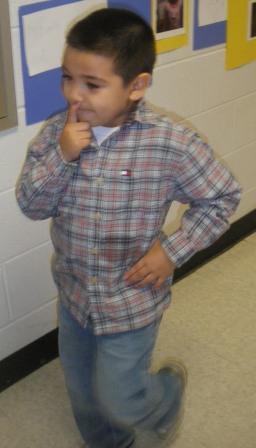
In an attempt to cut down on the wildly waving hands as students are desperate to share an answer, a thought, or a question, we often put our fingers on our noses instead. Sometimes I shake it up and have them put a finger on an ear, on their head, on their chin, etc. As a bonus, that also builds vocabulary.

Most of the kids put their index finger on the end of their nose. Effective, simple. But, as you can see with the girl below, sometimes the kids put their entire hand on their nose. I'm not sure why. Some kids pinch their nose and others smush it hard in their hopes of being chosen.

My favorite, however, is the little guy at the bottom. He doesn't always do this, but he frequently does. He's very serious and I'm certain he has no idea of the message he could be sending.

(I'm taking pictures all the time so the kids are accustomed to me pointing a camera at them. As a result, I don't think my snapping these seemed at all odd to them. Thankfully.)

Monday, October 25, 2010

A Rare Book Review

I don't tend to do a lot of book reviews here because I don't keep up with books as well as I should and there are so many blogs that do a much better job than I ever could.

However, my youngest daughter checked a book out of the library this summer that was so fabulous I had to purchase it myself. White is for Blueberry by George Shannon is perfect for so many things. The idea in the book is to look at items from another perspective. So, white is for blueberries that are not ready to be picked. When I read it to my class today they were quite hesitant at first. "White is for blueberry?" They began to buy into it after a few examples and then got to "Purple is for snow..." Then they were skeptical again. But it didn't last. They loved the book.

We'll be reading it again and again. After we finished it today we had a brief discussion of other ideas to include - such as pink is for rabbit (the inside of the ears). It could be fun to write a class book modeled after this.

It also fits well with our wondering about everything. We've started our Wonder Notebooks and began collecting questions we wonder about. Looking at things from such a different perspective, as this book does, will push us to wonder in some new ways.

I shared the book today with several other teachers and everyone adored it.

Thursday, October 21, 2010

Bad Teacher (But Still Trying)

In the midst of teaching everyday it is nigh on impossible for me to step back. When I am able to get a little perspective it doesn't really matter. I seem unable to control my reactions to the kids. I find myself responding to them in ways that are punitive. I'm taking away free choice time (not recess, at least). I'm easily frustrated.

I know how I want to respond. I know what would be helpful. But so far it seems to be beyond me to actually do it.

Reading Joe Bower's most recent post about a school-wide behavior system caught me. I've only recently discovered his blog and it's become a must read for me.

Reading his interaction with a student was a reminder of how I want to interact with kids. My two current goals (there are so many more in my head but I'm trying to keep this doable):
  • Take the time to listen more. I have not had the patience to do this lately and it is critical. Just doing this will make a huge difference, I think.
  • Give students the benefit of the doubt. Assume the positive rather than the negative. Children are not too often truly malicious. They are not often attempting to drive me crazy. I need to remember that.
Oddly enough, it would be astoundingly helpful if I could keep these things in mind at home with my daughters as well.

Tuesday, October 19, 2010

More About First Grade Writing


Clearly I'm thinking a lot about writing at the moment. This video was taken the first week we were doing independent writing. I was so impressed with how focused everyone was on their writing I grabbed my flip video camera to record it. Not every day is this focused, but mostly they enjoy writing. It often surprises me to see how students who are just beginning to be able to physically write things see themselves as writers. It shows what an awesome job our kindergarten teachers are doing.

Monday, October 18, 2010

First Grade Writing

One of the first things I had to learn when I started teaching first grade two years ago was how to read their writing. I've gotten reasonably good at it, but I still have a way to go. Friends who have taught in the primary grades for years are much better at deciphering early writing than I am.

These are examples from eight of my students (ones whose names were easy to remove or were missing altogether) from the first two days of our independent writing. We started that during the second week of school. Personally, I was thrilled with the work these students were doing that early in first grade.

How much of this can you read?


Sunday, October 17, 2010

Feeling Good about Tables

In our second year of having a wide range of table options, it seems to be working splendidly. As the students were writing the other day I noticed the decisions they had made about where to work.

Every small, intimate table (seating four or fewer) was occupied by students. Of the large tables, only the one on the floor had more than two students sitting there.

Setting up my classroom this way was a big switch after ten years with more traditional furniture. It's nice to see the students respond well to it.

I'd love to get rid of the big tables (at least the one with chairs) all together, but it is handy for guided reading groups.

Thursday, October 07, 2010

We Have Met the Enemy and He Is Us

When students are not doing the work we've asked them to do, maybe the problem is us. I'm coming at this issue as a first grade teacher and I know that affects my thinking. First graders are interested and excited about everything - or at least they can be if you sell it to them. So, when we see that they are not doing the activity, discussion, or work we are asking them to, we need to reevaluate our expectations.

I just unsubscribed from a blog that I often enjoy because of the frequent negativity. I understand the need to vent and I know I do it too. I don't understand the idea that young children should do what we require simply because we tell them to. I question what is required of me often. Sometimes I will do it after I learn why and sometimes I won't. Sometimes I have to when I don't want to (like report cards) but I don't usually do it well.

We expect students to do because we said so. We wouldn't want to be treated that way. When faced with students who are disengaged, we should look closely at what we are asking.

Wednesday, October 06, 2010

Makes Me Smile

These kids are in the kindergarten class across the hall. They walk in line with a 'hand on the hip and a hand on the lip'. Every time I see them it makes me smile. We should all smile more often.

Tuesday, October 05, 2010

The Rabbit Hole

Earlier today I tweeted this:


It was absurd. The test we gave was the Naglieri Nonverbal Ability Test. That's the positive aspect. The test is completely nonverbal. It consists of pictures (patterns, spatial relations, etc.) with five pictures to choose from for the answer. I don't think it stressed my students to take it. They did not seem concerned by the time limit. In fact, the twelve children who took the test with me all finished before the 30 minutes were up.

The test has been given to second graders in my district for some time now and it has been decided to move it to first grade. We use it as one factor in identifying children for advanced academic services (gifted and talented).

I did spend a few minutes one day showing students some model questions on the smartboard to teach them how to bubble their answers. I then gave them two model questions to do so that I could be sure they understood how to bubble and to only bubble one answer per question. On the whole that seems to have helped. No one bubbled more than one answer per question and, aside from accidentally skipping questions or pages (I was watching carefully as I walked around the room) they didn't seem to have any trouble with the structure of taking this test.

For all that, the best I can say is that it could have been worse. That's sad. We spent a good amount of our morning taking a standardized test. At the age of six. Sigh.

Update: Apparently I am incorrect. According to a couple of fabulous colleagues, in the past we gave this test in kindergarten. Who knew the current situation was an improvement? Thanks for keeping me in line splatypus and organized chaos!

Friday, October 01, 2010

Friday Night Ranting

In an obvious sign that I don't think clearly on a Friday night, I just left a comment on Jay Mathews' most recent blog post. He writes about education professors' priorities as noted in a poll. His main point seems to be disappointment that education professors don't see a need for much more focus on classroom management.
This is difficult to understand. Anyone in close contact with new teachers knows that creating discipline and order are vital to their success, and they often wish they knew how to do that.
I don't doubt that new teachers do wish they knew how to manage a classroom better. I know I did. What I doubt is whether or not that can really be taught. We can talk all we want about education schools, but this sort of thing needs to be learned on the job. Without actual kids in a classroom, management is just theory and fairly meaningless. Pre-service teachers need to spend a lot more time in classrooms observing and working with master teachers. This is awfully tough to achieve.

Also, "creating discipline and order" sounds too much like a military school to me. I would hope that teachers are empowering students and encouraging them to ask questions, try new things, and explore. This won't happen in a strictly managed classroom. Children are people and deserve to be treated and respected as such.

One final note, just to get it off my chest, some of the comments really irked me. The idea that disruptive students should be removed and the message sent that such behavior would not be tolerated seems simplistic and naive. It also seems hurtful. Many children have behavior issues due to factors beyond their control. We should be helping these children, not isolating them and thus compounding the problem. They should not have to pay for the life into which they were born. We should offer so much more than that.

Cue Embarassed Blush

Today was a long day. It's been raining all week. Our main hallway is being painted. It was picture day. We had a fire drill. Can you picture it?

At the end of the day I wandered down to the office while my class was in art. After chatting briefly with a few folks there I remembered the purpose of my errand. I pulled this out of my pocket:


and said, "I need batteries."


This, for the record, is a Crayola glow wand. It is used to "write with light" according to Crayola's website. I am planning to have the students practice their word wall words with it. However, that was not readily obvious to others in the office. I am not sure when I will hear the end of this.
At the beginning of first grade many of our students don't really know the difference between letters and words. We work on this in a variety of ways at various times throughout our day. Yesterday we tackled it head on. I pulled out our thinkblocks and we talked about word/not word and then letter/not letter.

I was pretty impressed with their thoughts. They said that words need to make sense (I chose not to get into the idea of nonsense words). They shared some words as examples of not letters.

Finally, at the end I asked them about the relationship between words and letters. In no time the students shared three relationships, "letters are part of words," "letters make the sounds in words," and "when you stretch out words you can hear the letters."

While I was thrilled to see the understanding of words and letters, at least from some, I was really impressed with their thinking about the identities of words and letters and the relationship. As well as their ability to explain their thinking.

On the 18th day of first grade this was fabulous. We've got quite a year ahead.