Saturday, May 31, 2014

Hating on Benchmarks

I've never liked benchmarks in school. I don't hate them to the same extent as certain other things, but they frustrate me. They ignore the idea that a child is a complete person, much more complicated than a set of assessments and data.
When you take your infant in for regular well-baby appointments, the nurse always tells you where your little one fits in the percentiles for weight and height (and maybe even head size). Typically, your nurse and doctor are only concerned if your baby is jumping around in those percentiles significantly.  The fact is, for some babies to be in the 80th percentile, there must also be babies in the 20th. Somewhere are the babies who fit at both ends of the range. They have to be. Otherwise you're not talking about percentiles. Doctors track this to be sure a child isn't suddenly losing or gaining a lot of weight. Or to watch for other surprising shifts or differences. It's one piece of information among many they collect.
In schools, benchmarks are often the only thing that matters. For example, every child in our school takes the Developmental Reading Assessment (a one-on-one fluency and comprehension assessment) in the spring (and the fall). At the end of first grade students are expected to be at a level 16. If the child started first grade reading at that level, you can just relax. If the child started the year not reading at all, you've got a mountain to climb, a serious one. But with a benchmark, those two children are looked at through the same lens. That child who never had the chance to read before (or who just wasn't ready yet) and who makes it to a level 14, which is an astounding amount of growth, still missed the benchmark. They are below grade level. What a message to send. (And we do send it. It is marked on their quarterly progress report throughout the year and sent home in a specific letter about the DRA at the end of the year.)
I'm even more irritated by these benchmarks when we measure them so far before the year is over. Summer slide is well documented, especially for children living in poverty. So I accept that the start of each school year (at least since we lost our fabulous modified calendar several years ago) needs to be some catch up time, some repetition of the previous year. But here's the thing, I only get 180 days with these kiddos. That's not even half the days in a calendar year. Not a lot. So when I have to assess them with 30 days left in our year, we're not really checking to see if they finished the year on benchmark. I read today with two of my five who did not make the benchmark. They are just shooting forward as readers right now. For a variety of reasons, these two kiddos (and a few others) are in the midst of a reading growth spurt. In a week or so, I think they could meet the benchmark. But the assessments had to be finished last week. So instead, at the age of seven, they'll be told they're behind. I don't like to tell them that even if I think they are behind (I don't think it's a great way to encourage young children as learners). I especially don't want to tell them that if I think they aren't really behind!
I think benchmarks could be helpful if we used them more like doctors do, as a way to be sure children are growing as they should. It can be easy, when teaching a classroom full of children, not to feel as urgently about the lack of growth for some kids as one would hope. Checking benchmarks regularly helps makes sure kids don't fall through the cracks. But let's not go overboard. Let's give kids time to learn and time to grow and support and encourage them as they do. Let's remember that they are people, with a wide range of skills and needs and they are, every single one of them, unique.
Cross-posted from jenorr.com.

Tuesday, May 27, 2014

Random Thoughts as We Near the End

I seem to be losing children at about the rate that I am losing my mind in the last few months of the year. One little darling moved at the end of March, another in April. Last Friday was the last day for another, although she's only in Lebanon for a month and will be back at our school for second grade. I learned today that another precious one will finish at our school on Friday. In two months I'll have gone from twenty kids to sixteen. That's a lovely teacher-student ratio, but I didn't want any of these kiddos to go.
Our last math unit of the year is on graphing. Last week the kids got to choose a survey question with preset options for answers. Such as, What is your favorite subject, reading, writing, science, social studies, or math? Or, What is your favorite farm animal, cow, pig, chicken, or horse? The kiddos had the chance to ask their classmates their question and tally the responses. (Not everyone understands how to tally clearly, based on reviewing these tonight.) Then they graphed their results and answered some questions about them. Some of the questions are basic, such as "Which choice on your graph has the most votes?" However, because they could use different survey questions, we had to be creative to work on comparing quantities on the graph. 
Kids had to pick two of their choices and then say which one had more and how many more. This was, not surprisingly, the hardest part. Even knowing that, some of their answers nearly drove me to drink.
Pick two of your choices: Hamster and fish
Which one has more? Hamster (for the record, so far, so good)
How many more?  Dog (Huh?)
Pick two of your choices: Hamster and dog
Which one has more? fish (What?!?)
There are 21 days left with kiddos. (I only know this because our fabulous art teacher is, sadly, retiring and she knows how many days are left.) This is the point in the year at which I am both completely ready to be finished because I'm exhausted and worn down and panicking because there are not nearly enough days left for us to do all the really fun projects we want to do. And then I'm even more tired. Sigh.
Cross-posted at jenorr.com.

Sunday, May 25, 2014

Accommodations

I've been in several IEP and 504* meetings lately and it's got me thinking. One of the things we do in each of those meetings is go through a list of accommodations and modifications. Some of these are very specific - the use of Braille, for example - but many are pretty general - extended time, opportunity to respond orally, frequent breaks, etc. 
As I reviewed those general accommodations I realized that these are things that are available to my kiddos. All my kiddos. Pretty much whenever they need them. I don't care if they have an IEP or a 504, I want to be sure they are able to learn all they can and share all they've learned. If that means they need to get up and walk around a bit, that's fine. If that means they need to talk to me rather than write things down, great. (If the goal is writing, obviously they'll have to do some writing, but if the goal is sharing their knowledge about maps, they can talk rather than write.)
Mostly I'm happy to realize this. So many of these things are just a part of our classroom I don't really think about them. (Of course, it took sixteen years to get to that point.) However, when I'm concerned that a child is significantly struggling this can actually be a problem. I've been to our Responsive Intervention Team several times this year to discuss different kiddos. One of the things I have to do is create a list of accommodations I've provided for that child in order to show that I've tried different things. I struggle with this every time. Can I say a student has preferential seating if that's true for all of them because they choose where to sit based on what they need (lots of space, move to the back of the carpet - need to stand, there's a tall table for that - need to work alone, go to one of our small tables)? Can I say they get frequent breaks if they all know they can get up and get water or just walk a bit if they need to? 
If the accommodations are just a part of our classroom culture, how do I list this for my referral for support? Also, how do I better support these kiddos who are still struggling in spite of this classroom culture (or maybe even because of it)?

*IEPs are Individualized Education Plans, created for students requiring special education support and 504 plans are for students who need accommodations, but not special education support, often students with ADHD or other such challenges.
Cross-posted from jenorr.com.

Wednesday, May 21, 2014

To Sleep, Perchance to Dream

Lawrence Block wrote a series of books about a man named Evan Tanner. This is not Block's most popular mystery series by any stretch, but it's my personal favorite. Don't pick these up if you aren't willing to do some serious suspending of disbelief. I am and I believe these books are worth it.
Evan was injured during the Korean War and the sleep center of his brain was damaged. As a result, he does not sleep. Ever. He can't. I love this because it explains how he has been able to learn a ridiculous number of languages, read about history and current events in many different countries, and basically just know so much more than I do about anything. He has six to eight more hours everyday than I do!
I am jealous of Evan, even when Block writes scenes into the books that show how challenging this can be because Evan has to pretend to sleep at times to keep up appearances with others. Just lying in bed for extended periods does not appeal to me. But the trade off would be worth it.
As a parent and as a teacher, sleep is something I think about way too often. My husband and I just chatted tonight about our daughters' bedtime and whether or not we thought it was working for them (and, to be honest, for us). I have many conversations with parents about when their children go to bed. In fact, for homework every night one of the things my kiddos write down is, "Bed by 8."
There seems to be a lot of research supporting my obsession with sleep. KQED in San Francisco had a brief thing about how our students need more sleep. Basically we think they're getting plenty of sleep but they aren't. 
Ed Week covered a study suggesting the supreme importance of regular bedtimes for young children in regards to their behavior.
And the BBC wrote about the way in which sleep cleanses our brains of toxins. This opens up lots of questions about how much sleep impacts brain disorders as well as more common behavior or learning challenges.
Reading all of these is reassuring and validating. However, I've had conversations with folks I greatly respect who grew up in other cultures who have told me that bedtimes didn't exist. Kids went to bed when they were tired. It seemed to work, at least in their eyes.
So I have to wonder, has our society's focus on sleep and bedtimes impacted our beliefs about this? Have we created structures that mean we require more structured sleep? Or are consistent bedtimes and a certain amount of sleep truly critical? 
Cross-posted at jenorr.com.

Monday, May 19, 2014

One Way to Have Kids Reflect

We still have many weeks to go until the end of our school year, but I know that many schools are closer to the end - much closer. If that's true for you, congratulations. Also, I've got an option for you to have your kiddos reflect on their year. I've mentioned it before, but it seems appropriate at this point in the year. My oldest, currently a fifth grader, created a site she titled, How WE Feel
Thanks to another teacher I met at the White House Teacher Appreciation Social, she is going to be adding to it soon (maybe tomorrow). He suggested including the arts, which she (and I) agree is brilliant. 
Anyway, if you have a few free minutes as you near the end, this might be a great way to have students think back on their year (or on multiple years) and share how they are feeling about school.
As an added bonus, it would make my daughter's day.
Cross-posted at jenorr.com.

Friday, May 16, 2014

Play or Work

"That looks like playing, not working," I heard my self say to a child during our reading and writing workshop time earlier this week.
To set the stage, I was working with a couple of students in a guided reading group while the other sixteen kiddos were either writing or at a work station (in our classroom library, sorting high frequency words, working in their poetry binders, or retelling stories with a partner). So it's a very busy time. 
I noticed a child I thought was messing around rather than writing and I said, "That looks like playing, not working." As soon as these words came out of my mouth I thought, "What the heck? Why did I say that?"
The message I just sent to that child was that playing is not okay in our classroom, at least not during reading and writing. Also, that reading and writing are work and not play.
Those messages go against everything I believe. In spite of that fact, I doubt any student in my class was surprised to hear me make that statement. Both because of societal beliefs about work and play and what they've come to expect within our classroom, I'm sure my statement was completely routine. So sad. I can do better by these darlings. 
We say so much more than we realize frequently. This week I heard two other adults in our school chastise students for being too loud in the hall because testing was going on. I understand the urge, but would so much prefer students be quiet in the hall because learning is going on. Otherwise we're telling kids testing is so much more important than learning. I'm not comfortable with that message. 
Anyway, next week's big goal will be to more closely live my beliefs about the importance of play in learning and work to show that to my students. I want them to see learning as play. That doesn't mean it's easy but it's fun.
Cross-posted at jenorr.com.

Wednesday, May 14, 2014

Coda to Roller Coaster Day

In the midst of the panic and fear as we searched for my missing student, there were at least three of us calling other kiddos. We went through the bus list and called kids who use the same bus stop and other kids on that bus we know to be responsible and observant. We also called a few kids from my class. It was quite an impressive system with some folks searching lists for useful names, others looking up those kiddos' information, and others making the calls.
As I was scanning a list I realized one of the other teachers who had jumped in to help (even when she really should have been picking her own kids up from their babysitter) was struggling to communicate. I turned and asked if she needed some help with Spanish. She said yes and I grabbed the phone. 
I'm not sure what I was thinking. There was a period in my life when I could have grabbed that phone and had a perfectly coherent conversation in Spanish. However that period was about twenty years ago. But I was in a panic and not thinking clearly.
To me, the conversation went something like this:
Hello? I would like to speak with L. I'm a teacher at A.T. 
L. is not here. He is at another house.
Can I call him there? Do you have that number? We need to ask him about another student on the bus this morning.
I don't have that number on hand. But I can contact him and have him call you.
Yes. Thank you.
And I hung up. However, I hung up completely uncertain if that really had been the conversation. And uncertain as to whether or not he would call. Fortunately, a few minutes later L. called us. Unfortunately L. had not been on the bus today.
As I reflected on the conversation, much later in a much calmer state of mind, I realized the conversation probably sounded more like this:
Hello? Me talks with L. Me teacher A.T.
L. is not here. He is at another house.
Me call here? You know number? We want question about other student bus today.
I don't have that number on hand. But I can contact him and have him call you.
Yes. Thank you.
When I shared these thoughts with my daughters, my fifth grader said, "Wow mom, she was probably wondering how you could be a teacher if you talked like that." Good point, girl, good point. 
Even though we didn't get helpful information from L. I appreciate that whoever I talked with at his house was so patient with my terrible Spanish and still took me seriously. We truly have the greatest families at our school. 
Cross-posted at jenorr.com.

Tuesday, May 13, 2014

Roller Coaster Day

I'm going to pass over all the ups and downs that happened before we even got to school (nothing like a road closed on your commute when you're already running late) or those during the school day (including the girl I had to speak with about scratching a classmate who later wrote "Ms. Orr is my BFF" as she worked in Pixie). Don't you just love how I'm passing over those parts of the roller coaster?
Because the serious, heart-in-your-throat, couldn't-go-higher-and-then-drop-lower, part of the roller coaster happened after school.
As my last kiddos were heading out my phone rang. It was my principal telling me there was a parent in the office registering their child for Head Start. As I, in my post-school haze, tried to figure out what on earth this might have to do with me, she continued and named the parent. Oh my. He was in my class about ten years ago, for both fourth and fifth grades. The backstory is here and I won't repeat it because today's story is enough.
Suffice it to say he has a darling three-year-old daughter (we looked at lots of pictures and videos on his phone), finished high school, and is working as a supervisor at a large retail spot nearby. He's doing well. It hasn't been easy; he and his daughter's mother are not together but are sharing parenting duties seemingly quite well. The high school diploma was shockingly hard to manage as he failed math his senior year. He attempted to take the course in summer school and in spite of registering and coughing up the money, he was told when he showed up on the first day that he wasn't on the roll and because the class was full he couldn't take it. (His money was refunded.) From his perspective his former principal made it exceptionally hard for him to finish this one course and it took teachers banding together and appealing higher up to make it happen. But he kept fighting for it and finally was able to take the course and graduate. Just more proof to me of his willingness to work hard and make things happen. (This barely touches on the challenges he has faced over the years.) We spent nearly half an hour talking and he promised to come and visit again. I told him to bring that little cutie with him! Cloud nine.
As he left I turned to chat briefly with another teacher and was grabbed by our office manager. She was on the phone with a mom because one of my students hadn't gotten off the bus. This happens on occasion and it scares me but I stay pretty optimistic. It always turns out the kiddo rode the wrong bus or walked home with a friend or headed to grandma's house. But this time I panicked immediately. This child hadn't been at school today. Optimism went out the window for me. Needless to say we kicked into gear immediately. We (office manager, me, two administrators, and three other teachers) talked with mom, dad, and big brother. We called various kids who ride the same bus to see what they could remember from the morning. We called other kids from my class to see if they had seen this little friend before school started this morning. We called the police. After about 45 minutes the student was found, safe and sound. I don't yet have all the details (and don't feel comfortable sharing some) so I will be so curious to hear the story tomorrow!
Teaching is always a roller coaster. I don't mind that, sometimes it's even fun. But I don't think I've ever gone from this high to this low this quickly.
Cross-posted from jenorr.com.

Wednesday, May 07, 2014

What a Day

My husband has recently learned that I will apply for anything that interests me. My attitude seems to be, why not? What can it hurt? He learned this because a couple of weeks ago I applied to attend a White House Teacher Appreciation Social. It crossed my radar at 5:30 one morning and I thought, why not? I don't remember exactly what the application entailed, but it was pretty short. I believe it requested our various social media links and there were two questions. Based on my memories (and some discussion today) the questions were 'What makes you unique as a teacher?' and 'Why do you want to attend this event?' As I spent a while at 5:30 in the morning I kept thinking, "Why am I wasting my time on this? There is no way I will get to go."
I was wrong. The email arrived last week informing me that I had been accepted to attend. I was in shock. I'm still in shock. There were 21 of us at the event today - amazing teachers from all over: New Hampshire, Massachusetts, South Carolina, Georgia, Illinois, Tennessee, Kentucky, Florida, Wisconsin, and more. I felt a bit like an impostor as I showed up after dropping my girls off at school and stopping for gas. These folks drove many hours or flew across the country. I also spent the day wondering what on earth I had done to deserve to be there. I think there might have been a lot of luck!
I have many, many, many thoughts about today, but for the moment, I don't have it in me. Instead, I'll share a few photos and keep processing the day to share soon.
Marine One Collage
Once we got through security we were ushered out to the South Lawn. As we stood there among a crowd of White House staffers and high schoolers on a field trip, Marine One landed in front of us, Barack Obama walked across the lawn, waved, and climbed aboard. We watched as he waved through the window on the first leg of his journey to Arkansas to visit the site of the recent tornado. It was amazing and completely unexpected. 
image (2)
Most of our time was spent in the Eisenhower Executive Office Building. (I took more selfies today than I have taken in my entire life. I am not ashamed of that!)
Me and Jill
In the EEOB we were in a conference room that is a part of the Vice President's suite (for lack of a better description - all of his staffers are in offices around there). The room contained a ceremonial desk (it has been used in the past but is now used only ceremonially). Just down the hall was Dr. Jill Biden's office. She took a picture with each one of us there and then joined us for lunch and a group picture. I have a major crush on her now.
Group with Jill    
We also met with Arne Duncan and several other administration officials who are involved in various education initiatives. They shared with us about these initiatives and policies and asked us about ideas for how to continue or publicize or improve. They also took questions from us. It was a completely unreal day.
Cross-posted from jenorr.com.

Monday, May 05, 2014

Language Matters

There are often multiple adults in my classroom - sometimes they are teachers and instructional assistants, other times they are volunteers or family members of students. As we transition from one activity to another I typically ask students to go to the carpet for us to meet together. The language I use might be, "If you aren't working with a teacher, wrap up what you are doing and please come to the carpet." 
One day when a fabulous volunteer was working with one student, it occurred to me that this language didn't really work. Instead, I said, "If you aren't working with an adult, wrap up what you are doing and please come to the carpet." Great. Problem solved.
I thought about it a bit more (because I tend to be a tad obsessive about these things) and realized this language is way better. Not because not every adult isn't a teacher, because they all are, even if that isn't their title. It's way better language because everyone is a teacher. I know I haven't conveyed that to my students as well as I want to, but at a minimum I can ensure the language I use doesn't undermine the idea. 
Cross-posted at jenorr.com

Sunday, May 04, 2014

Parenting vs. Teaching

Friday we took a field trip into Washington, D.C. The original plan had been to walk around the Tidal Basin, as we’ve done for the past two years. Sadly, due to some insane rains earlier in the week, the Tidal Basin was flooded and we had to make a last minute change. We ended up at Smithsonian’s Museum of National History (a museum I love). So there wasn’t a lot of time to prep kids for this trip (as we had spent a lot of time prepping them for a trip that wasn’t to be).
I knew we wouldn’t be able to do too much of the museum in just two hours. We watched this video before going and they talked about what excited them. Based on those conversations and our curriculum, I picked four exhibits for us to hit – and hoped we’d actually make it to all four!
As we made our way through the museum, sometimes at leisure and sometimes rushing, I found myself comparing this experience to taking my daughters to a museum. For our field trip I had a pretty set agenda for us. I talked to the kids about some questions and ideas to be thinking about in each exhibit. We fanned out in exhibits and gathered back to talk about what we had found and what we were thinking. The kids had cameras (one for every two kids) and they took almost 600 pictures. We’ll use those pictures to build on this experience for the next few weeks. All in all, it felt like a pretty successful field trip.
When I take my girls to a museum I do tend to some planning ahead, looking at the layout and possibilities. But we share the decisions throughout. If they see something that interests them, we’ll check it out. If something isn’t as interesting as we’d hoped, we move on. I don’t care if what we see has anything to do with their curriculum at school. I care that we all get to follow our interests and questions.
As a parent, at museums or just in our daily lives, I get to dig deep into questions with my girls (hence recent dinner conversations about the Holocaust and the Challenge explosion). We can get books from the library and look things up online. I don’t have to stop a conversation because we need to move on to our next subject or next standard.
One of my goals as a teacher is to get as close as possible to who I am as a parent (at least in terms of following our passions and interests).
Cross-posted from jenorr.com.

Wednesday, April 30, 2014

Questions I Ask

I recently asked our new (phenomenal) instructional coach to help me out with the questions I am asking students. She came in three different times, during a language arts focus lesson, a math focus lesson, and our calendar time.
I have thought a lot about questioning during calendar and expected to find that I asked much better questions during that time than I did at other times. What she noted and our discussion was highly enlightening. (This was about a month ago and I'm still mulling it on a daily basis.)
First of all, I can't say how helpful this was. I could have videotaped my lessons and watched them to explore my questioning, but I think I would have been distracted by so many other things, even if I managed to stay just focused on me in the videos! Our instructional coach wrote down all the questions I asked. Having that list to review was perfect.
I was thrilled to see that I encourage my students to explain their thinking. When a student shares their thinking I ask for others to agree or disagree. We've established a routine so students do so and explain why. I spent a lot of time early in the year working on this during calendar. Looking at the lists, I found that it has spread out through our day. Good news.
On the downside, I ask a lot of really basic questions. Not yes or no questions, which had been my fear, but questions which don't dig too deep. I have some concerns about Bloom's taxonomy but I have been reviewing some resources based on it in the hopes of pushing my students' thinking more. The prompts and sample questions are helping me do a deeper analysis and plan questions accordingly.
One thing I've learned over a decade and a half of teaching is that I'm never going to reach my bar. I'm really proud of the strategies I've taught that result in my students explaining their thinking independently. But now I need to make that thinking more complex. The benefit of these years is that over time I build skills and routines. In a couple of years I expect my students will be explaining their more complex thinking!
Cross-posted at jenorr.com.

Monday, April 28, 2014

Pausing for Breath

It's a time of year when I have trouble keeping perspective. We still have eight weeks left but I doubt any of them will be normal weeks. We've got concerts, testing, field days, end of year picnics, more testing, class pictures, final field trips, even more testing, and who knows what else. We've got to be flexible, patient, and muddle through. And, ideally, stay focused on what matters.
As a result I feel a need to pause a bit to celebrate some things I've done well this year. It's easy for me to focus on all the things I haven't done this year or didn't do well, all the things I wish I had done better. 
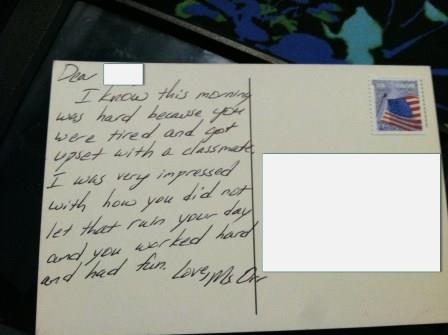
For a number of years now I have been sending postcards to my students. I figure everyone loves to get mail and chances are good parents will see the postcard as well. Here are three I wrote this afternoon.
Postcard 2
Many of the postcards I send are focused on academic successes. When a student does something awesome during the day I try to grab a postcard that day and write to them.
Postcard 3
Other postcards are about different kinds of successes. Anything that is hard for a student is worth celebrating when they do it well. (I also put the bit in here about being tired as a hint to these parents too - here's hoping!).
Postcard
Every once in a while the postcard might be about something important to that kiddo. 
My goal every year has been to send each kiddo four postcards - one each quarter or so. I've never once made that goal. At this point all but a handful of my students have received three postcards. I might just make it this year.
On a side note, one of my darlings wrote this today:
Dear Class Letter
"Dear class this has been the Best skoll year of my life thanks to a few" - then it said, "special friends and" listed kids in our class. As a first grader this is only her third year of school (Head Start, kindergarten, and now) so the whole 'best school year of my life' thing isn't quite as meaningful as it might be in a few years, but I'll take it!
Cross-posted at jenorr.com.

Saturday, April 26, 2014

A Friday in First Grade

Bowling Truck FJ
Thursday and Friday we got to go to the Bowling Truck. (This is the back of an 18-wheeler which has been converted into one bowling lane.) There is nothing quite like a full class of first graders taking turns bowling, cheering each other on (chanting names), and dancing to the blaring music. Normally I wouldn't spend two days of my planning time with my kiddos but I couldn't pass up the chance to watch this and take my turn bowling.
Lion Writing
One of my boys wrote this. He is fascinated with animals and knows a lot about them. I think he also knows a lot about gender.
Santa Hat

Yes, this was yesterday, a day in April. I have no idea why this little guy wore a Christmas hat on April 25th (although it is the 25th so...). He wore it when he came in, then put it away for the morning and got it back out for recess and lunch. He then put it back away until the end of the day. I never said a word about it. Because this is just normal in first grade.
Cross-posted at jenorr.com.

Wednesday, April 23, 2014

Benefiting From a Mistake

At the age of six or seven your birthday is a huge deal. Huge. 
(Of course, that tends to be true for some folks no matter how old they are. But it's true for all folks at six or seven.)
Now for the confession. I have done nothing for kids' birthdays this year. Nothing. I'm sure I've told them happy birthday but there has been no crown, no singing, nothing. This is practically criminal as a first grade teacher.
I decided recently that it is never too late to fix this problem. I can't start making a big deal out of birthdays as that would be terribly unfair to all the birthdays we've passed by so far. Instead, two or three days each week we take the last bit of the day to celebrate a student. We're working our way through, so far we done all the birthdays in November and December. (No one in our classroom had birthdays in September or October.)
We're making a construction paper sized poster for each child with all the ways they are special. Their name and the school year are there and then we add words as phrases about that child. Favorites are 'good friend', 'nice', 'gentle', 'helpful', and oddly enough, 'handsome'. 
By doing this we're celebrating birthdays but, hopefully, we're also looking at each other through a new lens. We needed to notice all the fabulousness about each other and this seemed like a good option. (Of course, we're seeing the same traits again and again but based on kids' facial expressions as their poster is being created, they aren't noticing or aren't bothered.)
The final thing I do before presenting the poster to the 'birthday' girl or boy is add my own word or phrase. It's a chance for me to share something I've noticed that is special about each child. For one boy I wrote about his encyclopedic knowledge of animals. The girl we celebrated today was gone for a month of school not long ago. I wrote about her determination when she returned to keep up with everyone. It's good for me to think this way about my students. I need this push just as much as they do.
This may have started as a desperate way to catch up and to build community, but it is something I plan to continue in the future. I just plan to actually do it ON a child's birthday.

Cross-posted from jenorr.com.

Tuesday, April 22, 2014

First Grade Writers Rock

True or False Writing
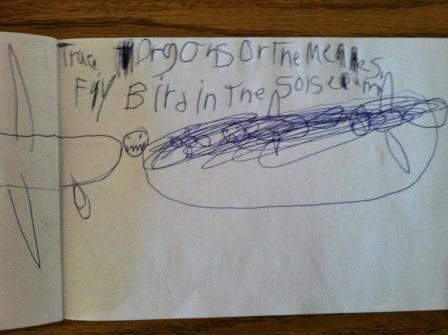
Dragons was the meanest flying bird. True or false?
First grade writing is fabulous. Our most recent nonfiction unit involved the series of True or False books. If you haven't seen these, they are worth checking out. You can see many of the ones my first graders wrote at our class blog. We created those in Pixie but some students wanted to continue writing them. This boy wrote one in class about dragons. The book is great but these two pages were my favorite. Somehow the addition of the solar system to the sentence just raises it to a higher level.
True or False Writing 2
True. Dragons are the meanest fly bird in the solar system.

We've also been working on some narrative writing. We've used a story mountain (beginning with an opening that typically introduces the characters and setting, followed by events climbing up the mountain about the complication, leading to a turning point at which things change, followed by the resolution heading back down a bit). The most challenging part for most of my first graders is the events leading up. They usually begin the story, explain the problem or complication, and then solve it.
One I conferenced with today had written something along the lines of, "We couldn't ever get to sleep." Then, on the next page, "We finally falled asleep." Complication. Resolution.
We've been using fiction for our narrative study, but yesterday I suggested that they might want to tell a personal story that fits with the story mountain. My goal was to allow them a venue for sharing some stories from spring break. I shared one from our spring break to get us started. Then they told stories with a partner before going off to write. 
This friend had a story about roller skating. Although there was a problem I didn't think the story was really building on it as he read it to me. Then we got to this page.
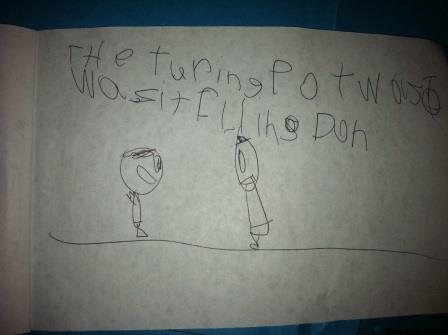
Turning Point Writing
The turning point was when I stopped falling down.
I couldn't say anything. This was the turning point in the story. Yup.

Cross-posted from jenorr.com.

Saturday, April 19, 2014

Productivity Tool

I'm far from the most organized person. One of my favorite things to do is to buy organizational containers and things. Sometimes I actually use them.
I have found two online tools that have made a huge difference for me. One of them now costs money (it didn't when I started using it) but has been so useful to me that it's worth it. It's teux-deux, an online to do list. Anything I don't do on a given day automatically gets bumped to the next day. I can put things on any day in the future, which means I don't forget something that I need to do in a few weeks. I can also put on recurring to dos, things that I need to do every week or every other week or once a month.
TeuxDeux

The other tool is called Chains. It is designed to help you do something that you don't really want to do. Each time you do it the event gets added to the chain. If you miss one the chain is broken and you have to start over. I use it for my evening routine (I often would rather just go to bed than brush my teeth or wash my face at night) and for working out. Things can be every day or at whatever interval you want. The downside, in my mind, is that I don't want to get too long of a chain because after it's broken it'll take too long to beat it!

Chains.cc

I have no idea if these would be helpful to others but they have been immensely useful to me.
Cross-posted from jenorr.com.
Friday, April 11, 2014

Totally Worth It

Since early February I've been arriving at school half an hour early three days each week to work with a few of my students. Our school has dedicated some funding toward extra before (or after) school remediation. I've never done it before because it isn't a lot of money and I couldn't see us (me and my daughters) managing to get to school half an hour early. Half an hour isn't much but it's big in the morning.
I did it this year because I have some students I thought would really benefit. It seemed worth a try. It should be noted that between school closings and delays for weather, both of which meant we didn't meet, and my conference travels, we've missed a lot of those days. Unfortunately.
Yesterday was our last day. It's the week before spring break so I was exhausted. I decided I needed some way to know if this time and energy had really helped. Over our mornings together we've worked on reading and math. In reading our focus has mostly, but not exclusively, been high frequency words. We have a list of one hundred high frequency words we want our first graders to be able to read and write by the end of the year.
As a team we assess these words every January. Yesterday I assess my kiddos again to see how many of these words they can read now. 
In January these four kiddos could read 49, 25, 64, and 31 words. Yesterday, those same kiddos read 72, 51, 91, and 87 words. Huge improvement. But I still wondered. I had one more kiddo I had invited to our morning times but who never came. I decided to assess her as well, as a control. In January she read 61 words. Today she read 70 words. I was convinced. Our mornings together were totally worth it.
Cross-posted from jenorr.com.

Update to What Am I Doing Wrong

I woke up this morning with my heart racing. I dreamed that I took a few of my first graders on an overnight field trip (something I can't imagine doing! more power to those of you who do). On that trip, two of my students died. Just before I woke up I was explaining to my principal what happened. Except I could only remember what happened to one of them. I was going crazy trying to remember what happened to the other. Even in my dream I remember thinking, "Someone will know what happened to him. I'm sure someone can explain this." I woke up and kept trying to remember what happened. (I'm not sure I ever actually knew. Ah, dreams.)
I mentioned this to a couple of my teammates this morning and they were quite concerned for me. Later, when they learned about my little one who had the allergic reaction yesterday, one of them said to me, "That's why you had that dream. You sent home field trip forms yesterday and a kid left in an ambulance. No wonder you dreamed that." Thank goodness for her! I felt so much better.
I don't typically think too much about my dreams. But something like this is hard to ignore or just sluff off. Whew.

Cross-posted from jenorr.com.

Thursday, April 10, 2014

What Am I Doing Wrong?

Back in the fall one of my little ones fell off the monkey bars and broke his arm at recess. It was highly traumatic because it was still pretty early in the year and this little guy was still learning English (still is, of course). In the midst of the pain and shock he refused to talk to his folks on the phone and refused to talk to the EMTs. The fabulous folks in the office got me in the hopes that I could calm him down. I don't know if I did but luckily dad showed up shortly after me and that helped a lot. Dad went with him in the ambulance. Way better than a random adult from school.
This wasn't the first time I've sent a kid away in an ambulance. Several years ago one of my little girls broke her arm at recess in quite a similar manner. Last year another darling girl had a serious asthma attack and had to go to the hospital.
Today I sent another child off in an ambulance. This was a new one for me though. Yesterday she pointed out to me that her lower lip was red. I thought it was chapped. In fact, another teacher gave her some balm for it. This morning she showed me again. We talked about how it can take a while to heal. She said, "Yeah. The last time this happened it took about ten days." Made sense to me.
After lunch, during math, she was working with one of the most amazing instructional assistants. I was busy with a small group of kiddos but when I got up this fabulous woman pointed at the girl's face. The red, chapped-looking bit was spreading up onto her cheeks. The IA thought it might be an allergic reaction. I agreed with her so she took the little sweetheart down to the clinic. 
To my understanding, by the time they got to the clinic or briefly thereafter, this little girl's lips and face were swelling up. We have a policy in place for this so an epi-pen was grabbed and administered. It sounds like her swelling and redness decreased significantly after that. I am exceptionally grateful to the woman in our office who administered the epi-pen. I can't imagine that was an easy task for many reasons. 
Again, when the EMTs arrive my little one was not exceptionally cooperative. This one didn't clam up but instead, according to another staff member, "gave them what for." She clearly did not want to be stabbed with something again and did not trust them.
Her older brother, high school age, arrived before the ambulance left and scooped her up and carried her out to it. He was fabulous from all accounts.
Four kids leaving school in an ambulance in four years. That seems an overly high number. 

Cross-posted from jenorr.com.