Saturday, November 26, 2011

Butter Making

Every year during the week of Thanksgiving the first grade team does special rotations. Teachers team up to do a specific activity and classes rotate through. This year we all felt too overwhelmed and too spread out around the school for it.

My rotation since moving to first grade has been making butter. I decided on Monday that I couldn't just skip it, I wanted to have my kids make butter. I invited one other teacher and her class to join us and it was wonderful.

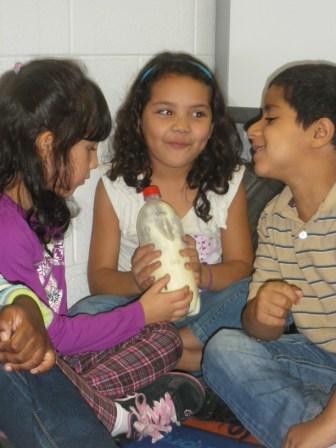
It was crowded with about 40 kids in the room but they were fascinated. We talked about where we get butter when we want it and how that is different from the past. Then I poured the heavy whipping cream into the bottle and asked about how it is different from butter. This led us to a discussion about cream being a liquid and butter being a solid (thus including a social studies standard of past/present and a science standard about states of matter in just a few minutes).

We passed the bottle around so that everyone got a chance to shake it. The whole group counted by 5s to 100 as each kid shook the bottle. Thereby including math in our lesson.

There is simply nothing better than the smiles on all these faces. We also worked together to write the instructions for making butter (writing instructions being a type of writing we do in first grade) and created a VoiceThread about our experience.

The kids all said, "Ewwww" when they saw the butter but loved it when they tasted it. They even said, "Ewww" after tasting it when they saw it. They never cease to amaze and amuse me.

Friday, November 25, 2011

Thanksgiving Fun

We've tried to cram a bunch of Thanksgiving fun into the day and a half before the holiday. This in addition to attempting to continue some of our normal routines. (I may be completely insane or an idiot.)

On Tuesday we colored coffee filters for our turkeys. We colored them with markers, folded them up, dipped them in water, and let them dry. Then on Wednesday we used them to make fun turkeys.

We also made fall trees. (I couldn't come up with a way to make this work with turkeys no matter how hard I tried.) Each branch of the tree had ten leaves or none at all. Then some leaves could be added to the ground. Once the trees were dry we counted our groups of tens and ones to determine how many leaves we had. It wasn't perfect, but given that it was a new idea it was a good start. I'll improve on it next year I hope.

Thursday, November 24, 2011

Things We Are Thankful For


Many of my students come from another country and their family traditions are tied to that culture. Their understanding of Thanksgiving comes from the media and school. I decided we needed to take at least a bit of time today to focus on the 'thanks' part of Thanksgiving. I modeled my plans, as you can see in the first picture in this movie. The kids created their own with no guidance. I was thrilled with the results.

Next year I'll try to start a little sooner. Somehow the whole idea of thankfulness gets a bit lost when the teacher keeps yelling at kids to hurry up and follow the directions for saving the picture.

Wednesday, November 23, 2011

Thanks From Around Our School

In spite of my issues with the historical accuracy of Thanksgiving as it is typically taught in schools, it may be one of my favorite times at school. I love seeing all the displays about the things students are thankful for. Not seeing "I am thankful for my XBox" or some such makes me smile. It's possible teachers didn't allow that, but knowing our students I'm betting these examples are all genuine. These happen to be from kindergarten classrooms that I pass on my way anywhere.


Tuesday, November 22, 2011

"Jamie"

I asked to have this kid in my class this year because I've known his 3rd grade brother since he was in kindergarten and this one almost as long. How could anyone not love that smile?

I've held off writing about him because I know him so well I struggled to find a good name for him. After lots of thinking and reviewing favorite books I settled on Jamie from The Mixed-Up Files of Mrs. Basil E. Frankweiler. Jamie is an awesome little guy in the book, totally on top of things and capable far beyond his age. Quite like my little friend here.

He's one of those kids that will take care of anything. If I ask him to remind me of something, make sure he brings something back to school the next day, or help someone out he will take care of it, guaranteed. Tell him something once and it is set. I know he can keep us going with our routines or make sure things are back where they belong.

Plus, he's a blast to have around. He loves to tell jokes, reads great books, and gets excited about learning, books, and friends. He doesn't like to mess up and takes it seriously when he does something wrong. It happens rarely, fortunately. I'm so glad to get to see him each day.

Use of Our Interactive White Board

I have an interactive white board in my classroom. Sometimes I do a better job of using it than others. I would not describe the current time as a great one. However, we've done a couple of things lately that I like.

I write our morning message on our interactive white board every day. For one thing, it saves a lot of paper (at least in some ways). The kids sign in on it every morning, answering a simple question. One students, our meeting manager, leads the kids in reading the message and then calls students up to circle something (word, letter, upper case letter, hanging letter [like y or g]). Every two weeks I print out our morning messages and send them home with kids to read and share with their parents. We also keep a copy in our classroom library for them to read. The morning messages are something we've read together and most of the kids can read independently.

The other thing we've been doing lately is using Animationish. We've used it to animate high frequency words as a fun way to practice writing them. The idea of change is important in our study of past, present, and future. Yesterday we talked about pictures of a tree near our playground. I took one picture at the start of the year and one last week so that we could talk about how it has changed. We brainstormed other things that change and then we animated a couple of changes. I did the one of the tree as a model. The kids worked together to do the one of the frog. It starts as an egg, then becomes a tadpole, then grows legs, and then becomes a frog.


Monday, November 21, 2011

Why We Learn

My 3rd grade daughter was working on her homework tonight. I have to admit that before this year we have not been good about making sure her homework got done. This year we're trying to be better about assisting with this.

She did not get her word study homework done last week (her teacher requires three word study assignments each week from a list of many options). She was working on this tonight while I did dishes. She was illustrating her words and was stuck on one. She asked me for help and I had trouble understanding the word. I told her to spell it for me. She looked down at her paper and I said, "No, YOU spell it for me." She said, "But I already took this test!"

I couldn't decide whether to laugh or cry. How is it that in third grade she is learning something solely for the test? What happened to the joy in learning for the sake of learning? I know she still does plenty of that, at least outside of school. Is it simply (as my husband suggested) that she doesn't understand why learning these words might be important or useful?

Once I finished the dishes we got started on her fractions homework. She had to take mixed numbers and make them improper fractions. For the first few we drew a picture and she could figure it out. That became a bit cumbersome by about the third mixed number because the numbers got too big. She wanted to just use the strategy she learned at school: multiply the whole number by the denominator and add the numerator. I wanted her to be able to figure these out because she understood what she was doing, not because she had memorized an algorithm.

I pushed on this and, I think, by the end she did understand what she was doing and, therefore, how to do it. But, again, I was astounded by how little interest she had in understanding what she was doing. She was working these out to jump through the hoop of homework. She wants to please her teacher, who is an amazingly wonderful, fabulous teacher. That's not a bad thing but I want her to want to understand.

We'll keep doing all the things we do outside of school to learn and grow but I want those things to work hand in hand with school. In previous years I felt like that was happening.

When I taught fourth graders I was often pained to hear the question, "Is this for a grade?" When I moved from the upper grades down to first grade I was thrilled to never hear that question. First graders love learning and doing new things. I wondered where it was that we managed to beat that out of kids. For my daughter at least it appears to be by third grade.

I don't blame her teachers. She has had fantastic teachers. I think this is a much bigger societal issue and goes far beyond our school. The conversations with my daughter tonight simply pushed me down this path.

"Fern"

Fern is such a sweetheart. She's quiet and thoughtful. I know I can rely on her to help someone else and to do so quite happily.

Thinking about her makes me think that Fern in Charlotte's Web doesn't get enough credit. Nothing else in that book can happen without her. I can see that in this little one's future. She will make big things happen.

Fern works hard and not everything comes easily to her. Watching her struggle and then succeed is pretty awesome. I think her chances for success in the future are actually better because of this. A child who has to struggle on occasion is more likely to be able and willing to do so in the future. I don't think she'll give up when the going gets tough. I hope she stays at our school so I can see what her (near) future holds.

Sunday, November 20, 2011

Updates on Some Darlings

I always enjoy parent-teacher conferences (at least most of them) but one this year really made my day. Nate's mom came in and I thought she looked close to tears. In fact, she looked that way for most of the conference. I came to realize it stemmed from her fear that I was going to tell her how little progress Nate was making. That had been true in kindergarten (at least at first). Instead, I had nothing but wonderful things to say about this boy. Then she seemed close to tears of joy.

Nate's mom doesn't speak much English but I think she understood everything I said. We did have a translator though. She shared that Nate keeps telling her that she lives in America and she needs to learn to speak English. He has even gone so far as to put labels on things around the house in English to help her learn (including a 'moon' label on a window with an arrow). He calls her and reminds her of meetings (like our parent-teacher conference). She babysits a little girl overnight and Nate sends her videos about the books he's reading at home while she's gone. I love this boy.

Another little one, this time one who tends to drive me a bit nutty, is reminding me to keep an open mind. After we wrote our Knuffle Bunny book as a class she came in one morning having written Knuffle Bunny Nine: A Halloween Special. It started with "Not so long ago" and in the middle she included "Trixie realized something" - both phrases Mo Willems uses. It was brilliantly beautiful and completely independent.

She's also one of the few kids who can already really think and talk about what she is doing during our language arts block to help herself become a better reader and writer. And still I have to remind myself of these powerful examples of her learning and brilliance when she's driving me crazy. I've got to work on that open mind

Saturday, November 19, 2011

Internet Safety, Or Not

Our wonderful tech guy has been spending a lot of time teaching internet safety and introductions to the internet in every classroom in our school. A really great classroom teacher would have talked with him ahead of time to be ready to support and be a part of the lesson. I'm not that teacher. I signed up for my time and just looked forward to half an hour during which someone else would be teaching in my classroom.

I adore our tech guy and think he is a fabulous part of our staff. He has set up structures and supported all of us in endeavors that have changed the world for our students. Plus, he's a friend and I enjoy chatting with him. I say all this because it makes what happened during, or really before, this lesson that much worse.

He came in with his laptop, opened it up and set it on my keyboard. As the kids were getting settled I noticed it was open to Cog Dog Blog. Without thinking I said, "Hey, I had dinner with Cog Dog last weekend." (My husband and I had to be in Fredericksburg on a Saturday evening so we crashed a gathering at the Bava household where Alan, aka Cog Dog, was staying at the time.)

Our tech guy went on to teach a wonderful lesson which included the big idea that one should never meet an internet friend in real life. Oops. I just hope the kids weren't paying attention to our discussion at the start.

Too make the lesson go south in another way, our tech guy made a Venn diagram of online and real life friends. He used me as the example of a real life friend and said that he knows where I live but not where Cog Dog lives. He said that he has been to my house. A students piped up, "I've been to her house too." The other kids immediately jumped in to argue that it couldn't possibly be true. Fortunately our tech guy pulled them back in before I had to say that yes, he has been to my house because his big brother and my daughter are good friends.

Friday, November 18, 2011

"Anna"

Sweet is the word that comes to mind with this little girl. I can't imagine her being mean in any way.

The name Anna comes from Sarah, Plain and Tall by Patricia MacLachlan. Anna is the narrator and daughter in the story.

Both girls are quietly strong. They are good to the others around them, helpful, kind, and thoughtful.

Anna doesn't smile all the time but she does so frequently, and it is a wonderful smile. It's genuine and her eyes light up.

She's a hard worker, willing to put in serious effort in just about everything. Watching her write a book or play a math game is a delight. Anna is there, actually in the moment with whatever she is doing. Wonderful.

Thursday, November 17, 2011

Thank You Little Prince

A brilliant, thoughtful, wise colleague of mine has often said that one of the roles of a first grade teacher is to tame the children. The vision in my head of taming is one that makes me somewhat uncomfortable when I think of children. So I've turned to the definition of tame from The Little Prince: "It means to establish ties." - from chapter 21. That makes perfect sense to me as a teacher.

I've got a little friend this year who is making me question this. He was born in the U.S. and lived here until just over a year ago, just before he turned six. For reasons I don't fully understand he (and his brothers) were sent to eastern Africa to live with their grandparents. Their mother relocated to our area and my little one returned to the U.S. Technically, by age, he should be in second grade but he just barely makes the cutoff and he is now in first grade (a more appropriate place for him). This is his first experience with school. He's been in day care before but never in school.

Academically he's actually doing pretty well. He's not yet at grade level in reading and writing but he is making quick progress in both. In math he's really capable. Honestly I'm quite impressed by him academically.

The taming issue comes in because he does not know how (or is unable) to behave the way one is expected to do in school. I don't think I'm overly strict about this but I do expect that he have some control of his body and his voice. I do feel as though I am trying to tame this child.

The struggle I'm facing is how to 'tame' this child without squelching him. He's got so much potential and I don't want to turn him into a compliant dullard (not that I think that's actually possible). Am I worrying over nothing? Am I right to be concerned? If so, how do I help this student without losing my mind?

A Surprising Moment


These two boys are as different as one can imagine. On this day, during our math workshop, they were working together to fill in one of our big 100 charts and finished it pretty quickly. When kids finish their work stations during math workshop they can go to our math library (just a tub full of math related books) to find something to read. These two boys picked a book together and sat down together. I would never have expected it. It was absolutely wonderful.

Wednesday, November 16, 2011

"Ramona"

The look on this little one's face is so perfect. This picture was taken on the second day of school. I had no idea then that it so perfectly captured her personality. She's a great kid.

Ramona loves her friends and being at school. Her attention span and stamina don't last that long, but she's excited to get started on everything.

At only six it's hard to say what her future holds but I fully expect her to be a bit of a prankster. She just has that twinkle in her eye all the time. Not dangerous or cruel pranks, but fun. She's the kind of kid all of the other kids like.

Ramona has actually been absent quite a bit and I'm sad each day she doesn't show up, eager to be with the other kids and excited to start learning.

Sunday, November 13, 2011

Animated Words


Practicing writing high frequency words is an important job in first grade. It also tends to be a pretty boring job. We write them in rainbows using colored pencils, using doodle pros, with dry erase markers on plastic display stands and with light on a glow station.

That's great for a few weeks but it gets dull pretty quick. So, to mix things up and keep them interesting we've added animating words. Using FableVision's Animationish kids take turns during language arts workshop animating the words we are studying that week. It requires writing the word at least two times, most write it three times. Then they watch the animation as well.

I love playing around in Animationish and I know we'll be using it in a lot of other ways throughout the year.

It's Not All About the Tools, but Tools Can Be Fun

Teachinghistory.org has a wide range of resources for teachers (mostly history teachers, of course but some of these resources are handy across curricular areas).

One piece includes reviews of websites and technology tools. I try not to get caught up in the tools, but I find it handy to have reviews of them to help me determine what would work best for a specific lesson or need. I can't try out every tool and really explore it the way I would like, so this is a pretty nice substitute. In that vein, I recently wrote a review of Primary Wall for this section of teachinghistory.org. It's basically an online wall on which folks can stick post-it notes. My first graders enjoy using it.

Tuesday, November 08, 2011

"Laura"

This little darling arrived in the U.S. at the age of 3 1/2. She started kindergarten at our school last year and it was the first time she'd really been away from her mom. I'm sure that was hard for both of them.

She was very quiet last year as she was learning English. She's still a pretty quiet child. But she participates and engages in conversations.

Laura listens to everything around her. She doesn't miss a thing. She's like a sponge, just soaking everything in.

She's very responsible and mature. I know that she will take care of anything I ask: remembering to deal with something at a certain time, taking something home and returning it signed, helping another student with a task, etc. She does not seem six most of the time.

I did not know Laura last year but have had many conversations with her kindergarten teacher. I feel like I am getting the opportunity to watch a flower slowly blossom. Laura opens more each day. It is an amazing process to see.

It has been years since I read any of the Little House on the Prarie books so I do not feel truly confident in this name choice. It is based more on my memory and perception of Laura in the books than it likely is on reality.

Teaching Heroes on teachinghistory.org

If you teach early elementary grades you probably teach specific famous individuals in your social studies curriculum. Often those people are treated as heroes, or superhuman in some way. It can be a challenge to teach young children about famous people in a meaningful way.

I wrote about these challenges and ways to address them in my latest teachinghistory.org post.

Friday, November 04, 2011

Stress Tests

My oldest daughter has hit that critical grade, 3rd. This is the year she is required to begin taking standardized tests. That will start next week with our district's practice standardized tests.

As I may have mentioned in the past, this darling daughter struggles with anxiety. She does not, however, struggle with academics. I really thought we had convinced her not to be concerned about these tests, but it seems I was wrong.

Tonight, in a flash of exhaustion and frustration unrelated to school, she said, "It's just my life is so hard."

I managed not to laugh and pulled her close to me and asked what was making things feel so hard. The first thing out of her mouth was about these practice tests next week. Ugh. Really? Sheesh.

My response to this was to tell her that she doesn't have to take these tests. If they are causing her stress and anxiety then I will write a letter saying that we refuse to have her participate. We did talk a bit about what these tests are, why they take them, and what to expect. (I don't really believe in all of the things I said, sadly, but I don't need to add that burden too.) My great hope here is that she will actually take these tests, but without any stress or anxiety, and finds that they are nothing to worry about. That said, if she is still worried and upset about them I will refuse to let her participate.

"Max"

Meet Max, from Where the Wild Things Are. He's a natural leader (including leading many of the wild things in our classroom) who is not afraid of anything. Fortunately, he tends to lead in mostly positive ways.

Max walks in every morning full of energy, excited about the day. I can always rely on him to be focused on the task at hand (as long as I keep it interesting) and help others do the same.

That said, he is still six (turning seven this month). He loves to play with the Matchbox-like cars or Legos whenever he gets the chance. I often have to ask him to be a bit quieter as his exuberance carries him away. At recess he never stops moving, but is often the first to help out a friend who is hurt or upset.

Picturing him in ten or twenty years is an exciting venture. He's got serious possibilities ahead of him.

Wednesday, November 02, 2011

Knuffle Bunny Fore! A High Flying Adventure


We did it! We finally finished writing, illustrating, and reading our Knuffle Bunny book! Not surprisingly the pigeon even managed to sneak onto at least one page in here.

Tuesday, November 01, 2011

"Dennis"

I'm not sure this name is a perfect fit, but Dennis the Menace comes to mind with this little guy. He can't sit still to save his life, he drives some adults crazy, and he is always smiling.

The look you see here is pretty constant, no matter what is going on. When he gets in trouble (see above issues with body control) he is never upset. He'll go off to take a short break or go sit somewhere away from certain friends or whatever the consequence is without any complaint, sulking, or the slightest sign of frustration. I find it really fascinating.

He is engaged in everything. Sometimes that means he is an excited, active participant in our class discussions or in small group explorations and sometimes that means he is an excited, active participant in side conversations or small group distractions. He is in the midst of it all.

There are a few adults who work with him in small groups regularly (reading groups and a special pull-out support) and he tends to drive them a little batty, the way Dennis does Mr. Wilson. However, in spite of that it is clear these women adore this guy.

I, somehow, don't work with him in a small group on any sort of regularly scheduled basis. So I can simply adore him. He makes me smile. Sometimes I have to try to hide that smile in order to not reinforce questionable behaviors, but he makes me smile.

I'm more than halfway through writing about the students in my class and this is taking a lot longer than I had anticipated. However, it has been and is a wonderful exercise for me in thinking about the positives of all my darling kiddos.

Lucky Happenstance

I've become a bit addicted to Groupon, Living Social, and such things. Occasionally I purchase one because it seems like such a great idea and later realize that I really have no idea what to do with it. (In my defense, I do often purchase them with specific, fabulous plans in mind.)

One recent purchase was for five posters. I don't recall what brilliant idea I had in mind when I hit Buy! but I found a great use for them.

My class happened to creat five rules this year through our hopes and dreams for first grade. They are written on a poster in our classroom which we have all signed. But it's not a great reminder for first graders.

So I took each rule and created a poster with pictures of students illustrating that rule. I'm hoping the visual reminders all around our room will keep us focused on what we think is important this year.

By the way, the order of the rules here is the order in which they created them. I love that "Have fun" was their number one rule.

Sunday, October 30, 2011

Serious about Mo Willems


My students are obsessed with Mo Willems and his books, most especially Piggie and Elephant, the Pigeon, and everyone in the Knuffle Bunny books. In fact, my students love the Knuffle Bunny books so much that they have written, as a class, a new one. I will be sharing it in the next day or so when we can record it.

Thanks to our amazing librarian, I have a number of pictures from Mo Willems' books. When the books have been so loved that they are falling apart, she removes them from the library and replaces them with new copies. She has given some to me to cut up. I am using them around my room as encouragement to my students.

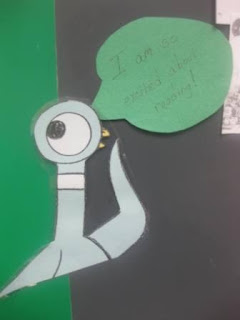
Their response has been, not surprisingly, positive. My favorite reaction, however, was to the pigeon. As they always look for him in any other book by Willems they were thrilled to find him in our classroom. Many said something along the lines of, "That sneaky Pigeon snuck into our classroom!"

Now the question will be whether or not I can manage to update what these little friends are saying regularly. I think they will lose their power if I don't change their speech bubbles pretty often.

Friday, October 28, 2011

Losing...time, my mind, who knows what else

I am not the teacher I want to be, or genuinely believe I can be, right now. I have had either meetings or duty four mornings this week. That means that from the time my contract day begins until lunch three and a half hours later I am either in a meeting or with my first graders. Lunch translates to about fifteen minutes of time for myself most days (once I get the kids mostly through the line and do any other essentials like copying or handling an issue with another teacher or administrator). Of the four days that my students have specials (P.E., music, art) I have had meetings during two of those times and missed that time completely today because P.E. was canceled for upper grade field day.

I don't mean to sound whiny, although I know I do. I just realized this afternoon that one result of this is that I do not give as much to my students as I should. I don't pull small groups or meet individually or check in with them as they work the way I should. I spend some time holding back and just surveying the room rather than digging in. I just don't have the energy to do it.

Something has to give and right now my students are the ones losing out. That's not right and I have to figure out how to fix it.

"Alice"

I'm never sure what will happen next with this little one, hence the name Alice. Alice in Wonderland is a sweet girl who stumbles through craziness. I think my little Alice may encourage, albeit unconsciously, some of that craziness.

She's very social and genuinely likes everyone. After an assembly today the performers were walking through the crowd slapping high fives. Alice managed to connect with every single performer. She was in the midst of things the entire time, at least until I dragged my class out of there.

In some ways this little one seems much older than six. Her eyes often have a wisdom that is at odds with her little-kid grin. She's one I am enjoying getting to know better and better everyday.

Thursday, October 27, 2011

Highs and Lows of Reading

My wonderful co-teacher and I were working on progress reports today. As a clear sign of my exhaustion or lack of brain power or etc. I had to ask her a couple of times if she had a kid in a reading group or if I did. Typically she did but there was at least one time I had the child. As soon as she said it I realized and could handle my role in the conversation.

We got to one (of my favorite) kid(s) and I was sure she must have him in a reading group because there is no way I would forget meeting with him. She said no. I looked skeptically at her. She repeated her refusal. I looked questioningly. She pulled out the list of our reading groups.

He was in one of my groups. I have never once met with this student.

I have a student who has never met in a reading group, not once in the month we've been meeting with the kiddos. He has not mentioned to us that he has never been called for a meeting. We have never realized he wasn't getting that instruction time. #majorfail

On the silver lining side of this saga, he is reading above where we expect him to be. I have to admit I would feel a lot worse if he were struggling more as a reader. But still...

Then tonight my daughters gave me a new story to tell (thank goodness). I lost all patience with them - that's not the good part - and told them we would not be reading any Harry Potter tonight. That worked out well when the 3rd grader realized she had some serious word study homework to do. The four-year-old kept bugging her until I sent her off to find a book to look at.

She brought over Dora's Sleepover. It has pictures within some sentences to help an early reader. But I would not describe her as an early reader yet. She started reading it and pointed at words for me to tell her. I gave her the first couple and then there was a picture. Then she kept going on her own for a couple of words. She was getting her mouth ready beautifully at each word and if she thought of a word that made sense that started that way she would say it. This got her pretty darn far. She needed help with about every third or fourth word, on average. But she was reading quite a bit on her own and feeling really, really good about it.

I'm grateful to end the day on a high note.

Wednesday, October 26, 2011

"Froggy"

The smile you see here never stops. Between those curls and that smile this child makes my day regularly. In fact, yesterday he totally pulled me out of a funk. One of our assistant principals came in just to hang out with our class for a bit and he walked up to her as soon as she entered the room and asked her, "Are you a spy?"

I have no idea what prompted the question but it was awesome. This AP is lovely but I think she was a bit thrown by the question. She loved it too but seemed unsure how to answer.

My students love the Froggy books. Froggy is excited about everything, often over zealous in his excitement, and often unaware of the challenges and problems he may be causing. That's this friend. And, just like Froggy, it is wonderfully fun for him and everyone around him.

He can be sensitive and feel awful when things don't work or he makes a mistake. I have to watch myself about that. I need to be gentle when working with him in areas that are challenging for him.

My hope for this year with Froggy is to encourage his excitement and not stomp it down in my carelessness.

Tuesday, October 25, 2011

Meaningful Results are Worth Our Time and Energy

Our school is in the midst of a transition. We're moving to more structured, rigid PLCs (professional learning communities). It's causing some tension and stress.

After lots of discussion with others and some serious reflection of my own I've identified my biggest concern. Everything about the way a traditional PLC is designed, in many ways, is focused on test results. The wording is about results in a vague way but those results boil down to standardized tests of some sort.

I tweeted my frustration about this yesterday and have continued to think a lot about it. Interestingly enough I just skyped in with a school in Florida to share my thinking about what matters. Andrea invited me to give the Encienda I gave at Educon last year to the staff at her school. They are planning to use this format for future staff meetings.

If you're a fan of Chris Lehmann you'll find the main gist here really familiar. This recording happened before I really got my brain wrapped around my personal frustrations with PLCs and the focus of educational reform in general and as it very specifically pertains to me. Looking at the video now I am pleased with my beliefs.

I care about results. But that doesn't translate to standardized test scores. Results in the lives of children are so much bigger than that.

Jump to 1:50 to watch the actual Encienda talk. The first bit is me chatting with Andrea and others at her school.

Monday, October 24, 2011

"Madeline"

Madeline may be the smallest child in our class. But her personality and smile far outstretch her size. She comes in every morning with a great grin and gets excited about anything we do.

Other kids love to follow her because she is full of good ideas. Watching her on the playground is a joy. She brings a lot of that into the classroom as well. During discussions or while at work stations her enthusiasm, excitement, and energy spread pretty quickly to those around her.

She may be pint-sized but she fills our classroom.

Friday, October 21, 2011

"David"

I chose the name David for this little friend because of his love for David Shannon's David books. Plus, he is a lot like David. He is wonderful kid who is always getting himself into trouble. He's never malicious but he can't sit still, talks all the time, and has trouble following directions. In short, he's a six-year-old boy.

I had David's older brother in my class a couple of years ago. These two boys couldn't be more different. The older one is a total rule-follower. He would get so upset when other students weren't doing what they should be doing. It's hard for me to remember that these boys are brothers.

I'm thrilled to have this little guy in my class. I got to know him a bit in kindergarten and was hoping to have him this year. He has a wonderful smile and we get to see it a lot. When he figures something out for the first time, it is exciting beyond words. He wants to share it with me, with other teachers, with anyone who will listen. It's great during our share time!

By the end of the day David usually has me worn out, but all he has to do is smile on his way out the door and I'm on my way again.

Thursday, October 20, 2011

Cult of Personality

One of my favorite people to follow on twitter, Jason Buell, had a series of tweets lately that got me thinking.

Read from the bottom up.

I've had subs twice this week (jury duty on Monday and out for a meeting for a couple of hours today) and it has not gone the way I would have liked.

I've come to the realization that I have a similar problem to Jason. My students are pretty fabulous with me. They mostly work hard, get along, and do what they should. I give them a lot of independence and choice and it works. But when I'm not there, it falls apart.

I'm clearly missing something in the development of our classroom community. I want them to be the way they are with me because it helps them learn and because they are thinking about treating each other well. I'm not sure what I'm doing wrong but it's something I'll be thinking about a lot.

Friday, October 14, 2011

"Corduroy"

This little guy seemed so shy at Open House the week before school began. He practically hid behind his mom and sister. Mom said that he wouldn't be so timid when school started. She was mostly right.

I would not describe him as shy. He loves to be with the other kids, talking, playing, running around. But he's still seems a bit shy when it comes to academics and school conversations.

I picked Corduroy for his name because friends are so important to him and because he often seems to be living in his own little world. It's not rude behavior in any way. It strikes me as being like the behavior I often saw in gifted students in the upper grades. He's in his own head and quite engaged there. He seems totally unaware of all that is going on around him.

My job is to figure out how to make our classroom as engaging for him as whatever he's got in his mind. I think he'll have a lot to offer our discussions once I can manage that.

Tuesday, October 11, 2011

"Nate"

Teachers shouldn't have favorites. I deal with that issue by having my favorite munchkin change every day. Lately, this little guy has been topping that list quite frequently though.

Last week he was telling me a story (I don't remember the gist of it). It started with, "My family is from Spanish..." At the end, I asked about this. He repeated that they are from Spanish. I pushed a bit more, asking what country they are from. "Spanish," he said again, with a hint of annoyance and sense that I might not be that smart. So I dropped it.*

His smile is almost constant and he has questions and interest in everything. Nate is unfailingly polite, kind, and generous to everyone.

He's been struggling a bit in his reading group (they're reading far beyond where we expect first graders to be at the moment) so my wonderful co-teacher mentioned this to me. I immediately said that he should join my guided reading group because it will be a better fit for him**. I think it will be but I have to admit that I mostly said it because it will be such fun to meet with him everyday.

Our astoundingly brilliant librarian noted to me the other day that Nate wears skinny jeans everyday. She was wondering where one might find skinny jeans for a six-year-old boy. I have no idea but she's totally right. I hadn't even noticed it. I'm too busy look at this kid's smile and sparkling eyes.

*His family is from Argentina. I learned that from his kindergarten teacher because he will either say Spanish or that he can't remember.

**Nate comes from both the Nate the Great books by Marjorie Weinman Sharmat and the comic strip Big Nate.

Monday, October 10, 2011

Who is Being Cheated?

I did a short race Sunday morning (300 meter swim, 3.7 mile bike, 1.2 mile run). It was a wonderful race, just a small group of people and pretty nice weather. It was held at my alma mater, a college I love. However, the area is hillier than I had noticed as a student - biking and running will make that pretty clear. As I hit about the halfway mark on the run, knowing that ahead of me I had a pretty steep hill that I had already biked, it occurred to me that I could cut through a part of campus and shorten things. Basically, cheat. It occurred to me, but I had no interest in doing it. I do these races for myself, for the exercise and for the accomplishment. Cheating in a race would only cheat myself.

I thought about that as I rounded the corner and headed up that ridiculous hill for the second time that morning. As a student there, cheating had occurred to me at various points but was always rejected. Back then I rejected cheating because I didn't want to get in trouble and because I felt very strongly about the honor code. Never because it felt like cheating would be cheating myself.

I haven't really figured out what this means. My sense is that somehow learning and the assessment that goes along with it needs to be so meaningful to students that cheating would be cheating themselves. When the only reason not to cheat is fear of getting caught there will be many who cheat.

When the focus is on grades rather than learning, cheating seems like an intriguing option. When students are working for someone else rather than for their own interests and by their own motivation the urge to cheat can be strong. We spend a lot of time thinking of ways to keep students from cheating and not enough time looking at why they cheat.

Thursday, October 06, 2011

Math Exchanges by Kassia Omohundro Wedekind

It has been such fun to talk with Kassia Omohundro Wedekind about, and to read, her new book, Math Exchanges, over the past month or so. The book has clearly been a labor of love and I have such respect for teachers in the classroom who manage to write books. Math workshop is something that has interested me for some time but I have never really been able to wrap my head around. Thanks to Kassia I think this year will be quite different. My students and I are beginning a wonderful exploration of math through math exchanges.

So, here is a brief interview with Kassia to wrap up her blog tour.

You write quite a bit about the importance of the mathematical foundation students are getting in the early grades. Do you have any thoughts on common misconceptions or common areas of weakness in our instruction that need to be addressed?

As a math coach, one of the most interesting parts of my job was the wide perspective I got as a result of working with many more students than I saw in a single class. I really got the chance to delve into why kids were struggling. And the most interesting realization that came out of this unraveling of understandings and misunderstandings was, that in almost all cases, when I really analyzed what students understood, partially understood, and did not understand at all, most of their misconceptions were very similar to each other. The good news of what I learned though is that I think that we can fix, or rather prevent, these misconceptions from occurring—which is really a lot easier to do than trying to fix them after the fact.

One common misconception that I talk a lot about in my book is the long and complicated journey to the understanding of place value. (See Chapter 7: Building Number Sense through an Understanding of Ten) I think we’re not giving kids enough time and opportunities to truly construct an understanding of place value. In some senses we talk a lot about place value—we talk about the tens place and the ones place, we build numbers with base ten blocks, we make groups and regroup). And yet, the time we give to really consider why we group, why ten is so important in our number system and really think about how numbers are composed and decomposed is really very limited.

So, here’s where the good news comes in. I think there are some very simple ways we can prevent misconceptions and build stronger place value. I think we can change some of the tools we use and the kinds of problems we give to students. In the research I did for this book, these small changes had a significant impact on children’s understanding of the number system and their construction of place value concepts.

It is clear throughout your book that you work in a wonderful, supportive, collaborative atmosphere. Do you have any advice for teachers attempting to begin a math workshop on their own, without such support in their building?

That’s a great question. Math workshop is a much newer, less well-established practice than reading and writing workshop. Here are a couple of ideas:

1) Find at least one other person who is interested in teaching math through a workshop model. It’s so important to have a partner (even if it’s someone at another school you’re emailing with) to discuss what is working and what is not.

2) Think about what you value in reading and writing workshop. How can you translate that to a math workshop? Play on your strengths. If you know how to get rich conversation going in your reading workshop, think about how you could establish this in math workshop.

3) Start small. Start simply. Math workshop does not have to be complex or a complete change from what you are already doing. Perhaps you’re just adding one small group math exchange to your structure during the time your kids are playing a game or working on a problem you've taught them from your current math program. Perhaps you’re adding a short counting routine at the beginning of your math time. Use the resources you already have and then add new components.

Creating an environment in which children can and will talk about their thinking, in mathematics and other areas, is an important piece of math workshop. Can you share what you think are the most important things for a teacher to remember in working towards this goal?

Whenever you can make math meaningful and relevant to your community of learners, you’re going to change how your students think about what math is. You help students make a shift from thinking that math is something that is static, to something that is very much alive and evolving. That’s powerful! So, when my class worked on problems about how many potatoes we could grow in a raised bed at our school, how much cat food my mom needs to buy for her six cats, or how many more stops we’d go on the metro to get into Washington, D.C., these problems mattered. It mattered if the answer was six or sixty. They were acting as real mathematicians solving real problems.

No matter what structure you use for your math instruction, you can include these kinds of problems. Here’s one way I have found to be powerful: Have students work in pairs and solve problems on chart paper. Have them use markers to write (for ease in seeing what they wrote and also because then you can see all the steps they took with no erasing.) Talk about the strategies. Compare them. Talk about the strategies and the math. Also talk about how they worked with their partner. How did they negotiate the solving of the problem? What did their partner teach them? What happened when they disagreed?

Just as in reading and writing, a critical shift occurs when students take ownership over their mathematical lives.

Establishing routines in the primary grades is a huge piece of the start of the year. What sort of a timeline did you have for getting math workshop started? What did you introduce first? How did you add pieces? How long did it take to get the full workshop up and rolling?

It is always tempting to move too fast at the beginning of the year! Every year I have to remind myself to slow down and really make sure routines and structures are strong before taking the next step forward. In September I focus on three aspects of the workshop: 1) the warm-up routines, 2) the independent practice part of the workshop, and 3) the reflection at the end of the workshop.

Our warm up routines (counting around the circle, dot cards, math read aloud) are a short, but powerful number-sense focused part of our math workshop. (See Jessica Shumway’s new book, Number Sense Routines, which is all about this topic). In September we focus on a different routine each week and we really delve into the expectations for the routine.

I also focus on making sure the structure of the independent practice is in place (be it centers or partner tasks). I teach them how to take care of materials, how to talk to their partners when playing a game, how to switch centers, etc. I want to make sure that there is meaningful talk and play going on during the independent practice portion of the workshop. Only then can I feel comfortable removing myself from this part of the workshop and working with small groups.

I also focus on the reflection at the end of the workshop because this is a place where we share our strategies, discoveries, investigations. I teach children how to talk to each other, agree and disagree respectfully with one another, add on to each other’s thoughts and connect to each other’s ideas. We learn how to look out to the group when we’re talking and not just at the teacher. I teach them to value this part of the workshop as a place where we learn from one another, and not just from me, the teacher.

In mid to late October I start thinking about how I want to work with small groups. I start by working with just one group per day. I get my kids up and going in the independent practice, work with one group, and then return to check in on the independent practice. When this is going well, I’ll start working with two groups per day.

Think about what you most value in your workshop. Take the time to teach the expectations for this. It’s ok to go slow (I’m writing this to remind myself too! This is hard to do!). Start simple. Take on one part of the workshop at a time, if that works for you.

Leave a question for Kassia or for me or just leave a comment and one lucky person will receive a copy of Math Exchanges from Stenhouse. (If you already own Math Exchanges you can choose another title from Stenhouse.)

Monday, October 03, 2011

"Riley"

This little friend takes his name, Riley, from the character in the Boondocks comic strip. It may not be obvious from this picture, but he's striking a thug pose. He has all the signature moves of a thug. Until, of course, it's recess and he runs around like any other six-year-old boy.

That may be my favorite thing about this kid. For whatever reason, he has taken on the persona of a thug. But he doesn't let that interfere with his fun.

He and I had a bit of a stand-off this morning. During our morning meeting we were doing a lightening share (everybody shares quickly and briefly) and he chose to pass, as did many others. When I got back to him, because I go back so that everyone does share eventually, he still didn't know what he wanted to say. We spent more than five full minutes waiting for him. He did finally share something, thankfully. That's a really long time to expect the rest of the class to just sit and wait! He seemed to be trying to figure out how long I'd hold out.

I want to figure out where this thug stance comes from. I don't mind it but I wish I understood it better. At the moment it feels like a glove he's trying on, checking to see if it's a good fit.

He's very quiet, rarely talking with the class if he doesn't have to. During free choice, recess, or lunch however he's the star. The kids gather around him and follow his lead. He's practically overflowing with leadership potential.

He participates in all our activities, literacy and math work stations, singing songs, reading together. But he does so, typically, in a somewhat isolated manner. My goal is to pull him in and, ideally, right in front. I want him to see how much he can be a leader in the classroom and not just on the playground.

Sunday, October 02, 2011

Don't Miss the Blog Tour

All four of the blogs on Kassia Omohundro Wedekind's blog tour this week will be giving away a copy of Math Exchanges. Stop by each one and leave a comment.

Tomorrow, Monday, October 3rd - Catching Readers Before They Fall
Tuesday, October 4th - Our Camp Read-A-Lot
Wednesday, October 5th - Reflect and Refine
Thursday, October 6th - here

See you there!