Thursday, July 25, 2013

School Year Successes

I have taught for 15 years and so, for 15 summers I have spent quite a bit of time thinking about all the things I did wrong or did not do in the previous year.

I want to break that habit and spend some time reflecting on the things that I did well. Some things, as I think back, are very small and some are pretty significant. But regardless, it's fun to celebrate the successes!
  • Classroom Set Up
I've taught three different grade levels in the past fifteen years, in four different classrooms, including a trailer. Classroom set up has always been fascinating to me. This year, for the first time, I got rid of my teacher desk. Looking back I can see a slow evolution as the classroom became less mine and more my students. They own the space and feel comfortable in all of it. I have a hard time keeping them out of my little corner where I keep my purse and lunch and stuff! I do need a little space that's just mine.

We've got lots of little tables, a low table, a high table, different kinds of chairs (including some bean bags), a couch, and various nooks and crannies. I hope the room is as open as it feels to me and as welcoming and comfortable.


  • Use of Pens
In many ways, this is really small. When I made the switch to first grade I also switched from pencils to pens for my students. My reasoning was that I didn't want them erasing all of their thinking. With pens I teach them to just cross out something and keep going. That allows me to see their thought process. That does work. But I found that pens have an added bonus - they don't have to be sharpened. The sharpening of pencils used to drive me crazy. It was noisy and distracting if done during the day. If I set a rule against that we would often run out of pencils because we didn't remember to sharpen them before the day got going. Now I trade the pencils my kids bring in with their supplies to other teachers for their pens. (This is getting harder to do as more and more teachers are discovering the joys of pens.) One tip, I do not buy pens that click and I remove the lids and get rid of them. I found them to be distracting.
  • Communication with Families
This is an area that I never feel I do well. Lucky for me, I had a parent this year point out all the positives here. I taught her older daughter a few years ago and had her son this last year. She told me that when her daughter moved on to second grade they had "Ms. Orr withdrawal" because they did not know what was going on in her classroom. She went on to detail for me all the ways they knew what was happening in my classroom.
  1. For homework every night my students must share about something from our day. I tell them what to share about (although they are welcome to share about more, of course!). Their homework is always three things: read, S.A. (share about) a part of our day, bed by 8. So they should be talking to their families about school every day. 
  2. Our class blog. I, and the students, try to write on the blog and post pictures about three times per week. That doesn't always happen but we're pretty consistent. I take pictures all the time, including art, P.E., music, library, lunch, recess. So this should give a pretty clear sense of our days.
  3. Postcards home - I try to write to every student once each quarter. When they do something fabulous, academically or socially or whatever, I grab a postcard and write to them about it. I write to the kid because getting mail is super fun when you're six and I'm sure the parents will see it too. It's a win-win.
This was fun! I'm sure there are other things that were good and I may write more later. I'd love to hear what you did well in the past school year. What was a strength? What will you definitely be doing again?

Sunday, July 14, 2013

Week One in the Rear View Mirror

I'm back again at the Northern Virginia Writing Project's Invitational Summer Institute. How many times does one have to do something before it is a tradition? This is my third summer spending four weeks writing and talking about teaching writing with teachers from elementary through college.

At the end of this first week I have a few reflections:

  • I adore my students. It's easy for me to lose sight of this during the school year and easy to get caught up in the chaos, the go, go, go, easy to focus on all the SBIs, SIPs, PLCs, MRAs, DRAs, and SOLs and lose sight of the kids, the actual living, breathing people in my classroom. Removed from them, removed from all that, I can see them clearly. Of course I'm seeing them in my mind but there they are, brilliant, hilarious, stubborn, quirky, frustrating, darling, amazing. There they are, such...people. It saddens me to think about how easy it is to lose sight of their peopleness.
  • I love being with other teachers. There is no question they are my tribe. The teachers I spend time with here, at conferences, online, are all dedicated, thoughtful educators, striving to continually improve. I hope that describes me as well. Time, like this, spent with teachers like these always gives me hope for the future of American education.
  • I like to write. That's another thing that frequently gets lost during the school year. Be it the freedom of morning pages (the 30 minutes we spend writing in silence to start each day) or the assigned writings during demonstration lessons, I truly enjoy it. I believe I write more during the four weeks of the ISI each summer than I do through all the rest of the year. The only challenge is rereading it all and doing something meaningful with it.
  • I enjoy presenting. I've done it twice in the past week and while I'm always nervous, I'm also always excited and enjoy it. In some ways it's like planning a great lesson, laying it out to build the way you want it to. It also means I get to have conversations with all these brilliant people about my teaching passions, the things I am excited to discuss. Plus, I get to show off my amazing students.

Saturday, July 06, 2013

The Most Brilliant Math I've Seen Lately

My gratitude to Bill Ferriter for this slide is immeasurable.

I'm grateful for it as a teacher and as a parent.

In some ways it's easier for me to remember this as a teacher.

I know my students, their strengths and challenges, their amazing talents, their senses of humor, their annoying habits, THEM. I know what they can do as readers, writers, mathematicians, scientists, historians, thinkers. Sometimes their test scores match what I know from our work in the classroom. Sometimes their test scores surprise me in a positive way and I take a closer look. Sometimes their test scores surprise me because they don't show their strengths as I would expect. I take a closer look at those too. I can learn from the test scores.

But they are not my students. They do not define them.

Why is it harder for me to remember that as a parent?


I feel confident that my daughters do not have any idea that this is a struggle for me. We, as parents, work very hard to ensure that our kids understand that we care about their learning, their effort, their thinking more than we do their grades or test scores.

Friday, June 28, 2013

I'm Just a Teacher

I'm ashamed and pained at how often I think that. "I'm just a teacher." I firmly believe my job is a challenging one. I firmly believe I work really hard at that job. I firmly believe I'm reasonably darn good at that job.

So why do I so often think, "I'm just a teacher."? That word, that 'just,' says so much, doesn't it? It says I don't value the job I do the way I believe it should be valued. It says I consider myself inferior to others because of my job.

A brilliant teacher wrote recently about hitting the ten year mark as a teacher (something I reached five years ago):
And yet, I have the same job that anyone right out of college could have. Although I've personally made huge gains professionally none of these really matter. I hold the same job 22 year olds are qualified for. We have the same voice, are treated the same professionally, and are considered the same in the eyes of the district. For that matter, we're treated the same in the eyes of society. Or maybe not. Maybe the 22 year old is given more respect because there is still time for her to get out. This isn't her career yet - it's just a stopping place.
(There's a lot more brilliance there and I highly encourage you to read the entire post.)

Do you hear some of the 'just' in her words? Maybe it's just me, but I do. The difference between me and a new teacher is how much we are paid. That matters, I'll grant you, but is that really all there is?

Deborah Meier, in her Bridging Differences blog, wrote about young people feeling a need for more than 'just' being a teacher:
So many say they are interested in teaching, and then imagine they will go on to more earthshaking occupations that influence more than 25 to 100 youngsters a year. Like making policy and/or becoming entrepreneurs of some sort. I recognize it—and it isn't bad. But it also worries me.
I don't want to leave the classroom. I love what I do and feel no need to more on to 'more earthshaking occupations." But I also don't want to 'just' be a teacher. Is it me? Do I need to change my attitude? Or is there something bigger here?

Thursday, June 27, 2013

Jay Mathews Gets Me Again

I think I might be a glutton for punishment sometimes. I keep reading Jay Mathews' Class Struggle in the Washington Post in spite of how often I get angry as a result. (I do have to admit that he's had some recent posts that surprised me in quite a positive way.)

Recently he wrote about end of year math tests in Montgomery County. Apparently half of the students fail these tests. These aren't state standardized tests, these are county created. Montgomery County students are doing significantly better on the state tests than on the county ones.

Mathews sees this failure as a positive thing.
Those big failure rates prove that Montgomery is one of the rare school districts that administers end-of-course tests challenging enough to flunk, thereby exposing poor student preparation and weak state standards.
I don't buy it.

An end of the course test covers a ton of material. Material students may have been quite successful with back in October, but can't recall as well by June. (Quite possibly, these tests cover too much content.) It's also a test that is given at a chaotic time of year. The end of a school year is full of events, fun and stressful, that impact students and teachers in many ways. One impact is that students may not be at their peak for attention, focus, and recall. That could impact end of course test results.

In addition, has anyone considered that these students may be all tested out? How many state, county, school, and classroom tests have they taken before these end of course tests? How much energy do they have left by the end of the year?

And if these students had phenomenal pass rates for these end of course tests would that prove that they are smarter than other students? Would it prove they learned more? Or would it prove they are good at cramming and taking tests?

I might have let all that go and moved on with only minor irritation if Mathews hadn't brought up one of his favorite stats near the end.
Graduation barriers are similarly low in most other states, even though in the past 30 years there has been no significant increase in average reading and math achievement for 17-year-old Americans.
Are my children (my daughters and my students) expected to be smarter than I was at their age? Am I expected to be smarter than my parents were at my age? Why do we expect that average reading and math scores will go up each year? Why must the next group of kids do better than the ones before them? When do we cap out? When do we say, "We did it. We achieved our goal."?

Monday, June 24, 2013

Why I Teach

I don't know about you, but I get asked why I became a teacher quite often. It's not a bad question, but I don't have a ready answer. I can't remember a time when I didn't want to be a teacher. (Although I had a brief period during which I was determined to be private detective thanks to my fascination with Nancy Drew and the Hardy Boys. That went away not because of the danger but because I eventually realized how much of a private detective's time is spent in terribly boring ways. Teaching is far from boring.)

Today, I found my answer. Diana Laufenberg, an idol of mine in education, wrote about the past year she has spent out of the classroom. I've been lucky enough to see Diana a few times in period so I had some sense of her thoughts before reading this post. Then I was smacked upside the head.
But, I will also share that nothing is as good as teaching kids.  Teaching is like a puzzle that just keeps needing solving, everyday.  It made my brain spin, inspired hope and anger and frustration and joy and heart break at times. 
That's it. That's why I am a teacher. Thank you, Diana, for saying it so well.

Teaching is a puzzle. And a puzzle that is so worth working hard to solve. Every time a piece fits in it is astounding. So often we try a piece, it looks so close, but it doesn't work. But it still gets us closer. It's never finished but that's just fine. We're lucky enough to get up tomorrow and keep trying to solve that puzzle. What an amazing thing to get to do.

Thursday, June 20, 2013

Reasons for My Exhaustion

There are about a dozen drafts waiting here from the past couple of weeks. Most of them are slightly cryptic one or two sentence drafts. Things I didn't want to forget in the chaos of the end of the school year and really wanted to ponder more. In the next week or so I'll have to see if I can figure out exactly what it was I wanted to reflect on and write about. We'll see how well that goes.

For the moment, I thought I'd share some of the reasons those are all drafts and not actually posts. As is so often the case with me, I had several big, time-consuming projects going at the end of the year. In math each student created a movie about graphs and a movie about a number sentence. For the graphs one they had to survey their classmates, create the graph (from a template), and describe it. For the other I had put a number sentence (an addition or subtraction problem) in for them and they had to tell and illustrate a story to match the sentence.


During our language arts time we had two projects going. One was creating a scrapbook of our year. I put pictures from the year into Word and the students captioned them. They managed to caption 73 (I think) pictures. Some are, not surprisingly, better than others. Often their captions do not capture what I remember from the moment. It gives me a new perspective on our year. 


Our final project involved the books we have read this year. Whenever I read a book aloud to the class I take a picture of the cover and post them all on a bulletin board in our room. It's a great visual reminder of all the books we have read. Here it was very early in the year.


Rather than just throw all these covers away at the end of the year, I take them down and the kids make a book of reviews from them. They pick a title they liked, glue it on a page, and write a review of it. Then we have a book for next year's first graders to enjoy.

Between those projects, school and grade-wide end of the year activities, and packing up my classroom (which is about 98% complete), my brain and body are wiped out.

Sunday, June 09, 2013

Reputations

I'm a bit behind in my comic reading, as this Foxtrot comic by Bill Amend, is from June 2nd. (I only manage to read the Sunday comics and I can still fall weeks behind.)


I've noticed my own interactions with students lately and they resemble this panel. One child goofing off during language arts block might get a quick, gentle reminder to focus on becoming a better reader and writer while another student doing the exact same thing might get moved off on their own with a stern reprimand.

One child pushing another in line gets a brief eye contact reminder to stop while another child gets to walk the rest of the way holding my hand.

One child defiantly ignoring another teacher gets a one-on-one talk about respect, with time to share their thoughts and work through the issue, while another one gets removed from the group without any discussion.

When I'm not in the moment of these situations I want to always react in the first way. I want to always give gentle reminders, give children second, third, fourth chances, give them the benefit of the doubt, and give them a chance to talk through the problem.

In the moment, however, their reputations (not from others but based on my year with them) weigh too heavily. I respond quite differently to children who have been defiant to other teachers again and again, to children who regularly push others in line, and to children who are often not focused on becoming better readers and writers. 

Stepping back I understand why I respond in the way that I do. The problem is, I don't think it's helpful. I think most children, no matter their reputation, will respond better to gentle, kind reminders and redirections and will be more thoughtful in the future if they are given the opportunity to talk through an issue rather than simply being removed.

As this post percolated in my drafts folder, this video came across my facebook stream.


The power of reputation, being one you have earned or one that has been thrust upon you based on race, ethnicity, geographic location, gender, whatever, is powerful.

I don't have an answer to this. I try to be hyper-aware of how I respond to students, regardless of their reputation, and still struggle with it. Any advice would be greatly appreciated.

Wednesday, June 05, 2013

Cramming

I can remember doing this in college (maybe high school, too, I'm not sure), staying up late, reviewing notes, rereading as much as possible. Then taking a test the next day. Sometimes it helped. Sometimes it didn't.

I don't think anything I accomplished in those late night sessions was actually learning however. I don't even remember some of the classes I took in high school and college, much less what was on those exams. What did I gain by cramming? A better grade, I guess. But not much more.

I'm seeing this happen a lot, at all grade levels right now. Kids with flashcards for all subject areas, Jeopardy games being played on a daily basis, rapid fire questions shot at kids whenever possible. Cramming isn't just for high school and college students anymore.

As we live in time of testing, testing, testing, that can impact our jobs and our school funding, we are doing all we can to ensure kids score well.

Are we doing all we can to ensure students are learning as well? Learning that will last?

Update:

Valerie Strauss posted this one sentence from Cognition: From Memory to Creativity by Robert S. Weisberg and Lauretta M. Reeves:
Rote repetition can result in some information being retained, although it is not  a particularly effective method of encoding information into memory.

Saturday, June 01, 2013

We Need to Be Together

Larry Cuban has a new post about online learning in K-12 education. If you aren't familiar with him, he's worth following. He was a teacher, superintendent, and college professor through the years. He's written quite a few books on education reform. (I was first introduced to his work in graduate school when I read Tinkering Toward Utopia.)

He is clearly skeptical of online learning, in general and in K-12 education.
Regardless of the quality of research on new technologies, cheerleaders continue to trumpet online learning as the “disruptive innovation” that will replace regular schools. 
While I don't always agree with Cuban about technology in schools, I think we're on the same page here. Maybe it's because I'm looking at this from the perspective of a primary teacher or even an elementary school teacher. Maybe if I taught middle school or high school I would have a different perspective on online learning.

It's hard for me to imagine my little six and seven year olds spending anywhere near half their time with online learning. Not only for the various reasons Cuban lists, but also because there is so much more to learning than content. What can be done online misses a lot of what happens in a classroom.

I fear that education is becoming solely focused on content. We are losing sight of the rest of what makes up the human beings that are our students.

In my classroom my students are learning to read, write, work with numbers, observe the world around them, share what they are learning, classify information, etc. I think that could probably all be done online (how well is still uncertain, in my mind).

My kiddos also learn to talk to other people, make eye contact, problem solve together, speak in front of a group, collaborate on projects, advocate for themselves and their needs, etc. I don't think these things can be done online, much less done well.

Maybe I'm missing something or unwilling to see the change that is coming, but it is hard for me to envision a time when face-to-face-with-peers education is gone. Time with other human beings is too important to the development of human beings.

Monday, May 27, 2013

Not Meeting Potential

I heard that phrase a lot as a student. I'm sure my parents heard it about me quite a bit as well. Frequently I was 'not meeting my potential.'

Right now it is true as a teacher. I firmly believe I can be a good teacher. At times a very good teacher. But not right now.

Right now I am cranky. Right now I am short tempered. Right now I have no patience.

As a result I am raising my voice. As a result I am threatening. As a result I am punishing. As a result I am scowling a lot.

This isn't about my students. It would be easy to blame them, blame spring fever, blame not enough outdoor recess, blame blah, blah, blah. It's not about them. They are delightful. They are bright. They are funny. They are excited to be at school.

Sadly, this is about me.

I know there are many factors affecting me right now; worries about some things at home, Testing Affective Disorder, stress about all that must happen as the year wraps up, frustration about things at school.

Knowing those factors isn't enough. For at least the past week I have listened to myself and been pained at what I heard. I knew as I was talking to my students that what I was doing was unfair to them and not what I believe in. In spite of that I couldn't or wouldn't make a change.

I don't have a solution. I will work extra hard starting tomorrow to meet my potential.

Saturday, May 25, 2013

Tidal Basin Field Trip Movies

Actually making use of all the pictures my students took on our field trip to the Tidal Basin is a challenge for me. Just taking the pictures could be enough - that is worth doing no matter what.

But I do like to do more with them. So we told the story of our field trip from beginning to end. Well, from the time we got off the bus until we got back on the bus because that was the time frame during which they had cameras.


The only guidance I gave them on this was to ensure that we talked about the right memorial to match the picture. Otherwise it was up to them.

Then they made their own. Most are still working on them but some have finished. I didn't do anything with these. These were done independently. The mics on some of our machines are not too great but we made do. These range in length from 25 seconds to more than 3 minutes.


Tuesday, May 21, 2013

Running Alongside

On Sunday morning I got up much too early for that day of the week (although it's getting to be a season when that happens some). I left my house by 6:15 in order to join others from my school for our local Girls on the Run 5K race.

One of my former students (the little darling on the left in the picture below) asked that I be her buddy runner. I couldn't say no. 

It took me more than two hours to get to the race location, due to the insane number of people going there. (The bus driver taking most of the folks from my school is rumored to have said, "The power of women can stop the world...and 66.) The race was delayed more than half an hour in order to allow people to arrive. (That was lucky for me because I got there about 10 minutes after the scheduled start.)


Unfortunately, the little one on the right was left without a buddy runner as her's did not arrive in time. She joined us and thank goodness she did! She's a fabulous runner and kept us moving. I don't know her well but she is in Girl Scouts with my daughter so I am familiar with her.

She's about as sweet as possible and pretty quiet. I'm sure my original buddy and I were holding her back through most of the race but she just kept turning back to us, smiling, and waving her hand to tell us to 'come on!'. I wish I had a picture of that.

Seeing kids outside of school is always a joy. Sometimes you see an entirely new side of them. Other times, as was true with these two, they are just the way you would expect, if possibly a little more relaxed and loose. I never regret the time I spend with kids in different settings.

Thursday, May 16, 2013

Testing Affective Disorder

This week I've felt quite down and weepy. One morning I was walking down the hallway to my classroom before school and I felt close to tears. I could not identify a reason. And I tend to analyze those types of things to death.

I've known folks who suffer from Seasonal Affective Disorder (SAD - such a great acronym). Personally, it hasn't been an issue for me, for which I'm grateful during some of our dreary winter days.

Then it hit me. I suffer from Testing Affective Disorder (TAD). I know this isn't in the DSMV but if we're not careful it will make it into a future edition.

Symptoms of TAD:

  • Exhaustion but difficulties sleeping
  • Crankiness; tendency to overreact to small issues and small children
  • Fatigue due to lack of fresh air and sunshine due to indoor recess everyday
  • Constant craving for chocolate, complex carbohydrates, and alcohol
  • Strong, negative feelings, especially towards Pearson and state policy makers
  • Lack of patience with family, traffic, and any emails that say "Urgent!"
  • Dreams that consist of #2 pencils and bubbles attacking
  • Visceral reaction to rows of seats, such as in churches or auditoriums
  • Hearing voices, most notably those of children begging for a break
  • Urges to scream as loud as possible because of the need for constant silence
Those sound absurd and mostly they are. But the more I think about it the more convinced I am that the testing season truly does affect many of us significantly. 

As a teacher and a parent it hurts me to hear that a few of our fifth graders, who began their reading test at 9:00 am didn't finish it until nearly 5:00 pm. I'm on edge watching so many of my former students as they face these tests. I am pained as I watch teachers try to balance pushing their students to do their very best on the test without making them overly anxious. A really tough line.

I've written before about my frustrations with testing, but the more it happens, the more concerned I get. Testing Affective Disorder is clearly satire. At least, I think it is.

Sunday, May 12, 2013

Mothers' Day

I am very, very lucky. I am blessed with a mom (and a dad) who encouraged, supported, pushed me. She held high expectations. She offered me everything I needed to meet those high expectations. She still does.

I am blessed with two (mostly) healthy daughters who make me proud, make me laugh, make my life better. Every single day.

For me, Mothers' Day is a delight. I spend it with my daughters, enjoying the homemade gifts they so eagerly bring me. If I'm lucky I also get to spend it with my mother or my amazing mother-in-law.

This year, however, I am struck by the complications surrounding Mothers' Day. Not everyone is as lucky as I, unfortunately.

I think of all the women who would like to be mothers and are not, for whatever reason.

I think of a good friend, a mature, wise adult who lost her mother a couple of years ago.

I think of a little girl I know who lives with an aunt and uncle because her mother can not care for her.

I think of a little boy I know whose mother died a couple of years ago.

Is this day anything more than painful for them? Is it anything but salt in an already painful wound? Are there not better ways to celebrate mothers and all the other amazing people who care for us?


Friday, May 10, 2013

Student Photographers

Last week our first graders went on a field trip to the Tidal Basin in Washington, D.C. My class started at the Jefferson Memorial, walked a long way to the Martin Luther King, Jr. Memorial, had lunch, and headed on to the Franklin Delano Roosevelt Memorial. After much time there we headed on around to see the George Mason Memorial, then back to the Jefferson to meet the bus. (As it turns out it's only 1.8 miles but it felt like double that.)

My kids had cameras - about one per every two kids, some regular digital cameras and others flips. It wasn't organized, I just gave them to kids and then they passed them around as we traveled.

I've been through their pictures about five times so far (I haven't tackled the videos yet because they intimidate me). The pictures include plenty that are exactly what you would expect - stereotypical shots of the monuments, goofy pictures of each other, lots of pictures of water (the Tidal Basin, the fountains), and ducks.

There's lots of other stuff too though. Here are a few of my personal favorites.


Most of their pictures of the statues are from this angle. It fascinates me.

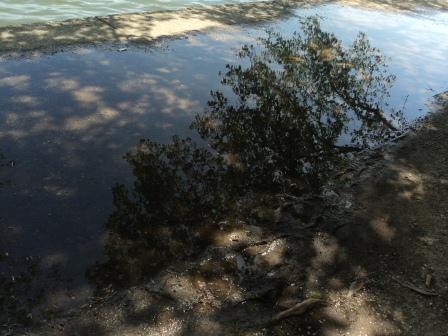
In case this small image isn't really clear, this is a reflection in a mud puddle. I found the puddles irritating as we walked around them. I love that a student saw them differently.


One darling girl seems to have spent the majority of the trip posing for photos. Here are just a few.

This is probably better than most school portraits.


I think this would be her social media avatar if she were a bit older.


Then we had a few selfies. That is something that was new this year.


This one struck me as a metaphor for something (not an intentional metaphor on the part of a first grader though - although I could be wrong).


And this one just struck me as sweet.


Handing my kids cameras has been one of the greatest things I've done as a teacher.

Thursday, May 09, 2013

Testing Causes Apathy

Conversations with various people lately have focused on apathy. Many teachers have complained about how their students aren't focused, working hard, paying attention, caring about what they are learning.

I sympathize. At the same time, I wonder how all these teachers would do in their students' shoes. Would they be focused? Would they work hard? Would they pay attention? Would they care about what they are learning?

A teacher (whom I greatly respect) recently had a talk with a child about effort. Apparently this child had scored lower on a post-assessment than on a pre-assessment. The child's explanation was that she had just guessed on some questions. My impression was that her teacher was frustrated.

So am I. But for a completely different reason. I don't blame this child for lack of effort here. I don't blame all these faceless, nameless students for their apathy.

A significant portion of their time at school is spent taking tests. State-mandated tests. District-mandated tests. Grade-level tests. Classroom tests. I would guess my daughter takes a couple of tests each week, on average. She's nine.

I would stop caring if that were true too. School should be about learning. Instead, it's about testing.


(Tim, a letter is being drafted. My concerns with testing will be shared with many.)


Monday, May 06, 2013

More Thoughts Thanks to John Hattie

I'm still working my way through Hattie's book. A conversation with a brilliant colleague today got me thinking about one piece from Hattie.

A powerful strategy (at 0.72 - nearly double the average) is teacher-student relationships. This is not a surprise to me and likely not to anyone else who works with other people. Relationships matter. A lot.

The way my district is interpreting Hattie is moving us away from strong relationships. We're standardizing lessons more and more so that the same thing is happening in every classroom at a grade level. That leaves very little room for getting to know students and for building the rapport that is critical. (I see a lot of other problems but I'll restrain myself for now.)

The conversation with my colleague came out of concerns that we are so focused on content that we are missing the many pieces of teaching that aren't related to content - wait time, talking less while students talk more, deep questioning, building relationships, etc. I hadn't considered this before she brought it up. Now I can't stop thinking about it.

Monday, April 29, 2013

Intel Visionary Conference

Last week, thanks to the fabulous Diana Laufenberg, I had the opportunity to attend Intel's Visionary Conference. Diana was there as one of four master teachers presenting to a host of district-wide tech folks, policy education people, and educational technology vendors. Diana, Darren Kuropatwa, David Jakes, and Sara Martin presented tech-infused lessons in each of the core subject areas.

Meredith and I (the other two flanking Diana in these photos) supported Diana. We were there to trouble-shoot, put things in context for participants throughout, answer questions, and give middle school and elementary school perspectives.

I appreciate that Intel hosts this conference and provides this opportunity for people who have been out of the classroom for a number of years (or who have never been classroom teachers) to get insight into power classroom technology use. They couldn't do better than the teachers they invited to present.

It seems to me that it is not exceptionally common for these two paths (policy people/vendors and teachers) to cross. Most conferences are aimed at one of the other. And, to be honest, this conference is not aimed at teachers. But the teacher voice is important and valued here. I wish that were true a lot more often.

My two regrets are that I had to leave before the bitter end (the problem with being local to a conference is that family life often cuts in) and that I didn't get to see any of the other sessions. Being with Diana was an amazing experience (and one I hope to write about soon) but I think being with David or Darren would have been too.


Monday, April 22, 2013

More on Bob Sornson


As I read CreatingClassrooms Where Teachers Love to Teach and Students Love to Learn weeks before finally managing to sit down and write about it, I found it interesting to see which pages I had marked. I had only marked three. There does seem to be a common theme however.
“The power of relationships to help manage behavior and improve learning in the classroom is sometimes overlooked in the attempt to boost testable academic achievement. But every good teacher acknowledges that kids learn better in an atmosphere of safety and respect, and that most children will try harder for a teacher they love.” (p. 16)
 “Solid relationships are far more powerful than the sum total of all other techniques.” (p. 26)
“How sad for the unsuccessful teacher who says, ‘My job is to teach the curriculum, not build relationships with kids.’” (p. 129)
As I am currently reading John Hattie’s book I do find myself wondering about the research behind Sornson’s statements. I believe them, I just wonder about the research. There is no bibliography of any sort, no list of resources, no further suggested reading. That leaves me hanging a bit.

Hattie’s research certainly supports the importance of relationships, although not quite to the degree Sornson is claiming.

I have long believed in the power of relationships but I don’t know that I would always have marked those three quotes. The current trend in education, and specifically in my district, is to move away from building relationships and towards a standard curriculum and delivery. That trend made those quotes more powerful to me than they would typically have been.

Sunday, April 21, 2013

Brief Break from Hattie


Thanks to some tweets from Laura Komos while she was at ASCD’s annual conference I was introduced to Bob Sornson. Laura was clearly quite impressed by him and her tweets made me want to read his work.

Although I finished the book a few weeks ago one idea is sticking with me. Sornson writes about nine skills in the book. The one that seems to me to be the most critical is “using empathy.” In many ways, I believe everything else can fall into place if a teacher is using empathy.

I am amazed at how often I find myself getting annoyed at a child because he or she is doing something again. In my mind that child is deliberately trying to drive me crazy. I think, “I know that child knows better. I know that child could stop that.”

I should know better. I need to stop that.

I have watched my oldest daughter hum or sing while she brushes her teeth, does her homework, rides her bike, makes dinner, eats breakfast, etc. The great majority of the time she has no idea she is humming or singing. She is not trying to drive me crazy.

Isn't that likely to be true about my students as well?

That little boy chewing on his sleeve. Isn't it likely he doesn't even realize he’s doing that? The little girl spinning down the hallway. Isn't it likely she isn't aware of what she’s doing?

That’s not to say I won’t stop the boy from chewing on his sleeve (I know his parents will appreciate my doing so) or the girl from spinning down the hallway (we do need to avoid the kindergartners walking our way). But a little bit of empathy from me means I can address these children with gentle reminders rather than stern admonitions. And which option is more likely to serve us well in the long term?

Saturday, April 20, 2013

John Hattie's Ideas

Videos are not my favorite way to take in ideas and content. I'd much rather read. That should give you some sense of how invested I am in learning about John Hattie's ideas if I've watched more than half an hour of him talking on videos.

This first one is the shortest, only about five minutes. It gives you a sense of who he is and where his focus is.


I'm interested in Hattie because his research seems to be a driving force for some decision makers in my district. Many of the decisions they are making based on Hattie's research are not ones I agree with. As a result, I decided I needed to do some learning to see if I'm missing something.

Hattie's book Visible Learning for Teachers: Maximizing Impact on Learning is not cheap. So, I started with these videos. Then I managed to borrow a copy of the book from a leader in my district.

I started with this video:


The first thing I noticed, after his fabulous accent, was that I was hopeful when he said things I agreed with and annoyed when he said things I did not agree with. Clearly as I go through all of his work I will have to work to remain open-minded.


My quick thoughts from the videos:

  1. He talks a lot about making sure students know what success looks like. That makes sense and sounds pretty good. But what if we set the bar too low? What if we show students what success looks like and they can already meet that? Are we limiting their growth by always defining success for them?
  2. He discusses teacher-student relationships as one of the big ones, as something that gives a big return on investment. That doesn't surprise me at all. Unfortunately, I feel like all the things we're doing as a result of his research (common pacing, common assessments, common planning) are removing us from those relationships. Everything is standardized so we don't know our students as well.
  3. Another idea he says is strong is spaced practice instead of mass practice. This means continuing to practice things over time rather than cramming it all in and then moving on to something completely new. This struck me because my team recently found that our students who did not do well counting money struggled not because of the money, but because they don't have the number sense to support them. We taught number sense in the first quarter and then moved on. It's a critical piece and needs to be part of things all year. That's certainly possible but it gets lost in our laser focus on whatever unit we are currently planning and assessing together.
I am reading his book now. It's not a quick read but I intend to continue writing about it and trying to understand why we are doing what we are doing.

Monday, April 15, 2013

From the Mouths of Higher Ups

In a recent meeting the following quotes were said:

"Our professional responsibility is a guaranteed curriculum."
"The schools that have been more successful..."
"You are responsible for every ______ grader in the building."
"What are you covering?"

Let's take these one by one.

"Our professional responsibility is a guaranteed curriculum." I'm not against a curriculum. But the message this statement sends is that the biggest thing I must do as a teacher is ensure that I am presenting the same information to every child. I think my job is much bigger than that. I also think the same thing for every student sets a pretty low bar.

"The schools that have been more successful..." This has been said again and again as justification for common assessments, common pacing, and all the team expectations. I find it disingenuous. The definition of success, in these statements, is test scores. Again, the bar is too low. And not meaningful - not for me, not for the kids, not for most parents.

"You are responsible for every ______ grader in the building." I get this one too. In fact, I kind of like this idea. But...right now there is a complete lack of any control for teachers. We don't control our schedule, who else works in our classroom, who is on our team, etc. We barely control what and how we are teaching. If you want me to be responsible for every child in my grade, allow me to do some of the things that I know will help those kids.

"What are you covering?" This one I don't get. I hate the term. I can cover all the content I want, that in no way means students will actually learn it. Ask me what I am teaching. Ask me what my students are learning? But don't ask me what I am covering.

I'm feeling a significant disconnect from those who are making decisions in my district.

Tuesday, April 09, 2013

Beautiful Classrooms

At Educon I attended a fabulous session, Where are the Beautiful Learning Spaces?, by Andrew Campbell and Jennifer Chan. Within minutes they had me thinking about what a school believes in and how (or whether) a school presents that. I was struck that much of what we do in our schools, at least in my district, goes against what we want. We want families and students to feel welcome in our buildings. But we lock all the doors, have signs up about trespassing, and lots of steps to pass to get beyond the front office. I understand why all those things are there, but I wonder what we lose as a result.

Anyway, we talked some about classrooms. I talked quite a bit with Christina Jenkins and we lamented how rarely we get to see other people's classrooms. There is so much to be learned just from a peek into another classroom, so many new ideas, things you've never considered.
From Stacy's 2nd grade classroom
Thanks to inspiration from Andrew and Jenn, we decided a tumblr would be a great way to try and make this happen. If you or someone you know has a classroom, or even just a part of a classroom, that you think is really welcoming or innovative or comfortable or special in any way, please share it! Christina (thank goodness for folks who know more than I do!) added a submit button at the top so that people can add their pictures on their own. Or you can email me if you prefer.
From my classroom
Please pass this on. I truly believe it could be an interesting resource for teachers, especially for new teachers, if it gets built up with plenty of examples.

Friday, April 05, 2013

Why Writing Groups Work and Matter

Last night I was lucky enough to hear a presentation by a highly skilled, very thoughtful educator. Even luckier, I've heard this presentation before. Like most presentations by highly skilled, very thoughtful educators, I learn something new each time.

This educator teaches in schools that work with various agencies in our district: mental health, alcohol and drug addiction, and our court system. The students with whom she works are in crisis, significant crisis. They are unable to attend their regular school, or even one of our alternative schools. However, they are still being educated, still being held to the same standards as their peers.

She works specifically, at this point in her career, with literacy. One of her greatest strengths is establishing writing workshop in these classrooms and building writing groups (peer groups that discuss each others' writing).

Not only is this work more challenging because these students are already coping with so much, but also because they rotate in and out of these schools. The goal is for them to return to their base school (or an alternative school, at least) so the population changes frequently.

This amazing educator has not let that stop her or even slow her down. One result is that the only state tests on which these schools have met the benchmark are the 8th and 11th grade writing tests. Clearly the writing workshop structure, the writing groups fostering conversation about their writing, and the high expectations have made a difference.

That said, student achievement is not the greatest driving force for using writing groups with these students. Kids who have hit a point that they are in these schools have many difficulties. Often those include communication and appropriate social skills (oh, the stories this educator can tell!).

Working in a writing group requires listening and talking. It really requires thoughtful listening and talking. Learning to do those things will be immensely useful in anyone's life. Immensely useful in personal and professional relationships. Even more useful than being able to write well.

I told you she was thoughtful.

Thursday, April 04, 2013

Success Means High Test Scores

From cireremarc’s flickr stream:
http://www.flickr.com/photos/23291498@N04/4891653678/
Do so few people really question this?

It seems like everything that is said about education today defines success this way. In a recent team meeting we were hearing about the PLC process and what is expected (really, what is required and what we can tweak). We were told, multiple times, that 'it works'. I kept thinking, "Yes, if by works we mean it raises test scores."

Does that mean it's better for kids?
Does that mean it actually improves learning?
Does that mean it's a good use of time, for kids or teachers?
Does that mean it is the right thing to do?

Are we really defining success in a meaningful way?

Wednesday, April 03, 2013

Assuming Positive Intentions

Over the years I have worked with many superstars. Our school has had, and has right now, many absolutely amazing teachers. Not everyone is lucky enough to know these amazing teachers. One of them, however, has truly broken out into superstardom and has become quite well known.

Last night a bunch of us went to her first book signing of the tour. 


There you see Glennon Doyle Melton surrounded by people who taught with her at our school. Some of us are still here, others have moved on to other schools or to stay at home with children. It was like a reunion. The whole evening, waiting in line for 2 1/2 hours, seeing Glennon, being with these amazing, brilliant educators, was an awesome experience. I don't use that word lightly. It was awesome.

(By the way, the lady just to her right in the picture co-authored a book with her years ago. It's a fabulous book as well.)

Glennon did not get a chance to talk to the entire group for long, nor did she have much time to speak to us individually. There was quite a long line and she was signing books until midnight. 


No matter how brief her remarks, I was struck by one sentence. She talked about all she has learned in the last few years. These were all things she has written about before. But, for some reason, one stuck with me. She said that she has learned that everyone is trying their best. 

That bears repeating. Everyone is trying their best.

I've thought a lot about assuming positive intentions, but I am not good at it. I'm especially bad when it comes to other drivers. But it seems to be something I struggle to remember. 

Somehow, Glennon's wording makes so much sense to me. Everyone is trying their best. My little first graders are trying their best. Their parents are trying their best. My coworkers are trying their best. Those other drivers are trying their best. Everyone is trying their best. 

I will continue to try my best to remember that.

On a related note, I have an extra copy of Glennon's book. It's not signed, sadly. However, I have been trying to figure out since last night what to do with it. I thought about giving it to my mom, but I think I should get her the kindle version instead. I thought about sending it to my sister, but she may have already bought it. I decided, instead, to pass it on here. If you are interested (and didn't give up on this post far above), leave me a comment. I'll pick a random number and send that person this fabulous book. (I'll pick a number this Saturday, April 13th, so that I can get the necessary information and mail the book out on Monday!)

Tuesday, April 02, 2013

Making Assessing Worthwhile

Common assessments have become a big thing at my school in the past couple of years. A big thing with which I am still struggling.

Prior to this quarter, our common assessments in language arts have been our running records. I had no problem with this. We were all doing running records to help us plan effective guided reading groups so it didn't require any extra time or energy. It was an authentic, meaningful assessment.

This quarter we decided to focus on the high frequency words our students should know by the end of first grade. Every January we assess all 100 words - the writing of which typically takes more than an hour over the course of a week. I do 25 words each day and it takes us between 15 and 30 minutes to do that, depending on how focused we are, how many distractions we have, etc. We also do one-on-one assessments of each child reading the words. When we decided to focus on high frequency words I immediately argued against assessing all 100 again. (We decided to focus on the 20-30 words each class worked on during this quarter.)

The time factor was a significant reason for my wish to not assess all 100 words. But I spent a lot of time thinking about what we gain from these assessments and what they cost us. When I tell students a word and they write it down, I learn if they can spell it in that moment, in that isolated manner. That may or may not translate to their actual writing. Which is where I really care if they can spell it.

In the past I would not have assessed 20-30 words at the end of the 3rd quarter. But that doesn't mean I wouldn't have been assessing them. During writing conferences I would be noting their facility with high frequency words. I would not have know who could spell each specific word at any given moment, but I'm not convinced I know that from our common assessment either.

In the past I would have known who has a strong grasp on the high frequency words and who does not. That would have allowed me to form guided writing groups around using our resources for these words as well as creating work stations to practice them. I believe that would have worked just fine.

Now, I'll spend a considerable amount of time assessing students rather than teaching them. I will likely still end up with guided writing groups and work stations, just as I would without this common assessment. I just wouldn't have hard numbers for us to compare as a team. Sigh.

Monday, April 01, 2013

Rick Riordan, My New Hero

My daughters have been listening to Rick Riordan's Percy Jackson and the Olympians series. (It's our first foray into books on CD and it has been an unqualified success.) Their love of the books and fascination with the gods and goddesses pushed me to read the books. In the fourth book, The Battle of the Labyrinth, Percy, Annabeth (a daughter of Athena), Tyson (a cyclops), and Grover (a satyr) come across the Sphinx. I was enjoying the books up to this point, but this made me absolutely adore Rick Riordan.

I don't believe reading this will spoil any part of any of the books. If you haven't read the series, I highly, highly recommend it. The relevant quotes from the scene follow (breaks are where I left out text to focus on just the critical pieces). Enjoy!


I slipped on a pile of wood scraps, but when I shined a light on them I realized they were pencils - hundreds of them, all broken in half.

Then I saw the monster. She stood on a glittery dais on the opposite side of the room. She had the body of a huge lion and the head of a woman. She would've been pretty, but her hair was tied back in a tight bun and she wore too much makeup, so she kind of reminded me of my third-grade choir teacher. She had a blue ribbon badge pinned to her chest that took me a moment to read: THIS MONSTER HAS BEEN RATED EXEMPLARY!

"Fabulous prizes!" the Sphinx said. "Pass the test, and you get to advance! Fail, and I get to eat you! Who will be our contestant?"

"Are you ready for your test?"
"Yes," she said. "Ask your riddle."
"Twenty riddles, actually!" the Sphinx said gleefully.
"What? But back in the old days -"
"Oh, we've raised our standards! To pass, you must show proficiency in all twenty. Isn't that great?"

A drumroll sounded from above. The Sphinx's eyes glittered with excitement. "What . . . is the capital of Bulgaria?"
Annabeth frowned. For a terrible moment, I thought she was stumped.
"Sofia," she said, "but -"
"Correct!" More canned applause. The Sphinx smiled so wide her fangs showed. "Please be sure to mark your answer clearly on your test sheet with a number 2 pencil."
"What?" Annabeth looked mystified. Then a test booklet appeared on the podium in front of her, along with a sharpened pencil.
"Make sure you bubble each answer clearly and stay inside the circle," the Sphinx said. "If you have to erase, erase completely or the machine will not be able to read your answers."

"Now," said the Sphinx, "next question -"
"Wait a second," Annabeth protested. "What about 'What walks on four legs in the morning'?"
"I beg your pardon?" the Sphinx said, clearly annoyed now.
"The riddle about man. He walks on four legs in the morning, like a baby, two legs in the afternoon, like an adult, and three legs in the evening, as an old man with a cane. That's the riddle you used to ask."
"Exactly why we changed the test!" the Sphinx exclaimed. "You already knew the answer. Now second question, what is the square root of sixteen?"
"Four," Annabeth said, "but -"
"Correct! Which U.S. president signed the Emancipation Proclamation?"
"Abraham Lincoln, but -"
"Correct! Riddle number four. How much -"
"Hold up!" Annabeth shouted.

"These aren't riddles," Annabeth said.
"What do you mean?" the Sphinx snapped. "Of course they are. The test material is specially designed -"
"It's just a bunch of dumb, random facts," Annabeth insisted. "Riddles are supposed to make you think."
"Think?" The Sphinx frowned. "How am I supposed to test whether you can think? That's ridiculous! Now, how much force is required-"
"Stop!" Annabeth insisted. "This is a stupid test."

"Why then, my dear," the monster said calmly. "If you won't pass, you fail. And since we can't allow any children to be held back, you'll be EATEN!"

I raised my sword, but before I could strike, Tyson ripped the monster's grading machine out of the floor and threw it at the Sphinx's head, ruining her hair bun. It landed in pieces all around her.
"My grading machine!" she cried. "I can't be exemplary without my test scores!"

Monday, March 18, 2013

Interventions

To kick off a recent day-long workshop we watched a video about a middle school girl who collapsed and her P.E. teachers saved her. The video is powerful and it's a great story.

The point of it, in our workshop, was to make connections to interventions. The idea being that the P.E. teachers intervened for this girl and we need to intervene to help students reach benchmarks. The more I thought about it the more it seemed like a serious stretch.

There is no question that the teachers saved the girls life. Without them she had no chance. But the same could be said for the doctors. The teachers made it possible for her to survive until the doctors could take over. The long-term life saving was done by the doctors.

I'm not sure where that leaves me in the analogy. I feel like there should be some big aha here. Instead, I'm just frustrated that this video was used in a way that feels very manipulative.

Sunday, March 17, 2013

Relationships Matter

I am blessed to be working with a fabulous intern (pre-service teacher, student teacher, whatever you want to call her) this semester. She is thoughtful, bright, interested in learning and in the students, and a delightful person. To be honest, most of the interns I have worked with in the past dozen years have been this way. This one, while being fabulous in all those ways, has also had to step up like nobody's business. I had a couple of conferences scheduled this semester meaning a few days out plus some doctors' appointments for me and my daughters. Then we had the minor crisis with our daughter which involved even more absences. Finally, there have been a surprising number of meetings and inservices required by my school/district. So this phenomenal intern has taken over for many days, planned and unexpected, with grace, flexibility, and competence.

Inevitably, no matter how stellar the intern, we always hit a point at which we need to be eating lunch with kiddos. We do this two or three times each week with a couple of students at a time. The goal is to build rapport and get to know the students outside of the academic setting. In the past, I've assumed this was necessary because some interns struggle with all they are balancing and need an extra push to focus on their relationships with students. But now I'm not so sure.

I get a grace period with my students at the start of each year. We have something of a honeymoon as we all get to know each other. As a result, I get to know them and build relationships during a lovely time. An intern, who joins us in January, is stepping into established routines and personalities, for all the good and bad that entails. My relationships with the students impacts hers - which can help or hinder depending on me. The kids' relationships with each other also impact how she perceives them. She doesn't really get to start fresh. Eating lunch together breaks down those walls a bit, opens up new views of each other.

The downside? I don't like giving up my lunchtime! That's why we only do it two or three times each week. In the moment, I love the time with the kids. But I also definitely need time without them during the day.

Tuesday, March 12, 2013

My Friends are All Teachers, Thank Goodness

Another reason for my recent absence here has been a small crisis with our daughter. Parents face small crises all the time. Sometimes a small crisis goes away on its own. Sometimes a small crisis becomes something huge. Sometimes a crisis needs to be addressed carefully and sometimes it needs to be studiously ignored. There is almost no way to know this until the crisis can be viewed through hindsight.

This isn't our first small crisis nor will it be the last. This, however, was eye-opening for me. I'm a teacher. I'm surrounded by teachers and other educators. As a result, I have access to a wealth of knowledge.

Teachers see small crises all the time. They also see large crises but, fortunately, those come less often. Seeing so many small crises mean that teachers know ways to address them and who else can help.

In this small crisis there were numerous people with whom I work who helped us with strategies to address our daughter's concerns and to point us to others and to help us navigate various possibilities. We have been stressed as we moved forward with this but all the information and support made it so much better.

I'm left now, as we see the light at the end of the tunnel (we think), with great sympathy for parents without this network of resources. I'm left wondering how I can better support my students' families when they are facing small (or large) crises. I think I often forget that most parents don't have the wealth of knowledge all around them that we have.

Saturday, March 02, 2013

Change is Hard

I tend to be a fairly sentimental person. I find it hard to throw away notes my students wrote to me, art from my daughters, tickets from theater performances, and Christmas letters from friends and family. That's not always a good thing. Our house is awfully full of stuff. But, luckily, most of that stuff is pretty small.

Today we (my daughters, my husband, and I) spent the day at my parents' house. This isn't uncommon. They live about half an hour from us and our girls are often there even if we aren't. The unusual part was when we left. We drove away knowing that it's very possible that was the last time we ever visit that house.

My parents have bought a motor home and are about to embark on a long-time dream. They are selling almost everything they own next week (thanks to a company that does these things). They've put a few things in storage for a future time when they feel they are too old to be driving around the country in a motor home. Some stuff has been shipped to my sister in San Francisco and my minivan has made trips for the past few weekends bringing stuff back to our house. Starting Monday my parents will live in their motor home.

I can't just tuck this house away in a keepsake box in my closet.

My parents have lived in this house since 1984. That's the longest either of them have lived in any home. At one point or another I lived in every one of its four bedrooms. I learned to play the piano in that house. Inside the hall closet door are the markings showing mine and my sister's heights over the years. And now those for my daughters as well. There is only one other family on that cul-de-sac that has lived there longer than my parents.

My daughters cried as we drove home. They don't like things to change. They're strong and spending spring break traveling with Grandma and Bobo in the motor home will do wonders for their adjustment period. I tried to talk with them about it as we drove. To acknowledge their sadness while reminding them of their excitement about future plans. I think that would have been more effective if I hadn't been crying.

Change is hard. When you are the one advocating for or planning the change it is different. When change is out of your control it is challenging. I'm not against this change. It's just hard to adjust.