Members of our special education team and our gifted and talented team presented at our school's faculty meeting today. The topic was twice exceptional students (kids who are gifted but also have a learning disability, social challenge, or some other such exceptionality). The main focus of the presentation was a video, Ennis' Gift, from the Ennis William Cosby Foundation. The video is beautifully done and tells the story of numerous people who were not successful in school because their teachers did not recognize their gifts. Parts will make you cry. We showed snippets of it and gave everyone chances to talk about it. We had thoughtful questions linked to the video to guide discussions. We had collected children's books with twice exceptional main characters and had them on display. We shared some Calvin and Hobbes cartoons to get things started. It was a brilliantly planned presentation (I had little to do with the planning).
The message we really wanted to convey was: students should not be denied services because of social, emotional, or behavioral issues. The great majority of our staff already know this. However, we still hear teachers saying things like, "That child doesn't deserve to be in the GT class." The belief that a seven year old should be excluded from a classroom that will best meet his/her learning needs because of laziness, defiance, or social awkwardness is sad.
I think the presentation inspired members of our faculty who already understood the concept of twice exceptional students. Hopefully they will be more willing and able to advocate for those students in the future. Those staff members who don't yet buy into the idea were not likely swayed by the meeting. I can only hope that it sowed seeds of possibilities for the future.
Monday, March 03, 2008


Thursday, February 28, 2008
Technology in Math
This lesson didn't begin with technology. Initially the students were working with three triangles from tangrams and creating polygons. Five regular polygons can be made with those triangles. They then had to find the area and perimeter of the shapes. The goal is for them to realize that shapes can have the same area but different perimeters (or the other way around). It was harder for them than I had anticipated, but they enjoyed it.


We ended up writing the perimeters of the shapes as algebraic expressions based on the sides of the triangles. Actually measuring was not working well and this was good practice for them writing expressions. Plus, that pushed some of them to finally realize that the areas of the shapes were all the same. Once they recognized that the sides of the triangles remained the same no matter what shape they created, they were able to realize that the areas of each triangle did so as well.
As we neared the end of the lesson we realized that we needed to look at some of it a bit more deeply. I gave each student some fresh graph paper and asked them to try and create shapes with areas greater than perimeters, perimeters greater than areas, and equal perimeters and areas. (I know we are comparing apples and oranges to an extent here because we are comparing units with units squared, but they had a lot of preconceived notions that needed to be questioned.)
Then I wanted to be able to look at some of what they found together. So I pulled up grid paper on my smartboard.
They drew several different shapes to show how each of the possibilities might look. Some students were just amazed that you could have equal perimeter and area or that the perimeter could ever be a larger number than the area. It was interesting to hear their discussion. Then Mr. B opened up Geometer's Sketchpad with a shape that he could manipulate so they could watch the perimeter and area change. This allowed them to test some theories quickly without having to do a lot of tedious computation (which would have caused them to not test their theories). They were enthralled.
This was the best on-the-fly use of technology I've done all year. I was so glad to have the smartboard and Geometer's Sketchpad at my fingertips. The one depressing piece was that I hadn't originally thought to do these things as a part of the lesson.


We ended up writing the perimeters of the shapes as algebraic expressions based on the sides of the triangles. Actually measuring was not working well and this was good practice for them writing expressions. Plus, that pushed some of them to finally realize that the areas of the shapes were all the same. Once they recognized that the sides of the triangles remained the same no matter what shape they created, they were able to realize that the areas of each triangle did so as well.
As we neared the end of the lesson we realized that we needed to look at some of it a bit more deeply. I gave each student some fresh graph paper and asked them to try and create shapes with areas greater than perimeters, perimeters greater than areas, and equal perimeters and areas. (I know we are comparing apples and oranges to an extent here because we are comparing units with units squared, but they had a lot of preconceived notions that needed to be questioned.)

Then I wanted to be able to look at some of what they found together. So I pulled up grid paper on my smartboard.
They drew several different shapes to show how each of the possibilities might look. Some students were just amazed that you could have equal perimeter and area or that the perimeter could ever be a larger number than the area. It was interesting to hear their discussion. Then Mr. B opened up Geometer's Sketchpad with a shape that he could manipulate so they could watch the perimeter and area change. This allowed them to test some theories quickly without having to do a lot of tedious computation (which would have caused them to not test their theories). They were enthralled.

This was the best on-the-fly use of technology I've done all year. I was so glad to have the smartboard and Geometer's Sketchpad at my fingertips. The one depressing piece was that I hadn't originally thought to do these things as a part of the lesson.
Wednesday, February 27, 2008


Thursday, February 21, 2008
Equality of Subject Areas
I teach 5th grade in an area where my students head off to middle school next year. Their middle school treats 6th grade as a sort of bridge between elementary and middle school. They switch teachers, but have limited options about courses. They are still pulled out of core classes for band, strings, chorus, and gifted and talented services. They have lockers and dress out for gym. It's a good transition year for them, in many ways.
In other ways I feel like they lose out because they aren't in elementary school for one more year. At my school (and I know this isn't true for all, or even most, elementary schools) our students have two and a half hours four days a week for language arts instruction (reading, writing, word study). They probably have an hour and a half on the fifth day. They have an hour, at least, for math instruction five days a week. Science and social studies get less time. My students have thirty minutes four days a week for each of those, at best. Occasionally we'll spend more time on science or social studies when we are really engaged in something. I feel that my students have to be able to read, write, and do math in order to be able to truly understand social studies or science. So I don't have any concerns about how we spend our time (although I love science and social studies and would enjoy spending more time with them).
However, next year they'll have the same amount of time for math class, social studies class, science class, and English class (which will include reading, writing, and word study). What a switch for them! If they remained in elementary school they would still have a greater focus on language arts and math.
This is yet another time where I think tradition and convenience determine how we handle instructional issues. I wonder if one of the reasons we see so many concerns about young people and reading is because of the small amount of attention we give it after elementary school. Does it truly make sense to value every discipline equally? And equally for all students?
Traffic Jam
A couple of people have expressed interest in the activity in the Wordless Wednesday pictures. The activity is called Traffic Jam and I found it on a website for team building activities.
It's my favorite of the team building activities that I do and I was thrilled to be able to come back to it.
I didn't use duct tape, but we put the pieces of construction paper on the floor. That allowed us to try it first with just half the class (both halves tried it in different parts of the room). Once they were able to do it several times we took it out to the hall to have the entire class do it. That was at the beginning of the year. I do team building activities all through the first week to emphasize cooperation and to foster community. We've done it again now as a part of math. We've looked at how the pattern works and how to explain it mathematically.Use the duct tape (or masking tape) to make a starting pattern on the floor.
Have the participants stand in the boxes of the pattern: half of the group faces right, half of the group faces left.
Explain the task: Using only legal rules, people on the left side must end up on the right side and the people on the right must end up on the left.
Legal Moves
A person may move into an empty space in front of them.
A person may move around a person who is facing them into an empty space.
You CANNOT:
Move backwards.
Move around someone facing the same way you are.
Make any move which involves two people moving at once.
It's my favorite of the team building activities that I do and I was thrilled to be able to come back to it.
Wednesday, February 20, 2008
Wordless Wednesday
 Traffic Jam - attempting to move students from one end to the other. They can only jump past one person at a time and can only move the direction they are facing. Very challenging!


Wednesday, February 13, 2008


Thursday, February 07, 2008
Authorities on Education
Every school day I receive an email from ASCD (Association of Supervision and Curriculum Development) with a collection of newspaper and magazine articles. The email includes links and brief summaries of the articles. A year ago it was something I looked forward to in order to keep up with what was happening in education around the country and around the world.
In the past few months I've noticed that I haven't kept up with reading these emails. I finally realized that I would rather spend time with all of the feeds to my reader than to skim through that email. (Of course, the amount of time for those two activities is nowhere near equal.) The authorities on education I turn to now are classroom teachers, like Dan, Doug, Woody, Ruth and Stacey, Tree, Organized Chaos, and Christian, or administrators, specialists and consultants, like, Tim, John, Wes, Chris, and Alice, as well as some big names in the field like Deborah Meier and Diane Ravitch.
The people I read now aren't journalists, they are educators. They know that of which they speak. Who better to be reading to keep up to date with the state of my profession?
Wednesday, February 06, 2008
100th Day of School
 Creating time lines of 100 years in U.S. history.


Things that measured 100 of some unit (centimeter, pounds, etc.)

Number sentences that equal 100 in a variety of ways (with 2, 3, or 4 operations or using 3, 4, or 5 digits).
Wordless Wednesday (mostly)
Tuesday, February 05, 2008
Good Nutrition, Good Economics
A study recently found that good nutrition for young children (infants and toddlers) affects their future earning potential. The study began in the 1970's looking at children in Guatemala. Researchers looked at these groups twenty and thirty years later as adults to determine the effects of a nutritional supplement program.
They found that the adult males in the group who had been given the supplement were earning 46% higher hourly wages than the others.
Surprisingly, however,
Does this mean that good nutrition promotes physical strength which helped these men make more money and does nothing for intellectual ability? That seems highly unlikely, but why these results? Was there a reliable way of assessing school performance? What sort of cognitive testing was used?
On a final note, the researchers asserted that their study suggests that societies need to ensure that children are well fed for economic reasons.
It always comes down to money.
They found that the adult males in the group who had been given the supplement were earning 46% higher hourly wages than the others.
Surprisingly, however,
But surprisingly there was no similar divide in school performance or cognitive test scores.
Does this mean that good nutrition promotes physical strength which helped these men make more money and does nothing for intellectual ability? That seems highly unlikely, but why these results? Was there a reliable way of assessing school performance? What sort of cognitive testing was used?
On a final note, the researchers asserted that their study suggests that societies need to ensure that children are well fed for economic reasons.
"Improving nutrition in early childhood led to substantial increases in wage rates for men, which suggests that investments in early childhood nutrition can be long-term drivers of economic growth," they conclude.
It always comes down to money.
Monday, February 04, 2008
Super Bowl - Quite a Test
The New England Patriots lost their first game all season last night. I know, that's not news to anyone. But it's got me thinking. After an almost perfect season, losing one game has meant that people have called the Patriots' performance disappointing or a failure. This one game, just a few hours, has changed many people's impressions of the team. Is that reasonable?
We seem to do the same thing to our students with standardized tests. One bad day, a few hours of sub-par performance, and a child can be labeled negatively for some time. Their scores on a test often are viewed as more accurate, exact, and important than anything their teachers might know about them. All the anecdotal notes, classroom tests, and other assessments carry less weight.
Our students, at their young ages, aren't ready for a Super Bowl of standardized tests.
Friday, February 01, 2008
Looking for Advice
I posted today on This Must Be Thursday, a blog I co-author with a close friend and colleague. I wrote the post for the cathartic qualities involved in getting emotions out on the page. However, in the process and since I've been mulling the big questions in it. And I'd love to know what others think.
The main questions were
The main questions were
So, what is my responsibility? Should my students be completely unaware of issues I face? Should they know if I'm having a bad day? Does their age matter, older students being more able to deal with understanding their teacher's mood swings or such? Is it my job to teach my students well regardless?I haven't really been able to figure out where I stand on this and I'm hoping for some thought-provoking ideas.
Wednesday, January 30, 2008


Thursday, January 24, 2008
Online Safety
I've read many posts on internet safety in the year I've really been engaged in the blogosphere. But I haven't really been invested in what I was reading. I think I figured it wasn't a big issue for my students - fifth graders who aren't upper middle class. They don't have computers in their bedrooms, many of them don't have internet access at home.
So, an incident last week took me completely by surprise. One girl in my class went to the counselor with a concern. The counselor kept returning to my room throughout the morning and borrowing or returning students. I didn't really think too much about it, assuming it was a friendship issue (a common problem). At lunch I walked past my principal's office and noticed the counselor and four of my students in there. I got them to lunch and went back to figure out what on earth was going on.
It turns out that quite a few of my students have been using a social networking site. I had never heard of it. It seems to have a focus on anime and manga. One student began receiving threatening emails two days before this. When she didn't respond the bully began emailing her friends to get to her. They were all quite scared.
As a school, we contacted parents, reassured students, and turned this over to the proper authorities. I'm keeping an eye on these students to see if they seem to be upset or distracted or if they show any other signs of distress. Hopefully they will all stop using this site and not be bothered by this bully anymore.
It was eye opening to me and I think I need to do more on internet safety with my students. I thought they were too young, but I was wrong. Only one of them had anything very personal on this site, fortunately, but it's clearly a lesson we need to discuss.
The positive side to all of this was a reaffirmation of the wonders of my school. I spent part of my lunch getting the scoop on the issue from the principal and counselor, but that was all that was required of me. The administration took care of everything. My job was to teach my class and they made sure I could do that. I'm not sure that level of support is a common thing.
(I have to admit that I wasn't willing to be that uninvolved. I'm lucky to have an intern/student teacher working in my room right now so I was able to be out of the classroom to help call parents and talk with the authorities. But, it was nice to have options.)
Wednesday, January 23, 2008
Wordless Wednesday
With our buddies (head start three and four year olds):


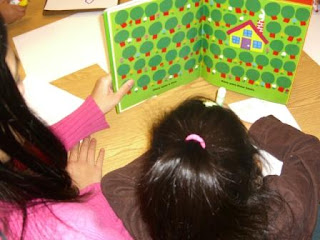

(Many bloggers, mostly outside of the edublogosphere, do Wordless Wednesday posts every week. I've greatly enjoyed them and decided to give it a try.)


(Many bloggers, mostly outside of the edublogosphere, do Wordless Wednesday posts every week. I've greatly enjoyed them and decided to give it a try.)
Tuesday, January 22, 2008
Me as a Model
Not a fashion model, obviously, but a role model for my students. I've been thinking about this since Dan posted about keeping students' attention. It's a great post and my musings are way off topic, but it got me thinking. He has a short video in this post in which he calls his class "boys and girls." It struck me because I typically call my students "ladies and gentlemen" and they are a few years younger than Dan's students. I wasn't the only one intrigued by this. Dina posted a poll asking what others call their students. The responses are interesting.
Since reading all of this I've been more aware of how I address my students. I'm exceptionally polite with them (thank you, please, etc.), more so than I am in the rest of my life. I've also realized that I write thank you notes for anything my students give me, no matter how small. I am not that good about thank you notes to others who give me gifts.
I've realized that, consciously or unconsciously, I try to model the behavior I would like to see in my students. As a result, I am a better person as a teacher than I am in general. I'm not sure if I'm proud of that or not.
This also made me realize how much I'm teaching my students that has nothing to do with the SOLs or our county curriculum.
Wednesday, January 16, 2008
Mary Lee, at A Year of Reading, was inspired by this year's Newbery Award Winner. Laura Amy Schlitz wrote Good Masters! Sweet Ladies! Voices from a Medieval Village. She is a librarian at a school in Baltimore and wrote the book originally as monologues for her students to perform. Mary Lee believes that Schlitz went to the ends of the Earth for her students and decided to award some To the Ends of the Earth awards to people at her school.
I think the idea is a fantastic one and I'd like to add a few awards. First, the parent liaison at our school who knows everything about our Spanish speaking students and their families. She arranges transportation to school for some, finds clothing and furniture when needed, and works tirelessly to find medical care and other services.
Second, the secretaries in our office who go way above and beyond for the teachers, students, and families at our school. They are the first ones in each morning and the last to leave. They track down maintenance help, find substitutes, help students celebrate birthdays, and are always cheerful.
The third grade teacher who in addition to raising three girls of her own, manages to be a model teacher, complete her National Boards, advocate for her students, innovate in her classroom, and recognize everyone else's achievements and contributions to our school. We are a better school thanks to her presence.
Our reading teacher who thinks everything through. Nothing happens in our school related to literacy that she isn't considering how it impacts our students. Her model has made all of us more thoughtful about our instruction and has made our school a model in our district.
And, our administrators. It is the atmosphere that they create that allows the rest of us to teach students as well as we can. They treat us as professionals and work hard to find the support for anything we request. They meet with families frequently and are at all evening events. It is thanks to them that we have so many others who go to the ends of the Earth for our students.
(I'm sure that once I post this I will think of six more worthy awardees!)
2008 Education Blogosphere Survey
Scott McLeod, over at Dangerously Irrelevant, has opened up his second annual survey. It's 25 questions, some of them quite thought provoking for me. If you can find 10-15 minutes, go fill it out. The more people who respond, the more fascinating the results will be. I'm looking forward to reading others' thoughts on blogs they enjoy, tech tools they use, and reasons they blog.
Saturday, January 12, 2008
Annual Report
dy/dan has put up a design challenge to create your own annual report. He did a previous contest, the Four Slides Sales Pitch, which fascinated me. I lacked the time and confidence to enter that contest. I refused to let that stop me this time.
I'm not happy with this as a final annual report, but time constraints require that I stop. I'm actually glad of those time constraints because I think I could spend a ridiculous amount of time on this. I will say that the more I do, the better I start to see ways to improve presenting what I want to say. I still have a ton to learn, but this has pushed me in a good way and I've really enjoyed it.

2007 was the year I really started blogging. I was on maternity leave from January on into April and took that time to get serious about reading and writing blogs. It was interesting to look back at what I've written and reflect on what I've learned through it.

With two children I've done a lot of reading of children's books this year.

Looking at this year through statistics got me thinking about the physical side of teaching elementary school.

Finally, after the birth of my second daughter I felt a need to get back in shape and lose weight. It felt good to look at the year this way.
Tuesday, January 08, 2008
Personal Learning Environments
The tech guru at our school has been thinking hard about how best to work with students and technology. He's pushing us to push the boundaries and meet students' needs in the best ways possible. This morning he shared an epiphany with me. He's been mulling over the idea of 'personal learning environments' and has created a working definition for himself. (I'm sure he'll correct my explanation if I'm missing something, at least I hope so.)
Here's an example: students are working on a study of oceans. In a group they could have a specific focus, say ocean currents. Their group would create a wiki as a base for all their research. They would create a group delicious site full of relevant links, a bloglines collection of feeds, and a blog that they write to share their thinking and their synthesis of their learning through the research. All of these sites would be linked in their wiki.
My question is, what else is a possibility? My feeling is that no piece will make sense for every group and for every project, but these seem like a good starting point. What other tools could help students research and/or pull their thinking together?
Friday, January 04, 2008
XO Laptop
I've been meaning to write about this since Christmas because my four-year-old daughter received an XO laptop from her grandparents. She has been loving it and goes to it each day. She now has an email account and has been feverishly sending emails to family and friends. So far folks have been quite kind and quick to respond. We'll see how long that lasts. My husband has done a lot to make the computer work for her and has been adding activities to it regularly. 
She dropped it off the kitchen table yesterday as she was trying to pick it up and it survived without problem. The keyboard is tough for me to use, but works well for her little fingers.
I was finally moved to write because I just read an article from BBC news. It seems that Intel has pulled out of the OLPC project rather than stop backing Classmate, a rival low-cost laptop. I'd love to think that competition will push all of this forward, but I have reservations. I know the XO is far from perfect, but I am very impressed with the entire project. I hope that the loss of Intel does not hinder the good work happening here.
More Grading Thoughts
(I wrote this post last night and it apparently disappeared. If it shows up multiple times in your reader, I apologize.)
The Washington Post had an article recently on grading scales and weighted grades in various honors classes in different school districts in our area. This is frustrating to parents (and I assume to students, although that is not a focus of the article). This was a front page article in the Post which suggests a significant level of importance. I read the article with growing frustration. These parents are up in arms over this issue which has absolutely nothing to do with what their children are learning. The only thing that matters, apparently, is the grade on the transcript.
I found this to be a sad commentary on the state of education today. Our students are working to earn grades rather than to learn and their parents are encouraging this. Many teachers will say that one of their main goals is to encourage life-long learning. Grades are in direction opposition to this aim.
Thursday, January 03, 2008
Brilliant Man (and small world)
My sister works with Gever Tully at his Tinkering School each summer. He is absolutely amazing in what he plans for those students and what they all do together. I'm looking forward to the point when my daughters are old enough to go. He recently presented a TED talk about dangerous things you should let your children do that is well worth the 10 minutes it takes to watch it. (Plus, there's a picture of my sister in the midst of his slideshow.)
The other piece of this that has fascinated me is how it is an example of the interconnectedness of our world. Doug Noon, blogging at Borderland, shared a blog post from Stephen's Web that linked to the TED talk. To recap, a blogger in Alaska shared a blog post from Canada with me in Virginia about a talk in California. I love it. I should also mention that Tim, in my own school district, also blogged about the TED talk. I'm thrilled to see Gever creating this sort of buzz.
The other piece of this that has fascinated me is how it is an example of the interconnectedness of our world. Doug Noon, blogging at Borderland, shared a blog post from Stephen's Web that linked to the TED talk. To recap, a blogger in Alaska shared a blog post from Canada with me in Virginia about a talk in California. I love it. I should also mention that Tim, in my own school district, also blogged about the TED talk. I'm thrilled to see Gever creating this sort of buzz.
Wednesday, December 26, 2007
Math Literacy
An article in the Washington Post this morning got me thinking about how we teach reading and how we teach math. It seems to me that we've made gigantic strides in our teaching of language arts (reading, writing, word study) in recent years. There are phenomenal professional books out there, many of them written by classroom teachers, or individuals who only recently left the classroom. There are some good professional books about math, but they are fewer and often written by large groups of professors or others removed from elementary classrooms.
We've got a lot to learn about teaching math.
We've got a lot to learn about teaching math.
Virginia Commonwealth University math professor William E. Haver, who is involved in the partnership, said elementary teachers need to know far more than the standard curriculum. With a depth of knowledge, teachers can help children understand relationships between numbers and solve problems in different ways. Without it, teachers often rely on memorization and aren't well-equipped to help struggling students.
"Elementary math isn't elementary," Haver said. "There are a lot of deep ideas there. Usually, if a child doesn't get the right answer, there's a fair amount of good thinking along the way, but it got astray at some point. If you can pinpoint that problem, you're better off."
I think this is a bigger problem than just our schools. Our society has math phobia issues. It's acceptable to be bad at math and to hate math. Saying the same thing about reading is taboo. It seems unlikely that we'll manage major change in education without similar change in society.
Sunday, December 16, 2007
To Grade or Not To Grade
It's the end of the second quarter for us. That makes it my least favorite time each quarter. Most elementary school teachers in my district will tell you that report card time stinks because it requires bubbling grades in eight content areas (an academic grade and an effort grade) and ten word study areas. Then comments also have to be bubbled in. It is very time consuming and mind numbing.
I, however, hate it with an even greater passion. I can't figure out why I'm doing it (aside from the fact that I'm required to as a part of my job). What is the purpose of these grades? My husband, a college professor, firmly believes that grades are what motivates his students to do the work. He's probably right. But, I think it's true because we've trained kids with that motivation. I want my fifth graders to work because they want to learn, not because I'm going to judge them.
Another argument is that we use report cards to communicate with parents. Again, probably true. But, does a report card really communicate effectively? Telling a parent that their child earned a B in math with a G (good) for effort doesn't really say much. It doesn't let them know that the student excelled in geometry that quarter, but is still struggling to understand how to multiply and divide with decimals. It does a much better job of ranking students and making it easy to compare them to one another.
I would much rather spend two or three times as long on a more effective mode of communication for parents than to use a report card. I'd rather have to work even harder to make my lessons engaging and relevant to my students than to expect them to do the work in the hope of earning an A. One of my goals as a teacher is that my students love to learn. I think grades are in conflict with that goal.
(I think I'm in the minority in this area and I'd love to hear others' thoughts.)
Friday, December 14, 2007
Do as We Say and as We Do
I've been thinking a lot lately about one of the main reasons I love my school: the collaboration. Teachers here are always talking to one another and working together to improve their teaching practices and find new ways to help students. It occurs to me that we are modeling what we expect from our students. We often have our students work together to solve problems and to deepen their understanding and we work with them to make those collaborations effective. It's wonderful to be able to do the same.
My reflections on this are more elaborate at my most recent post on In Practice.
My reflections on this are more elaborate at my most recent post on In Practice.
Wednesday, December 12, 2007
During a meeting yesterday I warned a friend of mine that blogging about a meeting during it is like calling someone when you're drunk. I'm no longer in the meeting I feel a need to blog about, but it may still be too soon. However, blogging is cathartic for me so I'm moving forward with this even if I may say things I'll regret later.
I spent two hours today in a local screening meeting. We were discussing a student who has been at our school since head start. He's been on our radar as a student we are concerned about since at least first grade. He's very, very bright. I think that is actually part of the problem. Academically he is fine, as a result we feel like we're doing our job as a school. However, he has significant issues with social interactions. He frequently says things that are offensive, hurtful, even cruel. He does not understand that people are hurt by him. Many of us have been concerned that if he does not get help he will have serious problems in the future. We've been trying to get his mom to get counseling for him and/or the family. I firmly believe that he needs counseling and we will keep doing all we can to push for this.
This child is not easy to label. If he were we'd have dealt with this years ago. We discussed a wide range of possible ways to serve this child with an appropriate label: autism, emotional disabilities, or other health impairment. None seemed to fit. I'm fine with that. I don't feel a need to slap labels on students all willy-nilly. What matters the most to me is that we help students. I don't feel that I can give this child all he needs on my own. We kept returning to the idea of counseling. Again, I think that is critically important for this student.
But...I finally got so frustrated with the whole situation (he's in 5th grade, we can't keep waffling!), I gave a little speech.
By the way, it probably goes without saying, but this is a great kid. For all of the difficulties and challenges we face (he and his teachers) he has many wonderful qualities.
I spent two hours today in a local screening meeting. We were discussing a student who has been at our school since head start. He's been on our radar as a student we are concerned about since at least first grade. He's very, very bright. I think that is actually part of the problem. Academically he is fine, as a result we feel like we're doing our job as a school. However, he has significant issues with social interactions. He frequently says things that are offensive, hurtful, even cruel. He does not understand that people are hurt by him. Many of us have been concerned that if he does not get help he will have serious problems in the future. We've been trying to get his mom to get counseling for him and/or the family. I firmly believe that he needs counseling and we will keep doing all we can to push for this.
This child is not easy to label. If he were we'd have dealt with this years ago. We discussed a wide range of possible ways to serve this child with an appropriate label: autism, emotional disabilities, or other health impairment. None seemed to fit. I'm fine with that. I don't feel a need to slap labels on students all willy-nilly. What matters the most to me is that we help students. I don't feel that I can give this child all he needs on my own. We kept returning to the idea of counseling. Again, I think that is critically important for this student.
But...I finally got so frustrated with the whole situation (he's in 5th grade, we can't keep waffling!), I gave a little speech.
In the past, when I've come to local screening, my goal has been to get a label for a child. This has nothing to do with our school. We will get kids what they need no matter what label they have, it's what we do. When I want a label for a child it's because I want to know that if they move or when they head off to middle school they will still get the services and accommodations they need in order to learn. I feel just the opposite with this kid. I don't care what label he does or doesn't have, I care that we figure out how to help him. I'm afraid that what we'll do is say that he doesn't fit any category, he needs counseling which his family needs to deal with, and therefore we wash our hands of this.I don't normally do this sort of thing. In ten years I've been through a lot of local screening meetings. I've never felt a need to preach to the committee. I was close to tears today. In the end, I think we're going to create a 504 plan for this child (similar to an Individualized Education Plan but probably more appropriate for him). That's fine. But I'm still unclear on how we're going to help him. Maybe next week's meeting will answer that question for me.
By the way, it probably goes without saying, but this is a great kid. For all of the difficulties and challenges we face (he and his teachers) he has many wonderful qualities.
Friday, November 30, 2007
Technology
My four-year-old has just figured out how to truly use a computer independently. She uses the trackpad on my laptop fairly well. She can now choose videos to watch and play games on the preschool websites we open for her.
Neither my husband nor I did any direct instruction on using a computer. A while back her grandparents had a child-sized mouse and keyboard for her and probably taught her some things. But it's been a while since she was using them. However, she's sees us on the computer frequently (most likely too frequently) and has played games with us controlling things for a while now.
She's not even four and a half and I'm wondering when she'll get her first email address. How long before she joins social networking sites? When will we she begin shopping online? Will she have a blog soon? I'm excited and terrified by the possibilities.
Her grandparents are getting her an XO laptop for Christmas. I can't wait to see what she figures out how to do on it. Learning new technology is a challenge for me, just as learning a new language would be. However, at four it comes easily.
This has re-energized me about using technology with my students. Her ability to pick it up so quickly has reminded me that my students are capable of learning and utilizing technology as well. We'll be in the lap next week.
Famous Folks
We just completed a biography unit in writing. I was astounded by some of the subjects my students choose. Some wrote about typical subjects for 5th graders: Shakira, JK Rowling, Emma Watson, and such. But others were much more creative. They wrote about William Shakespeare, Pythagoras, Martha Graham, Emily Dickinson, Edward Lear, Pocahontas, Al Capone, and Edgar Allen Poe.
I gave them no guidelines on who to choose. It was completely up to them. I am fascinated by their choices. As an added bonus, I'm enjoying reading these much more than I would if they had all chosen pop culture icons. Possibly I should thank them.
My big question now is how much influence I (or the student teacher or their previous teachers) had on these subjects. Were their choices influenced by us, in which case I'd like to know how so that I can replicate it, or would they have made these choices regardless of outside influences?
Wednesday, November 28, 2007
Buddies
My 5th graders met for the first time with their head start (3 & 4 year old) buddies this morning. Some of the little ones were shy and uncomfortable and some of the older kids didn't really know how to interact with their buddies. However, on the whole, it was quite a success. I feel compelled to write about it because of what I noticed with one student.
One girl in my class, very bright, friendly, and well-adjusted, never seems to be enjoying anything we do. She's happy with her friends and jokes and plays around, but during lessons she has a flat affect and is very serious. Serious doesn't really explain it though; she seems almost unhappy, but not quite. I'm not really worried about her, but I'd like to see her smiling more.
As soon as she sat down with the little girl in head start, she softened. It was a visible thing. I felt as though I could see hard corners and stiff lines melt away. She leaned in to her buddy to read and talk about the book. She smiled at her, made eye contact, and encouraged her. Her body language was completely different from what I am accustomed to seeing. She seemed maternal almost.
I could have sat and watched the two of them the entire time we were there. Other partnerships went well. I saw other fifth graders being strong mentors; asking questions of their buddy, getting their buddy to talk about his/her thinking about the book, etc. But nothing compared to watching this girl.
We will meet with our buddies every week now. I haven't done this for a few years because I haven't been able to find the time. Today's experience left me kicking myself about that. This may not help my students earn better grades or score higher on tests, but they are learning and giving something so much more important. For at least one student this half hour may be the most important thing we do all week.
And I haven't even started truly reflecting on how this benefits the little ones!
Monday, November 26, 2007
Edublog Awards
The Edublog Awards' finalists have been announced. (I have to admit that I'm still new enough to the whole blogging thing that this wasn't on my radar. I'm still learning.) In Practice is one of the finalists in the Best Group Edublog category. It's been such a pleasure to write for and read this blog. These educators are dedicated professionals who give their all for their students and, in addition, share their thinking and expertise in the blogosphere.
Check out the various finalists in the different categories. There are so many fantastic blogs out there.
Check out the various finalists in the different categories. There are so many fantastic blogs out there.
Reflections on Blogging
Doug, at Borderland, has written a post about educational blogging. It came at a time when I was already doing some serious reflecting on why I blog. I began blogging solely to force me to reflect because I don't do so as naturally as I would like. It has worked quite well for me. Blog posts float around in my brain constantly. The jury is still out on whether or not this makes me a better teacher. On the positive side, I do reflect more which I firmly believe improves my teaching. On the negative side, sometimes I have to stop in the middle of the day and have my students read silently so that I can write or I feel as though I'll burst.
My big thought from all this, and I promise there is one, is that this is why I've had my students start blogging. (There's nothing like the zeal of the converted.) I know what blogging has done for me as a writer and a teacher and I want that for my students. For me, blogging has been transformative.
And, if by chance, one of them really latches onto this, it will have been worth it. And if not, it certainly gives me more to reflect on.
My big thought from all this, and I promise there is one, is that this is why I've had my students start blogging. (There's nothing like the zeal of the converted.) I know what blogging has done for me as a writer and a teacher and I want that for my students. For me, blogging has been transformative.
I don’t see “transformation” as a particularly strong selling point for the blogging practice since transformative experiences are generally unsettling to people.Doug makes a really good point here. Expecting this result for my students is ambitious and probably just a bit unrealistic. Knowing this won't stop me for having them blog, but hopefully it will mean that I'm not crushed when blogging doesn't change their lives as learners.
And, if by chance, one of them really latches onto this, it will have been worth it. And if not, it certainly gives me more to reflect on.
Saturday, November 17, 2007
High School History Class
I'm in New Mexico so that my daughters could visit (and meet, in the baby's case) their great-grandparents. A highlight for me was getting to spend the day with my aunt while she taught her high school history classes.
She begins each class period with a 'news journal'. Every morning she audio records 3-5 minutes of NPR. She writes on the board a sentence about several of the main stories from the segment with blanks. The students fill in the blanks as they listen. They spend a few minutes talking about the news. They are able to make connections to previous days and even weeks or months in the news. The Iraq war has come up on many occasions. They also make connections to history. Yesterday, when I was there, one story was about a virus that is resistant to drugs. Students were able to connect it to the plague they had recently studied. I was so impressed with how much more they will understand about the world around them and the history they study through this ten minute beginning to class. After the discussion they write a three sentence commentary to reflect.
I think this is such a fantastic practice because of their learning and their practice writing. However, having watched a day in a high school I think it is helpful for the teacher as well. The teachers are in the hallway during the transition between classes so they come in after the students are seated and have no time to get anything together. Playing the recording of NPR gives my aunt a few minutes to get organized and get her brain in gear for the next class. Smart on so many levels!
Wednesday, November 14, 2007
Testing Hell
Right now I'm administering a practice SOL (Standards of Learning) test to one third grader alone. He's being given the test alone because he is autistic and very easily affected and distracted by others. I'm glad that we are able to offer him this accommodation to the testing. However, I don't believe that we are really going to learn anything about his achievement through this process.
A multiple choice test is very difficult for him because he is so literal. He has trouble analyzing the various answers. He completed the sample question and choose an incorrect answer. When I asked him about it, he was able to explain his thinking (which made sense in a convoluted way). I believe that if he were to answer questions about these short texts without multiple choices, he would do quite well.
He also is unable to work for an extended period of time. Just looking at the first passage, which is about a page long, stressed him out. He spent the morning yesterday taking the math practice test and is now spending the afternoon taking the reading test. He kept asking me why he has to take these tests. I had no good answer for him. According to his classroom teacher, he is able to read longer texts, but broken up over time. They are working on his stamina while reading or working, but he isn't there yet. Taking this test is torture for him.
He is an unusual example because he is autistic. For him, time spent taking this test is not helping him learn and for us, it is not giving us useful information about his learning. But, he will still spend four days this year taking practice SOL tests and five days taking the actual SOL tests. That is five percent of the school days in the year.
While he is an unusual example, I believe that there are many students for whom testing is hell and about whom we learn little from the results. We give the test on one day of the year and expect that it will tell us all about the student's abilities and achievement. Many students, even in third grade, have test anxiety, which also impacts the results.
I'm not against accountability. I'm happy to open my classroom to anyone who wants to come in and see what is happening. I'm happy to show the various ways my students can and have demonstrated their learning. I have nothing to hide. But I'm tired of spending my precious time with students taking multiple choice tests.
Thursday, November 08, 2007
Education through the Eyes of Mothers
DC Metro Moms spent yesterday blogging about education. I love reading this blog and was excited by the idea of them all focused on a topic so near and dear to my heart.
I think I posted comments on every single blog post from yesterday. And not for the reasons I had hoped. Again and again the posts were about parents struggling with the choice between public and private schools. I can understand that.
My issues with these various posts fell into two categories:
However, many of these parents voiced frustration with the boring work students do in these schools, worksheet after worksheet. Then they also voiced disappointment with the test scores. My thinking is that those two things are closely linked. Schools begin to panic about test scores and resort to drilling students rather than teaching engaging, interesting lessons. Our focus, as a society, on test scores is resulting in mediocre teaching, at best.
There are a lot of ways to judge a school. I think that test scores is one of the least useful. The problem is, it is the easiest way.
I think I posted comments on every single blog post from yesterday. And not for the reasons I had hoped. Again and again the posts were about parents struggling with the choice between public and private schools. I can understand that.
My issues with these various posts fell into two categories:
- sadness for families because of their local schools
- frustration with how public schools (and private) are judged
However, many of these parents voiced frustration with the boring work students do in these schools, worksheet after worksheet. Then they also voiced disappointment with the test scores. My thinking is that those two things are closely linked. Schools begin to panic about test scores and resort to drilling students rather than teaching engaging, interesting lessons. Our focus, as a society, on test scores is resulting in mediocre teaching, at best.
There are a lot of ways to judge a school. I think that test scores is one of the least useful. The problem is, it is the easiest way.
Wednesday, November 07, 2007
Classroom Environment Illustrates Priorities
I've been out of my classroom for a couple of weeks now because an intern is independent teaching there. It's always fun for me to have an opportunity to do other things around my school. This time, I've been observing in some primary grades because I'd like to teach younger kids next year.
I spent most of today in two different classrooms. Somehow, observing in these two rooms opened my eyes to changes in classroom set-up. Neither of these rooms has much "teacher space." Each teacher has a small table for themselves - a place for their computer and some papers to deal with, but nothing big. Each has a bookshelf for their things and a filing cabinet. But, it would take some looking around the room to recognize the teacher's place. The fact that these teachers rarely spend time at their tables also adds to this. The focus in these rooms is on the students, their work, and their learning.
Both of these classrooms also have tables rather than desks for the students. This suggests that the focus is on collaboration, discussion, and team learning. Added bonuses to tables is that they take up less space per student than desks and are easy to move around as needed.
As I continue observing for the next week or two, I'll be looking more closely at classroom arrangements. The set up of a classroom is an immediate, clear clue about the atmosphere and priorities of that class.
Sunday, November 04, 2007
In Practice
I've been lucky enough to join a talented group of teachers and bloggers writing at In Practice. All of us work (or have worked) in Title 1 schools. I originally discovered the blog through Doug Noon who writes at Borderland. I've been impressed with and enjoyed his writing and was thrilled to discover another place to read him. Then, through In Practice, I discovered Michaele at Tending the Kinder-Garden. Alice Mercer is the driving force behind the site. These two women have become favorites of mine.
Reading the blog was wonderful, writing for it is an honor.
Reading the blog was wonderful, writing for it is an honor.
I've been doing a better job lately of keeping up with reading blogs than I have done with posting to mine. That's not a bad thing at all.
I've noticed, however, that the majority, by quite a bit, of the education blogs I read are written by men. I read blogs from all levels of education, including colleges and universities. I read blogs written by classroom teachers, resource specialists, and consultants.
I've been weeding out blogs and trying to cut it down to a more reasonable number. It's this process that made me note the gender difference. In other areas, I have more gender balance. I read blogs about parenting, children's literature, and some that are simply for fun. The parenting blogs I read tend slightly more towards women writers, but not by a lot. Those that I read for fun are just about equal. The children's literature blogs are almost all written by women, interestingly enough.
I'm left wondering why this is. Have I just not found the large number of well-written blogs by female educators yet or do they not exist? Is this a gender gap in technology? (The blogs in other categories would suggest this is not true.) Are there lots of female teachers blogging but because they do so in addition to all of their teaching and family duties they aren't promoting their blogs for us to find them easily?
I'm not looking to add a lot more to my blog reading, but I'd love to know about some fantastic women bloggers in the education realm. If you have any thoughts, let me know.
Tuesday, October 30, 2007
Great Education Podcast Meme
Michaele, over at Tending the Kinder-Garden, tagged me for a meme some time ago. I'm embarrassed to admit how long ago, so we'll let that go for now. She's looking for links to educational podcasts that I've listened to and enjoyed.
Sadly, I've not listened to any. I don't have an iPod and never seem to find a time to listen on my computer. However, her meme inspired me and I'm hoping to get an iPod in the near future to get started with this. I know that I've been missing some great stuff and I can't wait to start listening.
Sadly, I've not listened to any. I don't have an iPod and never seem to find a time to listen on my computer. However, her meme inspired me and I'm hoping to get an iPod in the near future to get started with this. I know that I've been missing some great stuff and I can't wait to start listening.
Monday, October 15, 2007
Baby Steps with Technology
I just overheard two teachers discussing a lesson one of them taught today. Her students are researching endangered animals and she is having them do their research independently (they are fifth graders). Ahead of time she set up a list of bookmarks for them on the server so that they had approved websites, including search engines, to get started.
This morning she got one cart of laptops from nearby and another cart from the second floor of our other building, not an easy job, so that each student would have a computer. Then, during the lesson, she showed them how to log onto the server to access the bookmarks. Only about five of the students were able to get logged in. For some reason, the other fifteen or so were locked out. She got them started on another website, but found the experience very frustrating, especially after so carefully setting up bookmarks. (As an aside, I've shown her del.icio.us for future use.)
I know that many educators, parents, and others are frustrated by how little many teachers use technology in their classrooms. I know that I don't use nearly as much as I should. I also know that my school district has done a pretty good job of supporting teachers with this. Each elementary school has a technology specialist full time who is there to support the use of technology in the classrooms. Each school also has another tech person a couple of days a week to do the troubleshooting and to fix problems. However, our full time person often gets stuck fixing things around the building because he's here more often. He's done a ton to offer workshops before and after school to help teachers and he's willing to work with anyone who asks. But most teachers don't. They have a lot on their plates already. I'm not sure how we move forward here. I'm about as open to using technology as possible and I read plenty to keep me up to date with the options for web 2.0 tools, but I still can't pull off what I think I should be doing. How do we manage to support teachers in a way that really helps them integrate this? What's the first step?
List of Loves
There are so many reasons I love teaching. After being out of the classroom for a week and a half, being back today was wonderful. So, here are a few of my favorite things:
- when students ask a question I don't know the answer to (happened first thing this morning, what a way to start the day!)
- learning for the sake of learning, not for grades or approval, but simply because they are fascinated by a topic - somehow we manage to stifle that as students grow older (great teachers rekindle it, but it is less natural as students age)
- students getting so engaged in a discussion or project that we're late for lunch (or music or PE or art or library...)
- unexpected words, phrases, or ideas that come from students - you never know what you'll hear in an elementary school
- family atmosphere - we spend so much time together we become a family, with all the positive and negative aspects
- being a rock star - elementary age students get shockingly excited to see teachers, their own or ones they recognize from around the school and they greet you as if you are famous
- the growth we get to see - students change so much, so quickly in elementary school - it is encouraging to see how much they have learned and developed over time
Sunday, October 14, 2007
Teachers Have it Easy II
During our foray out to California, we had the opportunity to visit my sister's work. She is currently a project manager for Adobe. We had lunch in the cafe there (cheap because it is subsidized by Adobe and it was delicious) and checked out her work area. The building was open and inviting. She worked from home one of the days we were there and modified her hours to spend time with us on the other days. It was great.
It got me thinking, again, about life in education. This blog post considering treating students the way Google treats engineers just added fuel to the flame. I think the idea of 20% time for students is brilliant. But it also got me thinking about 20% time for teachers and a whole host of other wonderful perks.
I would love a subsidized, yummy lunch. I would love time to work on things I value as an educator. I would love more flexible hours. But, again, I'd be happy if people better understood the realities of teaching.
I took my laptop to California with me. My mother gave me a hard time about taking it, saying that she was sure I could survive a week without it and I certainly didn't need one more thing to carry (traveling with a four year old and an eight month old). She was especially shocked I was taking it when she realized that after the vacation I would be out of my classroom because a student teacher is taking over for four weeks. If I didn't have lessons to plan, what on earth would I need my laptop for? She is frequently surprised that I need to do so much planning now that I am in my tenth year. Why can't I just use what I did in previous years?
I don't want to suggest that my mother doesn't respect what I do. She does. Immensely. She does a lot to help me have enough time to do what I feel I need to do to be a good teacher. And she has listened to me for ten years talk about work. If she still doesn't really get it, I have little hope that anyone else will.
This sounds like complaining and I don't mean that to be true. I love my job. I love my school. I even love my school district. (The state I have less love for, but it's not too bad either.) But, I know how hard teachers work, how much of themselves they put into their jobs, and how important it all is. I'd like for families, politicians, and others to realize as well.
Saturday, October 13, 2007
Exploring Science at the Exploratorium
I just got back from a trip to California for a family wedding and some time with my sister. We crammed a lot into a week, but one of the highlights was taking the girls to the Exploratorium. It may be the best designed museum I've ever visited (and I've visited a lot). As soon as I looked at the map of the museum I wanted desperately to take my class there. They had exhibits that address every unit we study in science. Of course, exhibits is probably not the correct term because that suggests something that you passively enjoy. Nothing at the Exploratorium is passive.
Our school district has worked hard to create science kits for each of the units we teach. As a result, lessons are very hands on and allow for a lot of constructivist learning and exploration. However, they all pale in comparison with the experiences at the Exploratorium. I kept trying to figure out how to recreate some of these items. Fortunately, the Exploratorium has done a fantastic job of creating online activities similar to what you can do at the museum. I'll be incorporating some of these activities in my classroom.
As wonderful as the online site is, I'm still wishing my students had the opportunity to visit such a museum. The Washington, D.C. area has many, many wonderful museums. But, it has no significant children's museum. The National Children's Museum, which I remember visiting as a child when it was the Capital Children's Museum, is scheduled to open in 2012. The previous museum closed in 2004. That's a long time to wait. The closest, hands-on, exploratory museum for kids is Port Discovery in Baltimore. It's a fun museum, but it pales in comparison with the Exploratorium.
I've visited the Exploratorium before, but somehow it was this visit that made me realize what museums can be. It also got me thinking about how to offer my students experiences like what they could get at the Exploratorium. I hope that one positive result of this visit will be that I stretch as a teacher of science. It's certainly an area that I can grow in!
Wednesday, October 03, 2007
Apology? Promise? Too Off Track to Know
I haven't posted in a while. Strangely enough I'm conflicted about that. I don't want to post simply for the sake of posting. But I also don't want to ignore this venue for too long.
It isn't that I haven't had ideas and things I've felt the urge to write about. But, the quarter ended so grades were due and I've had parent conferences. In addition, we're heading out of town tomorrow for a week. So, other things have dominated my time.
I'm hoping to get back on track in the next few weeks. I guess this post is just to make me feel better about not having posted. I'm sure this should tell me something about my relationship with blogging, but I don't want to analyze it too closely.
Sunday, September 23, 2007
Teachers Have It Easy
I ran a 5K yesterday (thank you for letting me indulge in a little bit of smugness). It was an exceptionally well organized and run race. I was quite impressed. The race was hosted by the Navy Federal Credit Union and it began and ended on their campus. It is a beautiful campus with lots of trees and a small pond. What struck me the most however was the path that ran around the building and included an exercise course and equipment. Clearly the expectation is that before, during, or after work employees can work out there.
It got me thinking about the differences between the business world and education. Teachers can not take time to work out during their lunch hour (because it's not even close to an hour). Teachers can't arrive late or leave early without it being a huge hassle to get classrooms covered. And if you do, you know your students won't get the same level of instruction as if you were there. Teachers can't even make simple phone calls throughout the day or go to the bathroom at any given time.
I don't mean for this to sound whiny or to be complaining. The great majority of the time, I'm not too bothered by this. What I am bothered by is how little I think most people understand about the realities in a school and classroom. Even my husband, who is a college professor and who puts forth significant efforts to understand, doesn't really get it.
I'm not sure it's possible to fully comprehend without spending at least one complete day with a teacher. I just know that I'd feel a lot better about how teachers are viewed in our society if I thought more of the general public had a decent understanding of what it is truly like.
Title of this post from the book by Dave Eggers, Daniel Moulthrop, and Ninive Clements Calegari.
SOL Celebration
Before I begin ranting, it's important for me to mention that I love my school. I am so very lucky to teach there and I wouldn't trade it for the world. That said, every once in a while something happens there that drives me nuts. This time, I'm probably alone in my frustration.
On Friday, our administration arranged things so that all classrooms were covered for the first hour of the day so that we had time to relax. They also brought in a catered breakfast (from the culinary classes at the high school). Are you wondering why I'm frustrated by such generosity? All of this was done to celebrate the fact that we made AYP (annual yearly progress).
This was very kind of them. And we should celebrate this fact. But...
Celebrating SOL scores gives them an even greater importance. Our principal made a point of saying that we had made AYP without sacrificing best practice instruction. And I think she's right. But I'm worried about our priorities. Having such an elaborate celebration sends a message that these scores are really important. They are important, but so are many other things we do at school. I don't believe that SOL scores are more important than our Developmental Reading Assessment scores, our number of students qualifying for gifted services, or the number of students being suspended. I throw out those things, not because I think they are exceptionally important, but because they are just as easily quantified as SOL scores.
I'm concerned that we are defining ourselves by these scores. We need to see the big picture of what we are doing with students and why. Test scores should just be one small piece of that picture.
Sunday, September 16, 2007
Philosophy of Education
If you went through a traditional college education program you most likely had to write your philosophy of education at least once, possibly numerous times. Then you probably had to have one to turn in with job applications. Writing this philosophy is something young/new teachers do fairly often.
Old/experienced teachers don't end up doing so. Although the good ones think about it without realizing quite a bit. I've been thinking about it because, in my tenth year of teaching, I have to write one. I wouldn't have chosen to spend a lot of time writing it, if the choice were mine. But I'm finding the process to be beneficial. I'm not yet ready to post anything concrete for my philosophy, but the reflection required and the synthesis I'm doing is helping me grow as a teacher.
I'm not a naturally reflective person and I think that keeps me from growing as a teacher as much as I would like. This blog has pushed me to do more deep thinking about my teaching and about education in general. I feel lucky to have found a way to make this happen for me. In the past it took an external impetus of some sort to force me into reflection (graduate classes, National Board process, working with student teachers). While those are all wonderful, and I still take classes and work with student teachers, I'm glad to have discovered a way to reflect more regularly and on topics that I choose rather than reflecting solely in response to others' requirements or needs.
Thoughts about my philosophy will be showing up here over the next few weeks I'm sure. If you have any thoughts to share, I'd love to hear them!
Blog Observations
I read a wide selection of blogs regularly. They fall into categories of education/teaching, parenting, children's literature, and random fun stuff. And then I blog in three different places, here, This Must Be Thursday, and a blog my husband and I keep about our daughters.
Recently I've noticed that I only manage to find the time to do my blogging on the weekends. Between teaching and being a mom I can't get it done during the week. That doesn't bother me, but it appears to make me different from the majority of bloggers I read. Very little seems to get posted on the weekends, but a ton is happening during the week. This is true in all of the categories I read. I'm left wondering what makes my life so different from everyone else.
Recently I've noticed that I only manage to find the time to do my blogging on the weekends. Between teaching and being a mom I can't get it done during the week. That doesn't bother me, but it appears to make me different from the majority of bloggers I read. Very little seems to get posted on the weekends, but a ton is happening during the week. This is true in all of the categories I read. I'm left wondering what makes my life so different from everyone else.
Sunday, September 09, 2007
Computer Literacy
I was reading the various feeds to my Google Reader a few minutes ago. Reading one specific post my four-year-old noticed that I was using an arrow as I read. She asked if I was pushing the up or down arrow. I told her that I was using the down arrow. She looked at the screen and noticed the text scrolling up. She asked, "Why is it going up if you are pushing down?"
Good question.
Good question.
Who Knows Best?
I've read a couple of blog posts lately that have done two things:
Jeff, at Techist, wrote about a similar issue from the point of view of a college professor. He doesn't face these issues at a university (although, give them time) but has run into trouble accessing sites when he presents to K-12 teachers.
I find the two posts interesting lenses on the same issue. Sherry is venting about her situation, which is faced by many teachers in the public schools. We can identify with what she has to say. Jeff is looking at this from a more academic stance and considering the reasons for such filters and the consequences.
Read them both. Together they help show a fuller picture of this issue and the challenges facing all of us.
I know there are many other wonderful posts out there on this issue, but these two really struck me.
- made me think about who makes decisions in school districts and who should really be making those decisions
- made me grateful to teach where I am
Jeff, at Techist, wrote about a similar issue from the point of view of a college professor. He doesn't face these issues at a university (although, give them time) but has run into trouble accessing sites when he presents to K-12 teachers.
I find the two posts interesting lenses on the same issue. Sherry is venting about her situation, which is faced by many teachers in the public schools. We can identify with what she has to say. Jeff is looking at this from a more academic stance and considering the reasons for such filters and the consequences.
Read them both. Together they help show a fuller picture of this issue and the challenges facing all of us.
I know there are many other wonderful posts out there on this issue, but these two really struck me.
Saturday, September 01, 2007
Top 5 Lists in Grade 5
We're halfway through the first quarter! Last week was the fifth week of school for us so my class did five Top 5 lists to celebrate Week 5 in Grade 5. I had the students brainstorm their own thoughts for the list over the past weekend. We collected one item for each list per student and then voted. I was alternately impressed, surprised, and disturbed by their choices. I'd never done this before, but I'll be doing it again for the fascinating insights into their thinking. One of my goals was to have our top 5 lists be more than simply lists of favorites. Here are the lists:
Top 5 Books that Made Us Think
Top 5 Authors that Move Us
(I haven't read anything by #3, #4, or #5. Again, I think I better get with it. I love Sharon Creech. Good for these kids for recognizing her genius.)
Top 5 Famous Virginians
(We study Virginia history in fourth grade so I figured my students would have lots of ideas here. Mostly they did, but I had to nix Abe Lincoln, Ulysses S. Grant, and Helen Keller. I let Harriet Tubman in, although calling her a Virginian is a serious stretch. And really, Stonewall Jackson is number two on their list? And William Henry Harrison makes the list at all? Are they crazy? No George Washington, James Madison, George Mason, Maggie Lena Walker, Arthur Ashe, Robert E Lee - even Harry F Byrd, Sr would make more sense to me. Oh well. I blame their fourth grade teacher.)
Top 5 Most Beautiful Math Concepts
Top 5 Biggest Science Ahas!
I'd love to see what other classes come up with. Then maybe I could determine if my kids are as strange as they seem or more like fifth graders everywhere.
Top 5 Books that Made Us Think
- Harry Potter and the Deathly Hallows (#7)
- The Westing Game by Ellen Raskin
- The Dangerous Book for Boys by Conn and Hal Iggulden
- Harry Potter and the Order of the Phoenix (#5)
- Eragon by Christopher Paolini
Top 5 Authors that Move Us
(I haven't read anything by #3, #4, or #5. Again, I think I better get with it. I love Sharon Creech. Good for these kids for recognizing her genius.)
Top 5 Famous Virginians
(We study Virginia history in fourth grade so I figured my students would have lots of ideas here. Mostly they did, but I had to nix Abe Lincoln, Ulysses S. Grant, and Helen Keller. I let Harriet Tubman in, although calling her a Virginian is a serious stretch. And really, Stonewall Jackson is number two on their list? And William Henry Harrison makes the list at all? Are they crazy? No George Washington, James Madison, George Mason, Maggie Lena Walker, Arthur Ashe, Robert E Lee - even Harry F Byrd, Sr would make more sense to me. Oh well. I blame their fourth grade teacher.)
Top 5 Most Beautiful Math Concepts

- Challenge 24
- Square Roots
- 2 Teach is + 2 Touch Lives = 4 ever
- Multiplication
- Multiplying by 9
Top 5 Biggest Science Ahas!
- Atoms
- Animals
- Weather
- The sun is one of the smallest stars.
- Light
I'd love to see what other classes come up with. Then maybe I could determine if my kids are as strange as they seem or more like fifth graders everywhere.
Subscribe to:
Posts (Atom)