As I'm sure I have mentioned, I'm not currently in my classroom. I have a wonderful intern (student teacher) doing her independent teaching at the moment. This morning she came to find me in the midst of their language arts time while I was meeting with a guided reading group in another first grade classroom. She pulled me out to say that our little princess's dad was here to take her because they were moving. It was not clear that our little princess knew what was happening.
I wrapped up my guided reading group and abandoned the idea of meeting with my next one. I walked our little princess down to the office trying to figure out what was going on. She had no idea.
As it turns out, the family had moved two months ago into a mobile home half an hour away (after living in only one bedroom for years). They had hoped she would be able to finish the year with us but it was just too hard to get her here with all the other demands of work and family (two younger siblings at home). She did not know today would be her last day. My principal managed to convince dad to keep bringing her for the rest of the week so that there would be time to register her at her new school and to give her time to adjust to this idea.
In 13 years of teaching here I've had kids give us a day or two of notice before leaving. I've had kids just not return and then learn that they moved. But I've never had a parent come in the middle of the day to take a kid away for good. Thank goodness for our amazing principal and a handy parent liaison who could translate.
Our school has a 30% mobility rate. I've been lucky. Our little princess will only be the third child who has left my room this year. I've gotten two new ones during the year. Some classrooms have had half their population turn over as the year progresses.
A high mobility rate is a challenge for the students and for the school. A classroom with a lot of turn over spends a ton of time reteaching routines, learning about new students, and redesigning instruction to accommodate changes.
That doesn't even take into consideration the half hour I spent this morning sorting out what was happening with our little princess. Having an intern in my room meant that the students were able to continue with a normal day. Otherwise, instructional time would have been lost.
Tuesday, April 05, 2011


Saturday, March 26, 2011
Ready Or Not, Here I Come!
Today is the big day! My presentation, apparently titled Collaboration Through Technology for Assessment Information, is this afternoon at 4:00 at ASCD. I'm feeling reasonably prepared, but quite nervous. It's a topic about which I have quite a bit of passion (contrary to the surprisingly formal title I gave the session) which helps a lot.

Thanks to all who shared their thinking about collaboration.On that topic I still have a lot of mulling to do, but I appreciate the pushes.
The basic information from my session can be found here.

Thanks to all who shared their thinking about collaboration.On that topic I still have a lot of mulling to do, but I appreciate the pushes.
The basic information from my session can be found here.
Thursday, March 24, 2011
Goofing Off Poorly
As mentioned previously I have a wonderful intern working in my classroom at the moment. So, for nearly a week now I have been out of there. I'm keeping busy (teaching guided reading groups in two classrooms, observing in bunches of classrooms) but I don't have direct, daily responsibility for my kids at the moment.
Yesterday afternoon, however, I got pulled into a problem that irritated me, but is now mostly making me laugh. My students use VoiceThread a lot in a lot of different ways. Recently they've been recording themselves reading their guided reading books and their own writing. Then they listen to themselves. It's pretty powerful.
Yesterday a few of my darlings decided to record themselves singing and rapping rather than reading. It was fairly tame (with lots of references to butts and poop) but clearly not what they should have been doing. I deleted these recordings, so as to retain the integrity of our VoiceThreads, of course.

But I was left feeling really annoyed with these three. Not because they had goofed off, which is pretty normal and easy to handle. But because they did it in such a dumb way.
My kids all created images to use as their icons on VoiceThread at the beginning of the year. They have to choose their own image before they record each time. These three all chose their own image before recording themselves misbehaving on multiple occasions.
Really? They couldn't choose another child's image? It's not that we wouldn't recognize their voices, but still. These are bright kids.
My husband gave me a hard time because I was upset that my students weren't sneakier. I guess it does seem a bit odd. But honestly, what were they thinking?
By the way, this is what I do when I should be preparing for ASCD. Only about 48 hours til my presentation and I'm blogging? It's possible I'm making as dumb of choices as these kids!
Yesterday afternoon, however, I got pulled into a problem that irritated me, but is now mostly making me laugh. My students use VoiceThread a lot in a lot of different ways. Recently they've been recording themselves reading their guided reading books and their own writing. Then they listen to themselves. It's pretty powerful.
Yesterday a few of my darlings decided to record themselves singing and rapping rather than reading. It was fairly tame (with lots of references to butts and poop) but clearly not what they should have been doing. I deleted these recordings, so as to retain the integrity of our VoiceThreads, of course.

But I was left feeling really annoyed with these three. Not because they had goofed off, which is pretty normal and easy to handle. But because they did it in such a dumb way.
My kids all created images to use as their icons on VoiceThread at the beginning of the year. They have to choose their own image before they record each time. These three all chose their own image before recording themselves misbehaving on multiple occasions.
Really? They couldn't choose another child's image? It's not that we wouldn't recognize their voices, but still. These are bright kids.
My husband gave me a hard time because I was upset that my students weren't sneakier. I guess it does seem a bit odd. But honestly, what were they thinking?
By the way, this is what I do when I should be preparing for ASCD. Only about 48 hours til my presentation and I'm blogging? It's possible I'm making as dumb of choices as these kids!
Wednesday, March 23, 2011
Technology in the Primary Grades
When I made the move from fifth grade to first, one of my concerns was how I would integrate technology with students who were just learning to read and write. It seemed impossible. Fortunately, I found some fabulous mentors in the online education world and we've had a blast learning with a variety of tools.
My newest post on teachinghistory.org addresses a few of those tools.
My newest post on teachinghistory.org addresses a few of those tools.
Tuesday, March 22, 2011
Why Teachers Like Us Support Unions
This post is written as a part of today's Edusolidarity.
I am a member of a union. This has little meaning in the state of Virginia. We do not have the right to collectively bargain and we can not strike. But I don't think that is all a union does.
I joined the union as a new teacher for the insurance. It made me feel better to know that someone would have my back if there was a problem. I have never had such a problem. I don't expect to. I still like knowing the insurance is there. No doctor would practice without malpractice insurance. Doctors don't intend to need malpractice insurance, but they are human and not everything is under their control. I am human. I can't control everything.
But the union means a lot more to me. There are cheaper options for that insurance.
Individuals have so little power in our society. Money speaks and money makes things happen. Most individuals don't have the money to have that kind of power. The union is my way to some of that power. I am happy to give them some money, to join with others, to speak up for what we believe.
Teachers' voices need to be heard. We are the experts. I see the union as one, very powerful way for our voices to be heard.
I am a member of a union. This has little meaning in the state of Virginia. We do not have the right to collectively bargain and we can not strike. But I don't think that is all a union does.
I joined the union as a new teacher for the insurance. It made me feel better to know that someone would have my back if there was a problem. I have never had such a problem. I don't expect to. I still like knowing the insurance is there. No doctor would practice without malpractice insurance. Doctors don't intend to need malpractice insurance, but they are human and not everything is under their control. I am human. I can't control everything.
But the union means a lot more to me. There are cheaper options for that insurance.
Individuals have so little power in our society. Money speaks and money makes things happen. Most individuals don't have the money to have that kind of power. The union is my way to some of that power. I am happy to give them some money, to join with others, to speak up for what we believe.
Teachers' voices need to be heard. We are the experts. I see the union as one, very powerful way for our voices to be heard.
Monday, March 21, 2011
Is Collaboration Universally Accepted?
This Saturday I am presenting on Collaborative Assessment at ASCD in San Francisco. As I have been preparing (and I really have been, contrary to how it appears!) I have been thinking a lot about both collaboration and assessment. At Educon my husband and I focused on the assessment piece because I believed that would be the area we would have the most difficulty all agreeing about. However, based on that experience and my recent research I think collaboration is a tougher idea than I expected.
Looking at some of the recent, 'big' books in education, I don't see collaboration as a significant focus. (I'm thinking of Teach Like a Champion by Doug Lemov and Focus by Mike Schmoker.) Have we moved away from valuing collaboration or is there an assumption that it is happening so much that it doesn't need to be specifically addressed?
When I initially proposed this session I was thinking that collaboration is well established and accepted and I would need to simply make the argument and share ideas for collaboration in relation to assessment. Now I wonder if I need to make the argument for collaboration first. Any thoughts?
Looking at some of the recent, 'big' books in education, I don't see collaboration as a significant focus. (I'm thinking of Teach Like a Champion by Doug Lemov and Focus by Mike Schmoker.) Have we moved away from valuing collaboration or is there an assumption that it is happening so much that it doesn't need to be specifically addressed?
When I initially proposed this session I was thinking that collaboration is well established and accepted and I would need to simply make the argument and share ideas for collaboration in relation to assessment. Now I wonder if I need to make the argument for collaboration first. Any thoughts?
Thursday, March 17, 2011
Productive Math Games
 I love to use math games with my students. They seem to like them too. However, I've been frustrated for quite a while that I don't feel the math is as important to the students as I'd like it to be. It's clearly there, but I want kids to be aware of their thinking and sharing it. So, we teach kids things to say during a game to support that, but once they start playing they get caught up in the game (not a bad thing, actually).
One of our great math coaches recently suggested a way to scaffold this for kids. She suggested sentence starters. Give kids the prompt for sharing their thinking and learning about the math.
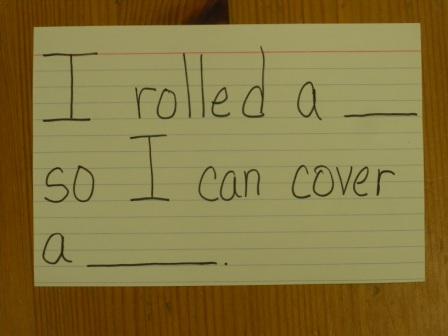
I've tried it with a few different math games this year and I'm amazed by it. The kids seem to appreciate having the support and use the sentence starters well.

I'm not ready to add these to every math game we play, but I'm glad to have this in my toolbox.
Wednesday, March 16, 2011
Choices and Decisions
I have a fabulous intern (student teacher) working in my classroom this semester. As always, working with an intern pushes me to think more deeply about why I do what I do.
Last week one of my dramatic little darlings got quite upset. She was frustrated by some friends and when we tried to smooth things out it just made things worse. She removed herself from the situation, but in a loud, stompy way. She headed over to our 'quiet spot' and shoved the chair and desk around. I told her I would count to 3 and if she did not stop the interruptions she would have to leave our room. I counted to 3 and she stopped, but as she sat down she shoved a stack of sentence strips around one last time.
I chose to let that go. She sat at that desk and cried (an exceptionally fake cry) for a few minutes. Then she sulked for another minute or so. Then she asked me if she could return to her math. I said that was up to her because she was the one who had decided to leave her math. She went back and worked with her classmates beautifully, including numerous high fives.
How did I know to let that last shove go? Why did I make that choice? I'm not sure. I do know, however, that the countless decisions teachers make each day can be so important. I owe it to my students to think about why a given decision worked out well or didn't.
Thirteen years of teaching, of making decisions every day, have increased my batting average. More of my decisions work out well now than did ten years ago. I owe it to my intern to try to explain what I've learned in that time.
Last week one of my dramatic little darlings got quite upset. She was frustrated by some friends and when we tried to smooth things out it just made things worse. She removed herself from the situation, but in a loud, stompy way. She headed over to our 'quiet spot' and shoved the chair and desk around. I told her I would count to 3 and if she did not stop the interruptions she would have to leave our room. I counted to 3 and she stopped, but as she sat down she shoved a stack of sentence strips around one last time.
I chose to let that go. She sat at that desk and cried (an exceptionally fake cry) for a few minutes. Then she sulked for another minute or so. Then she asked me if she could return to her math. I said that was up to her because she was the one who had decided to leave her math. She went back and worked with her classmates beautifully, including numerous high fives.
How did I know to let that last shove go? Why did I make that choice? I'm not sure. I do know, however, that the countless decisions teachers make each day can be so important. I owe it to my students to think about why a given decision worked out well or didn't.
Thirteen years of teaching, of making decisions every day, have increased my batting average. More of my decisions work out well now than did ten years ago. I owe it to my intern to try to explain what I've learned in that time.
Monday, March 14, 2011
Time is of the Essence
I feel strongly about how time is spent in my classroom. We have two hours every morning for language arts (reading and writing), fifteen to twenty minutes each day for our calendar math, and an hour for math. In addition, I make sure we have twenty to thirty minutes for free choice.
While kindergartners have 'center' time everyday to play, first graders are not expected to do so. I have a whole host of reasons for including this in our day which I will not go into here. Several teammates have remarked that they wish they could figure out how to include this in their days.
My feeling is that we make time for what we value.
However, I've recently been mulling this over some more. My thinking now is that how much time we spend on something is only part of the question. The quality of that time is equally, if not more, important.
Which is not to say that time is irrelevant. But we could spend two hours on math each day and if we don't use that time well then it doesn't really matter. Contrary to what so many (Bill Gates, Jay Mathews, Arne Duncan, etc) believe, our school days are plenty long. We just need to be using our time better, much better.
While kindergartners have 'center' time everyday to play, first graders are not expected to do so. I have a whole host of reasons for including this in our day which I will not go into here. Several teammates have remarked that they wish they could figure out how to include this in their days.
My feeling is that we make time for what we value.
However, I've recently been mulling this over some more. My thinking now is that how much time we spend on something is only part of the question. The quality of that time is equally, if not more, important.
Which is not to say that time is irrelevant. But we could spend two hours on math each day and if we don't use that time well then it doesn't really matter. Contrary to what so many (Bill Gates, Jay Mathews, Arne Duncan, etc) believe, our school days are plenty long. We just need to be using our time better, much better.
Saturday, March 12, 2011
Just Like Lincoln

This picture was taken by one of our kindergarten teachers around President's Day (maybe on that day since we had school to make up a snow day). In case you can't read it, their hats say, "Under my hat I would keep _________." As her class marched down the hall I remarked on how darling they were and she emailed me this photo. The little one striking a pose was attempting to look as much like Lincoln as possible. If he had a few more feet of height I think he'd be a match!
Thursday, March 10, 2011
Snow Fun in the Toasty Indoors
 After seeing this post I decided we had to give this a try. For a few weeks it sat around in my head without a good opportunity. Then, we were ready to wrap up our study of Benjamin Franklin, George Washington, Abraham Lincoln, and George Washington Carver (don't judge, state standards).
 So, we reviewed our data retrieval chart, with their names, dates, nicknames, contributions, and interesting facts. After reviewing each student picked one of the men and created a snow globe about them. We did show them some pictures of snow globes with people and items in them in the hopes that they would create something similar. These don't really hit that level, but they do show their understanding.
 On the whole I was pretty happy with the results. We haven't stuck any glitter on them yet as we were trying to avoid it being all over the floor in the hallway. Hopefully we'll do that before we send them home (because the parents will love that).
Tuesday, March 08, 2011
Very, Very Late to the Game
When Waiting for Superman came out, months ago, I read a lot of negative reactions. So, at that point I decided not to spend my time or money on it. Then, a couple of friends and colleagues saw it and actually felt reasonably good about it. I began to rethink it. Deep down I knew I'd have to see it for myself at some point.
Last weekend a friend invited over a small crowd to have dinner and watch the movie. Watching it with others and with wine was good.
My overall response to the movie is that it is propaganda. Maybe that is always true of documentaries, I haven't watched too many of them. The music used, the slow motion as parent and child walked to school, the images of the Capitol and sounds of the Pledge of Allegiance all work to create a certain feel. A clip from School of Rock was shown at one point to illustrate bad teaching. (Really? A movie?) The entire film builds around the suspense of several students attempting to get into charter schools. It is a well-made film. I understand why so many people were persuaded by it.
Just in case it isn't clear, I think we have significant problems in our urban schools. That may be the only thing I agreed with in this film.
Now to my concerns:
Another huge issue for me was the idea that there are so many bad teachers. At one point a statistic was thrown out about the percentage of teachers, doctors, and lawyers who lose their license (credentials, board certification, whatever) and the percentage of teachers was significantly smaller than that of doctors or lawyers. However, a significant number of teachers leave the profession in the first three to five years and that information was never addressed. I believe that many teachers who should be removed from the classroom, remove themselves early on. I would guess that is not so true for doctors or lawyers. Related to this I was very frustrated by the continuing suggestion that tenure means a job for life. That is completely untrue in K-12 education. Removing a teacher requires a process and it takes time, but it is far from impossible. If we want to blame anyone for this we should put that blame on principals who might prefer to move teachers around (The Lemon Dance as it was called in the film) rather than take the time to remove them. Finally, if we got rid of all these 'bad' teachers, who would replace them?
In light of all that is happening across the country with teachers' unions (and other public sector jobs) I found it frustrating that unions were somewhat demonized in this film. People they interviewed seemed to accept that they would have to deal with bureaucracy to do what they wanted to do, but were unwilling to deal with unions. Why is bureaucracy better than unions?
Final thought, a quote near the end asked, "What happens when a school fails a kid?" I believe we ought to be asking what happens when society fails a kid. The issues are larger than 180 days, six and a half hours each day.
I took five pages of notes as we watched the movie. There is so much more I could say, but this feels like it covers my major concerns. You're welcome.
Last weekend a friend invited over a small crowd to have dinner and watch the movie. Watching it with others and with wine was good.
My overall response to the movie is that it is propaganda. Maybe that is always true of documentaries, I haven't watched too many of them. The music used, the slow motion as parent and child walked to school, the images of the Capitol and sounds of the Pledge of Allegiance all work to create a certain feel. A clip from School of Rock was shown at one point to illustrate bad teaching. (Really? A movie?) The entire film builds around the suspense of several students attempting to get into charter schools. It is a well-made film. I understand why so many people were persuaded by it.
Just in case it isn't clear, I think we have significant problems in our urban schools. That may be the only thing I agreed with in this film.
Now to my concerns:
- There was lots of talk about how our country is falling behind the rest of the world. Actually, we've never been ahead in test scores. We've always fallen somewhere in the middle. It doesn't seem to have slowed us down very much.
- Lots of statistics were used without any information - where are those stats from? what tests are being discussed?
- Good schools, effective teachers, positive results - all terms used frequently without any explanation as to how they are defined. (I'm guessing I define positive results differently than Davis Guggenheim does.)
- Bill Gates arguing that innovation requires well educated citizens - I might be more interested in his thoughts on this if he hadn't dropped out of college - he seems to have succeeded just fine.
- Quote from the voice over: "This is the damage this school has done to this neighborhood." discussing an inner city area. I find it hard to imagine anyone really believes the school has caused all the problems the neighborhood faces.
Another huge issue for me was the idea that there are so many bad teachers. At one point a statistic was thrown out about the percentage of teachers, doctors, and lawyers who lose their license (credentials, board certification, whatever) and the percentage of teachers was significantly smaller than that of doctors or lawyers. However, a significant number of teachers leave the profession in the first three to five years and that information was never addressed. I believe that many teachers who should be removed from the classroom, remove themselves early on. I would guess that is not so true for doctors or lawyers. Related to this I was very frustrated by the continuing suggestion that tenure means a job for life. That is completely untrue in K-12 education. Removing a teacher requires a process and it takes time, but it is far from impossible. If we want to blame anyone for this we should put that blame on principals who might prefer to move teachers around (The Lemon Dance as it was called in the film) rather than take the time to remove them. Finally, if we got rid of all these 'bad' teachers, who would replace them?
In light of all that is happening across the country with teachers' unions (and other public sector jobs) I found it frustrating that unions were somewhat demonized in this film. People they interviewed seemed to accept that they would have to deal with bureaucracy to do what they wanted to do, but were unwilling to deal with unions. Why is bureaucracy better than unions?
Final thought, a quote near the end asked, "What happens when a school fails a kid?" I believe we ought to be asking what happens when society fails a kid. The issues are larger than 180 days, six and a half hours each day.
I took five pages of notes as we watched the movie. There is so much more I could say, but this feels like it covers my major concerns. You're welcome.
Sunday, March 06, 2011
Value of Smiles
I think of myself as a glass-half-full kind of person, a happy, hopeful person. When I run sprint triathlons I typically smile the whole time, even though I'm pretty awful at them. Folks have remarked on it at a number of different races.
Lately, for some reason, I don't feel I've been smiling enough (as much?). My gut reaction when I glance at a student or at my daughters or at my husband is closer to a frown. The message I think I'm sending is that I don't trust or don't like what they're doing. Is that the message I believe? Is that why I'm less smiley? I don't know.
At a recent team meeting one teammate had a cup of coffee from Caribou. It had fun quotes all over it and I couldn't help but read as many as possible from where I was sitting. One really struck me.
"Smile first, ask questions later."
That's my new goal.
Lately, for some reason, I don't feel I've been smiling enough (as much?). My gut reaction when I glance at a student or at my daughters or at my husband is closer to a frown. The message I think I'm sending is that I don't trust or don't like what they're doing. Is that the message I believe? Is that why I'm less smiley? I don't know.
At a recent team meeting one teammate had a cup of coffee from Caribou. It had fun quotes all over it and I couldn't help but read as many as possible from where I was sitting. One really struck me.
"Smile first, ask questions later."
That's my new goal.
Saturday, March 05, 2011
Benefits of Outside Observers
Several weeks ago some folks came in to video tape a lesson in our classroom. There were things that went well and things I would change given the opportunity. That's not surprising.
After everything was over, my student teacher remarked that she wished people came in to video tape everyday because the kids did so well.
My thought is that it might not be the kids who did so well, but me. Their presence in our classroom likely meant that I was my best self. I can't be my best self everyday, but how do I manage to increase the percentage?
After everything was over, my student teacher remarked that she wished people came in to video tape everyday because the kids did so well.
My thought is that it might not be the kids who did so well, but me. Their presence in our classroom likely meant that I was my best self. I can't be my best self everyday, but how do I manage to increase the percentage?
Friday, March 04, 2011
Mr. Chase's Wisdom
There are so many brilliant educators around the world writing about education. I'm grateful for that. So, it feels strange to single out one, but Zac Chase's recent posts have been so amazingly reflective, thoughtful, and thought-provoking that I felt an urge to share. If you aren't reading him currently, check it out. He's an English teacher at Science Leadership Academy. He turned 30 a couple of days ago, which actually makes him three or four years older than I would have guessed and makes me feel a little better.
I teach first grade, which is worlds away from high school in so many ways. However, I am pushed to think about my own work when I read Zac's writing. To be honest, that's one of my favorite things about the blogosphere. It has broadened my horizons. I learn from folks in and out of classrooms at all levels and in all areas around the world. That's pretty awesome.
Zac is writing a series of posts, "Things I Know" daily this year. That's quite a goal and I'm amazed he's not only kept it up but kept the quality so high. Go give him a read.
I teach first grade, which is worlds away from high school in so many ways. However, I am pushed to think about my own work when I read Zac's writing. To be honest, that's one of my favorite things about the blogosphere. It has broadened my horizons. I learn from folks in and out of classrooms at all levels and in all areas around the world. That's pretty awesome.
Zac is writing a series of posts, "Things I Know" daily this year. That's quite a goal and I'm amazed he's not only kept it up but kept the quality so high. Go give him a read.
Tuesday, March 01, 2011
What I Teach
For those who have never taught, it would be I think, a shock to realize how much we teach. I don't mean our content and subject areas, although that's daunting enough.
I also don't mean moving from one activity to the next, walking in the hall, sitting on the carpet, talking quietly with friends, or cleaning up. These are all fairly standard, along with a host of things I haven't even mentioned.
Just a bit ago we walked down the stairs from the computer lab and I had to help two or three students walk down the stairs. I'm not talking about being safe, I'm talking about walking down the steps one foot on each step. They still (in first grade) walk with both feet on each step. That takes forever. With my reminders and encouragement they can take the stairs like the rest of their class, but they aren't independent yet.
I spend at least at part of most days working with at least one student to help her realize when she is getting upset. If she can begin to recognize the way her body feels before she explodes, she can try to take a break and diffuse the situation for herself.
I teach students to use a stapler and paperclips regularly. Just recently I taught them to use screwdrivers and pliers (although I'll admit that's far from standard). I teach how to hang up coats and backpacks and where to put mittens and hats so they don't get lost. On a regular basis I teach how to close markers properly so they don't dry out.
If I am with my students then I am teaching someone something. The great majority of what I teach is not on any standard anywhere, but it is as or more important than anything the state or district has mandated I teach.
I'm sure other teachers could name dozens of things they teach that haven't even occurred to me, things that don't meet any standards for their grade or subject.
I also don't mean moving from one activity to the next, walking in the hall, sitting on the carpet, talking quietly with friends, or cleaning up. These are all fairly standard, along with a host of things I haven't even mentioned.
Just a bit ago we walked down the stairs from the computer lab and I had to help two or three students walk down the stairs. I'm not talking about being safe, I'm talking about walking down the steps one foot on each step. They still (in first grade) walk with both feet on each step. That takes forever. With my reminders and encouragement they can take the stairs like the rest of their class, but they aren't independent yet.
I spend at least at part of most days working with at least one student to help her realize when she is getting upset. If she can begin to recognize the way her body feels before she explodes, she can try to take a break and diffuse the situation for herself.
I teach students to use a stapler and paperclips regularly. Just recently I taught them to use screwdrivers and pliers (although I'll admit that's far from standard). I teach how to hang up coats and backpacks and where to put mittens and hats so they don't get lost. On a regular basis I teach how to close markers properly so they don't dry out.
If I am with my students then I am teaching someone something. The great majority of what I teach is not on any standard anywhere, but it is as or more important than anything the state or district has mandated I teach.
I'm sure other teachers could name dozens of things they teach that haven't even occurred to me, things that don't meet any standards for their grade or subject.
Monday, February 28, 2011
Fun with Tools
I finally got things together to add a new center to our free choice time.  I put this picture up as an option for the kids without telling them anything about it. Of the first 5 who went to pick their choice for today, four picked this with no idea what it would be.
They loved it! I have a few remote controls, a couple of portable CD players and a DVD player, all of which are broken. I have six screwdrivers and two pairs of pliers. The kids loved taking the items apart. So far the joy all seems to stem from unscrewing screws. I hope eventually they will find some interest in what is actually inside the items. For now, I'm happy they're excited about it!


 I put this picture up as an option for the kids without telling them anything about it. Of the first 5 who went to pick their choice for today, four picked this with no idea what it would be.
They loved it! I have a few remote controls, a couple of portable CD players and a DVD player, all of which are broken. I have six screwdrivers and two pairs of pliers. The kids loved taking the items apart. So far the joy all seems to stem from unscrewing screws. I hope eventually they will find some interest in what is actually inside the items. For now, I'm happy they're excited about it!


Sunday, February 27, 2011
7 Facts
Frau M. at Half Dollar in the Jar, weeks ago, tagged me with the 7 Facts Award. I'm always flattered when someone tags me for something and then I always manage to completely drop the ball. So, here goes...
1. I get all my news from NPR, The Daily Show, and The Colbert Report. It makes for a slightly jumbled, but mostly amusing sense of what's happening in the world.
2. I played harp on a cruise ship when I graduated from college. It wed the two things I wanted most at that time: to continue playing the harp and to travel. It was fabulous.
3. Related to number 2, we have a baby grand piano and a concert grand harp in our living room. There isn't room for much else.
4. I've been doing sprint triathlons (short ones) for three years now. I am exceptionally slow but I'm thrilled I can finish them!
5. As a kid I loved to read mysteries, Nancy Drew, Hardy Boys, and such, and I wanted to be a private detective when I grew up. But, really, only for the safe, fun parts.
6. In high school I spent two summers in Spain (I have an aunt from Spain and I stayed with her family) and loved it. I would live there if I could figure out how to make it work.
7. I was a total girly-girl as a kid. While still being something of a tomboy. I loved purple, flowery things, lace, and fancy dresses. Now I prefer sweatpants and a t-shirt.
I am not going to tag anyone, sadly, because clearly I'm not all that competent at these things.
1. I get all my news from NPR, The Daily Show, and The Colbert Report. It makes for a slightly jumbled, but mostly amusing sense of what's happening in the world.
2. I played harp on a cruise ship when I graduated from college. It wed the two things I wanted most at that time: to continue playing the harp and to travel. It was fabulous.
3. Related to number 2, we have a baby grand piano and a concert grand harp in our living room. There isn't room for much else.
4. I've been doing sprint triathlons (short ones) for three years now. I am exceptionally slow but I'm thrilled I can finish them!
5. As a kid I loved to read mysteries, Nancy Drew, Hardy Boys, and such, and I wanted to be a private detective when I grew up. But, really, only for the safe, fun parts.
6. In high school I spent two summers in Spain (I have an aunt from Spain and I stayed with her family) and loved it. I would live there if I could figure out how to make it work.
7. I was a total girly-girl as a kid. While still being something of a tomboy. I loved purple, flowery things, lace, and fancy dresses. Now I prefer sweatpants and a t-shirt.
I am not going to tag anyone, sadly, because clearly I'm not all that competent at these things.
Friday, February 25, 2011
Soul Searching
Inertia is a powerful force. The problem for me is that I can't tell when the issue is inertia or when it is fear or when it is neither.
A friend at work let me know today about a central office position that will be opening up soon. He suggested it might be a good fit for me.
It is an exciting position. There would be a lot of fun aspects to it and a lot of ways to impact schools. It would be a move up, something that doesn't happen as long as one remains in the classroom.
But, it would be outside of the classroom. In some ways I think that would be really good for me. In other ways I think it would be awful. It would also be outside of my fabulous, wonderful, amazing school. Again, that could be both good and bad.
Leaving my current job means leaving the kids. It means leaving the incredible teachers at my school. It means leaving the opportunities I've gained over the past 13 years, working with interns, supporting new teachers, teaming with colleagues and learning together.
Finally, leaving the classroom means not being a teacher anymore. I'm incredibly proud of the things that I do in the classroom and while I'm in a classroom. I've written an article, presented at conferences, blogged here and elsewhere all while being a classroom teacher. That means a lot to me. This is how I define myself.
Of course, there's no guarantee I'd get the job if I applied for it. That said, how do I know if I should try? My gut leans towards staying where I am, but is that because I'm afraid to take this leap? Is that because it's the easiest thing to do? Or is it because I'm not finished growing here yet?
A friend at work let me know today about a central office position that will be opening up soon. He suggested it might be a good fit for me.
It is an exciting position. There would be a lot of fun aspects to it and a lot of ways to impact schools. It would be a move up, something that doesn't happen as long as one remains in the classroom.
But, it would be outside of the classroom. In some ways I think that would be really good for me. In other ways I think it would be awful. It would also be outside of my fabulous, wonderful, amazing school. Again, that could be both good and bad.
Leaving my current job means leaving the kids. It means leaving the incredible teachers at my school. It means leaving the opportunities I've gained over the past 13 years, working with interns, supporting new teachers, teaming with colleagues and learning together.
Finally, leaving the classroom means not being a teacher anymore. I'm incredibly proud of the things that I do in the classroom and while I'm in a classroom. I've written an article, presented at conferences, blogged here and elsewhere all while being a classroom teacher. That means a lot to me. This is how I define myself.
Of course, there's no guarantee I'd get the job if I applied for it. That said, how do I know if I should try? My gut leans towards staying where I am, but is that because I'm afraid to take this leap? Is that because it's the easiest thing to do? Or is it because I'm not finished growing here yet?
Thursday, February 24, 2011
On a Lighter Note
 According to Zac Chase, this is Nerd Chic.
I wear my SLA lab coat everyday at school. It has one pocket to hold my flip camera and my regular camera and one pocket for pens, post-it notes, and my cell phone (forgive me, I've got a little one at a babysitter - I like to feel accessible). Plus, I can clip my badge and keys onto a pocket.
The first year I went to Educon, 2009, the students were all wearing their lab coats and I thought they were awesome. I casually mentioned to Chris Lehmann that, while I liked the Educon shirts, what I really wanted was a lab coat. He told me we could work that out.
I don't even think about what I'm wearing any more but I'm sure I look strange to other teachers or parents. But, being nerd chic works for me.
Wednesday, February 23, 2011
It's All About Me
I've got a little darling this year (it is first grade, most of them are pretty darling) who drove me nuts at the start of the year. She seemed snarky, if first graders can be snarky. She could push my buttons (see how it's becoming about me already).
We've all seen this happen when a student can just drive a teacher nuts. Some personalities just clash and being a teacher doesn't make one immune to this, unfortunately. Other teachers working with my class would also get highly annoyed by this little one. That was somewhat reassuring, suggesting that I was not the sole problem.
However, I'm smart enough to realize that I was at least a part of the problem. So, I decided I needed to build a better relationship with this one, and a few others while I was at it. I started inviting one child to pick a friend and eat lunch with me two or three days a week. To be honest, I find this almost painful because I highly value that time alone or to talk to other teachers, but I began with this student. It helped, but we still would butt heads a lot.
Then, by chance one day recently I came across the forms the kindergarten teachers filled out at the end of last year to help them create this year's first grade classes. These help us ensure well balanced classes: gender, ethnicity, reading ability, etc. This little one's kindergarten teacher had written "produces nice work, very sweet" about this child. I was shocked. That did not describe the student I knew (or thought I knew) at all. I went to this teacher and she was just as shocked to hear me describe the girl.
I can't say things are perfect now with this little one. But the difference is amazing. She's the same child she has always been. I just see her and respond to her differently. I'm more patient. I smile rather than frown. I gently remind rather than explode.
I am the difference. Like it or not, I have the control and power, even when I'm not aware or thinking about it.
I wish I could say I now respond to all my students in such a positive way. I can't, I'm far from perfect. I do believe I am striving for respect and kindness in all my interactions. I don't expect to succeed constantly, but I hope for continual improvement.
We've all seen this happen when a student can just drive a teacher nuts. Some personalities just clash and being a teacher doesn't make one immune to this, unfortunately. Other teachers working with my class would also get highly annoyed by this little one. That was somewhat reassuring, suggesting that I was not the sole problem.
However, I'm smart enough to realize that I was at least a part of the problem. So, I decided I needed to build a better relationship with this one, and a few others while I was at it. I started inviting one child to pick a friend and eat lunch with me two or three days a week. To be honest, I find this almost painful because I highly value that time alone or to talk to other teachers, but I began with this student. It helped, but we still would butt heads a lot.
Then, by chance one day recently I came across the forms the kindergarten teachers filled out at the end of last year to help them create this year's first grade classes. These help us ensure well balanced classes: gender, ethnicity, reading ability, etc. This little one's kindergarten teacher had written "produces nice work, very sweet" about this child. I was shocked. That did not describe the student I knew (or thought I knew) at all. I went to this teacher and she was just as shocked to hear me describe the girl.
I can't say things are perfect now with this little one. But the difference is amazing. She's the same child she has always been. I just see her and respond to her differently. I'm more patient. I smile rather than frown. I gently remind rather than explode.
I am the difference. Like it or not, I have the control and power, even when I'm not aware or thinking about it.
I wish I could say I now respond to all my students in such a positive way. I can't, I'm far from perfect. I do believe I am striving for respect and kindness in all my interactions. I don't expect to succeed constantly, but I hope for continual improvement.
Tuesday, February 15, 2011
Feeling Like a Real Writer
This year I've been writing posts for teachinghistory.org. My most recent post is Making Technology Work for Primary Students. There will be a couple of posts following-up on this one. I'm enjoying this opportunity to write in a different way and with a (somewhat) different purpose. The site is quite good and they've got some wonderful teachers writing for them across the grade levels. (Spoiler alert: Apparently the fabulous Diana Laufenberg has just joined the team.)
The first couple of posts I wrote were focused on accuracy in teaching history in the primary grades - specifically around Columbus Day and Thanksgiving.
The first couple of posts I wrote were focused on accuracy in teaching history in the primary grades - specifically around Columbus Day and Thanksgiving.
Monday, February 14, 2011
Hallway Math
 Twice a week I take my little darlings to the computer lab. In my brilliance I signed up for times right after lunch. The theory was that we wouldn't waste a lot of time wandering back and forth through the hallways. The reality is that now we have to stop and wash our hands because I refuse to take them to the lab after lunch without washing hands. Sigh.
So, twice a week we have time standing around waiting for our friends to wash hands. It's a surprisingly long process. On my lazy days we all stand around and they whisper (hopefully) to each other.
On my better days we play games. Our most recent, and my current favorite, involves me asking them to show a number with their fingers. Then, show it to me another way. Then another way. We try to find all the possible ways to show a number.
 Everyone can play at the same time and the only talking is me saying a number and telling them to show it another way. Hopefully it's also helping them cement the idea that numbers can be built in many different ways.

 Everyone can play at the same time and the only talking is me saying a number and telling them to show it another way. Hopefully it's also helping them cement the idea that numbers can be built in many different ways.
While we're loving this game right now, if you have any others that would be good for first graders, please share! Ideally they allow everyone to be involved and are pretty quiet. Thanks!
Sunday, February 13, 2011
How Does Snow Sound?
 After reading this post from Kelly Teaches I decided to try to be more positive about snow as well. Over the summer a bunch of us read and discussed A Place for Wonder by Georgia Heard and Jennifer McDonough. We've done a lot of wondering in a variety of ways this year. It seemed like time to wonder about snow.
I scooped some snow into four small clear tubs and put them out for the students to explore. I also put out magnifying glasses.


We talked about using our senses to explore the snow. This explains why one girl here is trying to listen to the snow.
They stirred the snow with the magnifying glasses, squished it between their fingers, and looked at it closely with the magnifying glasses. It was beautiful to watch. Some students were fascinated by how cold the snow felt (have they not been outside at all? what were they doing on our snow days?) and others were amazed by how the snow looked like diamonds when scrutinized.
I'm learning that I shouldn't assume my students understand the world they see everyday. One would think I'd have learned that from reading Science Teacher, but clearly I needed a more concrete reminder. We'll be exploring more common, everyday things in the future.
Saturday, February 12, 2011
Not the Utopia I Hoped
 While these pictures in no way represent the norm in my classroom, they do make one wonder. What am I doing wrong?
Add to this the fact that at least one or two kids breaks out into tears on a daily basis and I'm beginning to question the wonderful learning environment I thought we had created. (I haven't snapped pics of those sobbing students; it seems that crosses the line for me.)
Honestly, most of the time things are wonderful. I'm not truly concerned, but coming across these pictures after having just tweeted this yesterday:

did cause me to reflect a bit. This will remain on my mind as I plan our lessons, activities, and fun for the next few weeks. At least I hope I'll keep it in mind and work to make things better.
Friday, February 11, 2011
Loving Writing
Yesterday and today we had large writing celebrations at school. We do this every year around Valentine's Day to celebrate our love of writing. We've had to make it two days because our school has gotten so large (we don't have enough parking to have parents from the whole school visit).
In our first grade classroom we've worked hard to plan and write a book, revise it (make it sound better) and edit it (make it look right). By yesterday everyone had a book to share. We decorate the room and hallway, set up a stage (a coffee table) and read our books! About half of our class had family members here to share the joy. After everyone reads we have cookies and juice and the chance to really look at each others' writing.
It's a very exciting day for first graders, if a bit exhausting for their teachers. I recorded all of them reading and you can watch them on our class blog, if you feel such an urge.
To keep the excitement going we've put a poster up in the hallway. One side of the poster asks, "What kinds of writing do you do?" The other side is available for friends to share comments about our writing. I've left markers and the students' books on our coffee table under the poster. I'm hoping people will slowly add their thoughts and we can keep learning about writing.

In our first grade classroom we've worked hard to plan and write a book, revise it (make it sound better) and edit it (make it look right). By yesterday everyone had a book to share. We decorate the room and hallway, set up a stage (a coffee table) and read our books! About half of our class had family members here to share the joy. After everyone reads we have cookies and juice and the chance to really look at each others' writing.
It's a very exciting day for first graders, if a bit exhausting for their teachers. I recorded all of them reading and you can watch them on our class blog, if you feel such an urge.
To keep the excitement going we've put a poster up in the hallway. One side of the poster asks, "What kinds of writing do you do?" The other side is available for friends to share comments about our writing. I've left markers and the students' books on our coffee table under the poster. I'm hoping people will slowly add their thoughts and we can keep learning about writing.


Wednesday, February 09, 2011
Value of Silliness
If you missed Educon you missed a lot. More than I can begin to tackle. However, my very favorite moment of the entire event was this one:
I have immense respect for these two men and their takes on silliness and seriousness are fabulous. I don't think I could have put into words what they have said about this idea, that there is value in silliness but I completely agree with them.
I don't know either man well, but I spent some time with Chris Lehmann at CMK last summer and he is being completely honest about not taking himself seriously. I might not have believed it before then but it is true. I have spent less time with Zac Chase, but I don't question his sincerity here.
A principal's office like this has to be a good sign for a school.
I have immense respect for these two men and their takes on silliness and seriousness are fabulous. I don't think I could have put into words what they have said about this idea, that there is value in silliness but I completely agree with them.
I don't know either man well, but I spent some time with Chris Lehmann at CMK last summer and he is being completely honest about not taking himself seriously. I might not have believed it before then but it is true. I have spent less time with Zac Chase, but I don't question his sincerity here.
A principal's office like this has to be a good sign for a school.
Monday, February 07, 2011
Co-Teaching as Mentoring
I'm a month behind on this article from Education Week. (I blame Educon.) Apparently special education teachers are much less likely to have a mentor in their first years of teaching than general education teachers.
It got me thinking about my school, as I do frequently. In the years I've been there we've had a few teachers who have not had their contract renewed after two or three years. They've all be classroom teachers.
We have lots of special education, English Speakers of Other Languages, literacy, and math teachers. Just like our general education teachers they have not all started off super strong (as is true for most teachers). And yet, we've never had one whose contract wasn't renewed.
I think that's because of our co-teaching model. All of our non-classroom teachers co-teach in multiple classrooms everyday. They have the opportunity to watch the classroom teachers with whom they work. They plan with the classroom teachers, discuss what they are noticing about students together, and generally work as a team. They are not functioning in isolation.
Of course, this is true for our classroom teachers as well. But, a classroom teacher may only have one specialist in their room for an hour a day. Our specialists are in rooms for multiple hours each day. It can, for those just getting started, almost serve as additional student teaching time. That's pretty powerful.
It got me thinking about my school, as I do frequently. In the years I've been there we've had a few teachers who have not had their contract renewed after two or three years. They've all be classroom teachers.
We have lots of special education, English Speakers of Other Languages, literacy, and math teachers. Just like our general education teachers they have not all started off super strong (as is true for most teachers). And yet, we've never had one whose contract wasn't renewed.
I think that's because of our co-teaching model. All of our non-classroom teachers co-teach in multiple classrooms everyday. They have the opportunity to watch the classroom teachers with whom they work. They plan with the classroom teachers, discuss what they are noticing about students together, and generally work as a team. They are not functioning in isolation.
Of course, this is true for our classroom teachers as well. But, a classroom teacher may only have one specialist in their room for an hour a day. Our specialists are in rooms for multiple hours each day. It can, for those just getting started, almost serve as additional student teaching time. That's pretty powerful.
Sunday, February 06, 2011
Benefit of the Blogosphere
If you've missed the ongoing conversation between Chris Lehmann and Ira Socol about Educon (and, really, education in general) take a few minutes to check it out. The exchange has been fascinating and thought-provoking, but this comment from Chris really struck a chord with me.
One of the most significant benefits I get from my involvement in the blogosphere and twitter and such is this. It keeps voices I respect in my head. It keeps my focus on a high bar for me and my students.
Finally, let's also take a moment to enjoy this dialogue. It was on my mind today when I mediated a very challenging moment between a student and a teacher who were not seeing eye to eye. The easy move would have been to side with the teacher and tell the kid to deal. I don't think -- I don't think -- I would have done that under any circumstances, because I don't think that's my MO in general. But today, your voice was very much in my head, and I was even more aware than usual of being worthy of this conversation and worthy of trying to walk in the footsteps of my heroes / mentors (even the mentors I've never met) in that moment.
One of the most significant benefits I get from my involvement in the blogosphere and twitter and such is this. It keeps voices I respect in my head. It keeps my focus on a high bar for me and my students.
Monday, January 31, 2011
How Educon Changed My Thinking
Back at school for a teacher workday this morning several folks have asked how Educon was. After a brief chat with one, she asked me, "How has your thinking changed?" I had to admit I couldn't answer yet. I needed to carve out some reflection time. So, here goes.
The first session I attended was on policy. Whether or not the four who presented that session are typical of those involved in making policy I can't say. I appreciate their presence at this conference and I'm grateful to them for sharing their perspective and inside information with us. I left that session with a sense of empowerment, an idea that I could get involved. They've got a great google doc with information and ideas. We'll see what happens, but I'm hopeful this session was the kick I needed to stretch myself in a new direction. I'd like to invite people in to see our classroom and my students, to help give them a sense of the realities and possibilities. Through those invitations (accepted or not) I hope to build some relationships and work to make my voice heard. Stating this publicly will be one way to keep me accountable in this goal.
The last session I was able to attend asked the question, Is the Internet Making Us Stupid? I enjoyed the structure of this session - they had collected interesting, provocative quotes from the book The Shallows and we moved to points in the room to indicate our agreement or disagreement with each statement. This led to some really fabulous discussion. I don't think there was anything from this session that has changed my thinking right at this moment. What it did was raise a lot of questions for me about how what we do affects how our brains work. It brought new ideas into the forefront of my thinking and I will continue to be pondering them. That may be all that happens or it may lead to something more. I have no idea.
I have just skimmed the surface of Educon and my experience there in this post. Writing it, however, helped me synthesize my thinking and reflect. I need to keep doing that.
The first session I attended was on policy. Whether or not the four who presented that session are typical of those involved in making policy I can't say. I appreciate their presence at this conference and I'm grateful to them for sharing their perspective and inside information with us. I left that session with a sense of empowerment, an idea that I could get involved. They've got a great google doc with information and ideas. We'll see what happens, but I'm hopeful this session was the kick I needed to stretch myself in a new direction. I'd like to invite people in to see our classroom and my students, to help give them a sense of the realities and possibilities. Through those invitations (accepted or not) I hope to build some relationships and work to make my voice heard. Stating this publicly will be one way to keep me accountable in this goal.
The last session I was able to attend asked the question, Is the Internet Making Us Stupid? I enjoyed the structure of this session - they had collected interesting, provocative quotes from the book The Shallows and we moved to points in the room to indicate our agreement or disagreement with each statement. This led to some really fabulous discussion. I don't think there was anything from this session that has changed my thinking right at this moment. What it did was raise a lot of questions for me about how what we do affects how our brains work. It brought new ideas into the forefront of my thinking and I will continue to be pondering them. That may be all that happens or it may lead to something more. I have no idea.
I have just skimmed the surface of Educon and my experience there in this post. Writing it, however, helped me synthesize my thinking and reflect. I need to keep doing that.
Sunday, January 30, 2011
Educon 2.3
 I'm giving an Encienda* presentation at lunch today at Educon. My message (that I hope comes through) is that we need the focus in education today to be on students, not on content.
 I realized this morning that it hits on one of the reasons I love coming to Educon. I've spent the last two days with people who are focused on students, who are passionate about learning, who see the important pieces of education. That's easy to lose sight of in educational discussions in our country.
There is some frustration with Educon in that folks are frustrated by the lack of change. There seems to be a sense that after Educon everyone should go home and change the world. While I get the frustration, the more I think about it the more absurd it seems.
First of all, while I learn at Educon, it's not mind-blowing. I'm learning from most of these people on a regular basis already. There are things I will do as a result of this conference, but nothing will be earth-shattering.
Secondly, change takes time. Nothing is going to make our educational system change overnight. Not even Educon.
Finally, what on earth are people expecting from a few hundred human beings spending three days together? A whole new world?
The fact that Educon doesn't cause massive uproar in our educational system doesn't diminish its value.
*This is a 5 minute presentation with 20 slides that auto-advance every 15 seconds.
Image from WOScholar's flickr stream in the Educon 2.3 group.
Monday, January 24, 2011
It Gives Me Hope
I wrote a couple of weeks ago about one of my students who lost an infant sibling. My heart is still breaking over all the sadness for the family. Dad lost his job, the car was repossessed and they're grieving. It feels like all I can do is keep teaching this little darling and try to spend as much time together as possible. It's not much.
However, as a school, we are trying to do more. Several of us attended the funeral service. Our counselors are supporting the children of course, but they are also meeting with the parents to try and help them get the support they need for their emotional challenges. Grocery store gift cards and things for the kids (toys, books) are being delivered. Without anyone asking, people are donating money to help them pay their rent.
I am reminded, yet again, at the absolute fabulousness of the people at my school.
However, as a school, we are trying to do more. Several of us attended the funeral service. Our counselors are supporting the children of course, but they are also meeting with the parents to try and help them get the support they need for their emotional challenges. Grocery store gift cards and things for the kids (toys, books) are being delivered. Without anyone asking, people are donating money to help them pay their rent.
I am reminded, yet again, at the absolute fabulousness of the people at my school.
Saturday, January 22, 2011
Help Me Out
My husband and I are presenting at Educon next weekend (something that has me a bit panicked). We've never presented together before. I am actually quite excited, just equally nervous. Here's our conversation description:
Whether you are planning to attend Educon or not, I would love your thoughts on this. I'm curious to know if you think the session as I have laid it out makes sense. I'm also curious to hear folks' thoughts on these questions.
(I know throwing this out there on a Saturday night is far from ideal timing. That said, I'm still going to ask you to share your thoughts. Thanks!)
We're thinking of a few big questions beginning with 'What is assessment?' We figure it's a good idea to be on the same page about the meaning of the word, the goals of it and the basic idea behind it. Then we can move on to who should be involved and what would be gained by involving them. Hopefully we will also be able to address the various barriers (practical and theoretical) involved here. The final piece is to brainstorm how we facilitate this collaboration in light of the barriers.
Collaboration is all the rage in education teachers work together, students collaborate, and partnerships extend into communities. Collaborative assessment (including, but not limited to grades) does not receive the same attention. Who should be involved in assessing students? How can we facilitate collaboration between teachers and/or between students and teachers?
Whether you are planning to attend Educon or not, I would love your thoughts on this. I'm curious to know if you think the session as I have laid it out makes sense. I'm also curious to hear folks' thoughts on these questions.
(I know throwing this out there on a Saturday night is far from ideal timing. That said, I'm still going to ask you to share your thoughts. Thanks!)
Tuesday, January 18, 2011
Good Friend, Plank
 Apparently the cartoon Ed, Edd, and Eddy has a character who carries around a piece of wood with a face drawn on it, named Plank. That completely exhausts my knowledge of this.
I learned that much because a student of mine arrived one day carrying a piece of paper folded with a face drawn on it. He called it Plank. During morning meeting he would have the children say good morning to it during greeting and he carried it everywhere. You can see it in his hand as he is up at the smartboard.

 Most of the time Plank actually helped out. This student seemed more focused with Plank. When Plank did seem to become a distraction it took a quick warning to Plank and things got back on track.
I can't wait to see if Plank is back after the three-day weekend.

Monday, January 17, 2011
Another Reason Our Librarian is a Goddess
 One of the lessons our librarian teaches every year focuses on where students can read their library books. She does this because she has found that kids check out books one day and return them the next. So she has a few lessons on what to do with your library books, including this one.
With the kids she draws a house and an apartment and adds parts to them. Then she draws pictures of books in all the places they might be kept and people reading anywhere they might read.
The lesson is a worthy one but my favorite part is that every year at least one child mentions reading in the bathroom and our librarian happily draws someone reading on the toilet.
Sunday, January 16, 2011
Links I've Been Mulling
I try not to write posts that go on for days; mostly because I tend not to read those sorts of posts. I may not be able to help myself here though. Several things I've read in the last week or so keep percolating in my mind.
First off, Ben Johnson wrote on Edutopia about the need to learn. He seems to be arguing that teachers need to worry less about their students' lives outside of school and just focus on teaching.
To follow up on that topic Valerie Strauss had a post (on the Washington Post) about the shortage of school counselors. Apparently schools are recommended to have one counselor for every 250 students. Our district seems to fund one counselor for every 500 students. Just allotting counselors per student does not make a lot of sense. Schools with many students living in poverty are likely to have a greater number of issues requiring counselors. Need should be factored into this question. Of course, none of that is relevant if there aren't enough counselors to begin with.
The National Association of Secondary School Principals had a recent post considering the impact of poverty on PISA scores. They have taken the time to break out our PISA scores based on percentage of students in the free or reduced lunch program. One of the most astounding things to me is that no one seems to have the poverty rate we have. That alone suggests a problem far greater than anything in education. The charts the NASSP have created comparing PISA scores are worth checking out.
Finally, Jay Mathews (also at the Washington Post) encouraged schools offering free or reduced price breakfasts to require students to read as they eat. This is not surprising as Mathews often argues for more learning time in a variety of ways. While I am not against making powerful use of the time we have students in school, I also believe that learning is social. Children need time to talk to one another. I also know that in many high poverty schools children do not have a lot of social time outside of school. They go home to apartments and remain there because their parents do not feel it is safe to let them run around outside (and quite possibly they are correct). I fear we are losing sight of children as people and seeing them only as small vessels who must learn things we have deemed important.
(While Mathews did not offend me with this post, many of the comments do. But that's a whole other post.)
First off, Ben Johnson wrote on Edutopia about the need to learn. He seems to be arguing that teachers need to worry less about their students' lives outside of school and just focus on teaching.
Am I sacrilegious by saying we should not spend so much time worrying about what happens in a student's home and should spend more time creating effective learning environments at school?I have a hard time divorcing the two. If I ignore the fact that one of my students is living in a homeless shelter and that another just lost a baby brother in order to focus solely on their learning environment, is that truly helpful? I can't completely separate my life outside of school from my life in school so it seems absurd to think that young children can.
To follow up on that topic Valerie Strauss had a post (on the Washington Post) about the shortage of school counselors. Apparently schools are recommended to have one counselor for every 250 students. Our district seems to fund one counselor for every 500 students. Just allotting counselors per student does not make a lot of sense. Schools with many students living in poverty are likely to have a greater number of issues requiring counselors. Need should be factored into this question. Of course, none of that is relevant if there aren't enough counselors to begin with.
The National Association of Secondary School Principals had a recent post considering the impact of poverty on PISA scores. They have taken the time to break out our PISA scores based on percentage of students in the free or reduced lunch program. One of the most astounding things to me is that no one seems to have the poverty rate we have. That alone suggests a problem far greater than anything in education. The charts the NASSP have created comparing PISA scores are worth checking out.
Finally, Jay Mathews (also at the Washington Post) encouraged schools offering free or reduced price breakfasts to require students to read as they eat. This is not surprising as Mathews often argues for more learning time in a variety of ways. While I am not against making powerful use of the time we have students in school, I also believe that learning is social. Children need time to talk to one another. I also know that in many high poverty schools children do not have a lot of social time outside of school. They go home to apartments and remain there because their parents do not feel it is safe to let them run around outside (and quite possibly they are correct). I fear we are losing sight of children as people and seeing them only as small vessels who must learn things we have deemed important.
(While Mathews did not offend me with this post, many of the comments do. But that's a whole other post.)
Tuesday, January 11, 2011
Everyone Deserves a Childhood
I'm sitting here in my classroom half an hour after the kids have gone home, crying. It's been that sort of a day.
I learned this morning that a younger sibling (7 months old) of one of my students died last night. I know the baby had been in the hospital (maybe in and out, I'm not certain) but I don't know details. This family has a second-grader, my little first-grader, a pre-schooler in a high-needs program at another school and this baby. I don't know if mom works, but we learned today that dad lost his job last week. He's had bronchitis and hasn't been able to work so he lost his job. Money was tight before, I can't imagine what it will be like now.
The fabulous people at my school have kicked into high gear contacting various groups and government folks to find any kind of help (funeral costs, food). Our principal is planning to send an Edible Arrangement from the school. Many people have already offered to donate towards grocery store gift cards or anything else that might be needed.
I managed to continue teaching all day, through a fog. I hope my student will be back tomorrow. Our counselors are already on deck to meet with both these kiddos. I'm not sure how to support a child through something like this (both the loss of a sibling and the difficulty involved in watching your parents handle such trauma). I'm grateful to be at a school with so many people who have stepped up to help in big and small ways. I know they'll help me help my student.
But I'm also a bit bitter about what the families at our school face. I've got one student living in a homeless shelter (one that I know of, anyway). The majority are on free or reduced lunch. And have you ever looked at that? You have to make almost nothing to qualify for that. I know of at least one family that doesn't qualify but can barely make their bills. Many of our families don't have health insurance, which means that little problems become much bigger problems. The areas in which many of our kids live are not as safe as we would like. They may live two or three families in a small apartment.
Amazingly enough, these kids are happy and eager to learn. Working with them is a delight. Their families are incredibly grateful for all we do for their children. They try to support us in every way we ask. They do this in spite of crowded living conditions, not enough money, working multiple jobs, and, often, limited English. I'm amazed by them.
They deserve better. We as a society deserve better. No one should struggle to survive like this. No child should face such adversity. They should get to be children.
I learned this morning that a younger sibling (7 months old) of one of my students died last night. I know the baby had been in the hospital (maybe in and out, I'm not certain) but I don't know details. This family has a second-grader, my little first-grader, a pre-schooler in a high-needs program at another school and this baby. I don't know if mom works, but we learned today that dad lost his job last week. He's had bronchitis and hasn't been able to work so he lost his job. Money was tight before, I can't imagine what it will be like now.
The fabulous people at my school have kicked into high gear contacting various groups and government folks to find any kind of help (funeral costs, food). Our principal is planning to send an Edible Arrangement from the school. Many people have already offered to donate towards grocery store gift cards or anything else that might be needed.
I managed to continue teaching all day, through a fog. I hope my student will be back tomorrow. Our counselors are already on deck to meet with both these kiddos. I'm not sure how to support a child through something like this (both the loss of a sibling and the difficulty involved in watching your parents handle such trauma). I'm grateful to be at a school with so many people who have stepped up to help in big and small ways. I know they'll help me help my student.
But I'm also a bit bitter about what the families at our school face. I've got one student living in a homeless shelter (one that I know of, anyway). The majority are on free or reduced lunch. And have you ever looked at that? You have to make almost nothing to qualify for that. I know of at least one family that doesn't qualify but can barely make their bills. Many of our families don't have health insurance, which means that little problems become much bigger problems. The areas in which many of our kids live are not as safe as we would like. They may live two or three families in a small apartment.
Amazingly enough, these kids are happy and eager to learn. Working with them is a delight. Their families are incredibly grateful for all we do for their children. They try to support us in every way we ask. They do this in spite of crowded living conditions, not enough money, working multiple jobs, and, often, limited English. I'm amazed by them.
They deserve better. We as a society deserve better. No one should struggle to survive like this. No child should face such adversity. They should get to be children.
Sunday, January 09, 2011
The Value in Labeling
Tonight at bath time my husband was attempting to wash our three-year-old's hair. As he was trying to get her to lay down and get her hair wet she said (in an exasperated voice), "I'm being patient." I know he and I were both thinking, "This is what you look like being patient?"
This interaction got me thinking about something that has been on my mind a lot lately. Having read a lot of Alfie Kohn's work and Peter Johnston's Choice Words, I struggle with using praise with my students (and my daughters). I've come to a conclusion recently that what I am attempting to do instead is to label things: behaviors, strategies, skills, etc. Sometimes that means telling a student that what they are doing is rude. I'm not assuming they realize that already. Sometimes it means pointing out how efficient a math or reading strategy was for a student. Sometimes it means showing a student how they used dialogue in their story. Hopefully I am not making a judgment call but simply putting a name to what they are doing. (Although I realize that rude is a judgment call.)
Young children, and my students in particular, do not have words for all they see, try, or know. I hope by labeling things in conversations with them they will be better equipped to use that strategy again or choose an appropriate behavior.
As for my three-year-old, I'm not sure if we need to do a better job of labeling patience when she is actually demonstrating it or if she just labeled it so we will recognize it in the future.
This interaction got me thinking about something that has been on my mind a lot lately. Having read a lot of Alfie Kohn's work and Peter Johnston's Choice Words, I struggle with using praise with my students (and my daughters). I've come to a conclusion recently that what I am attempting to do instead is to label things: behaviors, strategies, skills, etc. Sometimes that means telling a student that what they are doing is rude. I'm not assuming they realize that already. Sometimes it means pointing out how efficient a math or reading strategy was for a student. Sometimes it means showing a student how they used dialogue in their story. Hopefully I am not making a judgment call but simply putting a name to what they are doing. (Although I realize that rude is a judgment call.)
Young children, and my students in particular, do not have words for all they see, try, or know. I hope by labeling things in conversations with them they will be better equipped to use that strategy again or choose an appropriate behavior.
As for my three-year-old, I'm not sure if we need to do a better job of labeling patience when she is actually demonstrating it or if she just labeled it so we will recognize it in the future.
Friday, January 07, 2011
Play vs. Learning (Maybe)
This morning during our independent reading time I was rereading Reading with Meaning by Debbie Miller (an absolutely fabulous book). At the end of a chapter I came across this quote:
My initial reaction to this quote was a firm support for it. However, as I mulled it over I began to question my response. Is it a bad thing for the materials to no longer be an end unto themselves? Does everything have to come back to the learning?
I can't decide if I'm looking for a happy medium between what Debbie Miller is describing and a completely free play time or if I think one or the other is better. I'd love to hear thoughts.

"Once children begin to integrate their learning into their play, the materials are no longer an end unto themselves; they've become another means for creating understanding and constructing meaning. They've become a means for living the learning."I sat there, staring off into space for several minutes. (I would chastise my students if they were staring off into space for several minutes during independent reading. I will have to be more careful about that.)
My initial reaction to this quote was a firm support for it. However, as I mulled it over I began to question my response. Is it a bad thing for the materials to no longer be an end unto themselves? Does everything have to come back to the learning?
I can't decide if I'm looking for a happy medium between what Debbie Miller is describing and a completely free play time or if I think one or the other is better. I'd love to hear thoughts.
Tuesday, January 04, 2011
All Kinds of Luck
A little darling in my class will be out for the next two weeks after she has her tonsils and adenoids removed tomorrow. I would be sympathetic to any child and their family looking at surgery and two weeks of recovery.
However, it struck me today that many of my students are in a tough position when it comes to things like this. Her mom is a single mother and she can't take two weeks off from work. Most people can't. Luckily, the grandmother lives nearby and she will take some time off to help out. This family is also lucky enough to have health insurance, something many of our families don't have.
On the whole, this family is in a better position to weather this health challenge than many.
I mentor this little girl's older sister, a 3rd grader. About six weeks ago I talked to their mom because I noticed that she was having trouble seeing well, not huge trouble but I thought she might need glasses. Our clinic aide immediately knew that she does need glasses and had some earlier this year. (Glasses and young children do not go well together - they are frequently lost or broken.) Mom told me that she had an eye appointment in January. They had to wait until then for it to be long enough since the last appointment for the insurance. It turns out that appointment is tomorrow, the same day as her sister's surgery.
Again, luckily mom has been able to find someone to pick the older sister up from school and take her to the eye doctor.
I am quite impressed with everything this mother has managed to coordinate quickly (the surgery was bumped up a few weeks this morning). Her daughter seems almost excited about the surgery. Apparently she has been told she will get lots of ice cream and sorbet.
Dealing with something like this would intimidate me between the concern for my child and the logistics of it all. And I have a helpful husband. I am lucky. Many people aren't.
However, it struck me today that many of my students are in a tough position when it comes to things like this. Her mom is a single mother and she can't take two weeks off from work. Most people can't. Luckily, the grandmother lives nearby and she will take some time off to help out. This family is also lucky enough to have health insurance, something many of our families don't have.
On the whole, this family is in a better position to weather this health challenge than many.
I mentor this little girl's older sister, a 3rd grader. About six weeks ago I talked to their mom because I noticed that she was having trouble seeing well, not huge trouble but I thought she might need glasses. Our clinic aide immediately knew that she does need glasses and had some earlier this year. (Glasses and young children do not go well together - they are frequently lost or broken.) Mom told me that she had an eye appointment in January. They had to wait until then for it to be long enough since the last appointment for the insurance. It turns out that appointment is tomorrow, the same day as her sister's surgery.
Again, luckily mom has been able to find someone to pick the older sister up from school and take her to the eye doctor.
I am quite impressed with everything this mother has managed to coordinate quickly (the surgery was bumped up a few weeks this morning). Her daughter seems almost excited about the surgery. Apparently she has been told she will get lots of ice cream and sorbet.
Dealing with something like this would intimidate me between the concern for my child and the logistics of it all. And I have a helpful husband. I am lucky. Many people aren't.
Thursday, December 30, 2010
Common Assessments: Too Common and Not Truly Assessing
I've questioned the ideas behind PLCs for some time. Currently I've been mulling over the idea of common assessments. This year our school has a focus on common assessments and my team has been using them in math once a quarter. It's got me thinking about the purpose of these assessments.
Unless I am mistaken, common assessments are often used for assessing students. As surprising as it may sound, I don't think that's an appropriate use for them.
A lot can be learned from a common assessment, but it should not be used to judge the students. Assuming that every student in a grade level is ready for an assessment at the same time, or that they should all be assessed in exactly the same way, makes no sense. At least not if we really want to assess their understanding.
When we look at our common assessments we learn about misconceptions or language gaps our students have that we can address to help them understand the concept. We identify flaws in the assessment in order to improve it for the future. Sometimes we find that one teacher was really successful with a concept and should share his/her strategies.
But we don't learn much about what our students understand. There are infinitely better ways to do that than a common assessment.
It's possible I am completely misunderstanding the intention of common assessments or how they are frequently used.
Unless I am mistaken, common assessments are often used for assessing students. As surprising as it may sound, I don't think that's an appropriate use for them.
A lot can be learned from a common assessment, but it should not be used to judge the students. Assuming that every student in a grade level is ready for an assessment at the same time, or that they should all be assessed in exactly the same way, makes no sense. At least not if we really want to assess their understanding.
When we look at our common assessments we learn about misconceptions or language gaps our students have that we can address to help them understand the concept. We identify flaws in the assessment in order to improve it for the future. Sometimes we find that one teacher was really successful with a concept and should share his/her strategies.
But we don't learn much about what our students understand. There are infinitely better ways to do that than a common assessment.
It's possible I am completely misunderstanding the intention of common assessments or how they are frequently used.
Thursday, December 23, 2010
New Year's Resolutions
I have been a super cranky, Grinch of a teacher lately. I have a lot of excuses, but it always comes back to me. In the moments of crankiness I can feel how awful it is but I can't seem to handle things in a better way.
So, I'm hoping the break will help me get rejuvenated and start fresh in January. My resolution is to stop reacting to my students and start reflecting more. I hope that if I can step back to reflect I will be in better shape to respond well.
This week my first graders created resolutions (we called them goals for the new year). They wrote their goal in Pixie and then illustrated it. I was amazed at how thoughtful and hard-working they were during our 45 minutes in the computer lab.
This is why my resolution is important to me. Kids who can create these goals deserve a patient, thoughtful, respectful teacher.


So, I'm hoping the break will help me get rejuvenated and start fresh in January. My resolution is to stop reacting to my students and start reflecting more. I hope that if I can step back to reflect I will be in better shape to respond well.
This week my first graders created resolutions (we called them goals for the new year). They wrote their goal in Pixie and then illustrated it.
 I was amazed at how thoughtful and hard-working they were during our 45 minutes in the computer lab.
This is why my resolution is important to me. Kids who can create these goals deserve a patient, thoughtful, respectful teacher.


Thursday, December 16, 2010
Edublog Award Thoughts
I didn't pay too much attention to the Edublog Awards this year. Actually, I don't ever. It comes when I'm much too busy to give it much attention. I do enjoy seeing the results, however. Just as I enjoy the results of the Oscars or the Tonys or the Pulitzers. I don't follow any closely, but I like to see who won.
Some blogs I enjoy and respect won Edublog Awards. But the results got me thinking about what the edublogosphere (defined by those who nominated and voted) is looking for in blogs. Richard Byrne's Free Technology for Teachers won three awards, Best Individual Blog, Best Resource Sharing Blog, and Best Ed Tech Support Blog. Larry Ferlazzo's Websites of the Day was a runner-up in Best Individual Blog.
First off, I have immense respect for both of those men. I can't imagine how they manage to be aware of all those resources, knowledgeable about them, and able to share them so thoughtfully. I greatly appreciate them doing so.
That said, I found seeing both their names in the Best Individual Blog category surprising. The category Best Resource Sharing Blog seemed made for them. Their wins in the Best Individual Blog category suggests to me that many, many people are looking for resource sharing blogs and that those blogs are of critical importance to them. I found it a little disappointing that the Best Individual Blog was not a blog that makes me think. The blogs that sit in my reader until I have the time to sit with them, think about them, post comments - those are the types of blogs I expected to see win.
Am I alone in this? Am I off base? Am I not giving enough credit to these resource sharing blogs? Am I missing something (certainly possible!)?
Some blogs I enjoy and respect won Edublog Awards. But the results got me thinking about what the edublogosphere (defined by those who nominated and voted) is looking for in blogs. Richard Byrne's Free Technology for Teachers won three awards, Best Individual Blog, Best Resource Sharing Blog, and Best Ed Tech Support Blog. Larry Ferlazzo's Websites of the Day was a runner-up in Best Individual Blog.
First off, I have immense respect for both of those men. I can't imagine how they manage to be aware of all those resources, knowledgeable about them, and able to share them so thoughtfully. I greatly appreciate them doing so.
That said, I found seeing both their names in the Best Individual Blog category surprising. The category Best Resource Sharing Blog seemed made for them. Their wins in the Best Individual Blog category suggests to me that many, many people are looking for resource sharing blogs and that those blogs are of critical importance to them. I found it a little disappointing that the Best Individual Blog was not a blog that makes me think. The blogs that sit in my reader until I have the time to sit with them, think about them, post comments - those are the types of blogs I expected to see win.
Am I alone in this? Am I off base? Am I not giving enough credit to these resource sharing blogs? Am I missing something (certainly possible!)?
Tuesday, December 14, 2010
Assessment vs. Kids
As the federal government requires that we give standardized reading and math tests to students from grade three on, our fabulous district has decided we should do the same for kindergarten through second grade. For reading, this is actually no change. We give the Developmental Reading Assessment (DRA) to every child in elementary school twice a year, at least. For math, our district created a standardized assessment for the youngest kids. So we know give a multiple choice and short answer Mathematical Reasoning Assessment (MRA) twice a year.
Recently our first grade team met together with our math coach to look at our results. We had a pretty good discussion about the data, identifying areas in which we need to think about our instruction and analyzing questions we thought they should know but didn't. Sometimes it's simply a matter of language (when it asks which fraction is shaded, it helps if our kids know the word shaded).
Several folks brought up the idea that our students, as first graders, don't do a lot of paper and pencil tasks and so had trouble with this. The reaction, immediately, was that we need to do more paper and pencil tasks.
I wanted to cry. Why isn't the reaction that we should work for an assessment that better fits our kids' needs. Why should they change to meet the assessment?
Recently our first grade team met together with our math coach to look at our results. We had a pretty good discussion about the data, identifying areas in which we need to think about our instruction and analyzing questions we thought they should know but didn't. Sometimes it's simply a matter of language (when it asks which fraction is shaded, it helps if our kids know the word shaded).
Several folks brought up the idea that our students, as first graders, don't do a lot of paper and pencil tasks and so had trouble with this. The reaction, immediately, was that we need to do more paper and pencil tasks.
I wanted to cry. Why isn't the reaction that we should work for an assessment that better fits our kids' needs. Why should they change to meet the assessment?
Thursday, December 09, 2010
Posts by Kids
As I try to hand responsibility over to the first graders for their learning and choices, I decided they could take over our class blog. I'm not convinced this will be less work for me, in fact I think it will likely be more work. But worth it, I hope.
Today, during our free choice time, two girls chose to join me and compose their first blog post. They picked the topic, pictures, and composed the post. I did the actual typing, but nothing else. For the moment, I'm going to allow them to chose to work with me rather than require it of anyone. I'm also sticking with two kids at a time. We'll see how it goes.
Today, during our free choice time, two girls chose to join me and compose their first blog post. They picked the topic, pictures, and composed the post. I did the actual typing, but nothing else. For the moment, I'm going to allow them to chose to work with me rather than require it of anyone. I'm also sticking with two kids at a time. We'll see how it goes.
Tuesday, December 07, 2010
Last year I tried something new at the beginning of the year. As many of our first graders are only beginning to read and write in September I wanted to support their independent reading as much as possible. So, I collected multiple copies of books and read aloud as many as I could in the first couple of weeks. Books in series are great for this too. I read the various Betsy Lewin and Doreen Cronin books about Duck, some Elephant and Piggie and some Pigeon books by Mo Willems, and some Froggy books. (There were many others but these are favorites for this year's class.) Then, because I have multiple copies these are the books they are 'reading' at the start of the year.
I have found this to be a fabulous way to start the year and, as long as I am choosing books I think are good, I love that the kids come back to these books again and again. By this point in the year they all have lots of books from guided reading as well as access to our full classroom library. But these books are still very popular.
I noticed this little guy reading a Froggy book during independent reading last week. Later, when we had a few minutes, I asked him to read it to me in the hallway. He is still very much a beginning reader and this book is too difficult for him to read independently. But he loves it and the other books in the series. He remembers them and knows the repeating patterns (the mom or dad calling Frrrrrrooooooooogggggggyyyyyyy! and Froggy answering Wwwwwhhhhhhhaaaaaattttttt?). Listening to him 'read' this book made my morning.
I hope this is a sign that he sees himself as a reader as much as I do.
I have found this to be a fabulous way to start the year and, as long as I am choosing books I think are good, I love that the kids come back to these books again and again. By this point in the year they all have lots of books from guided reading as well as access to our full classroom library. But these books are still very popular.
I noticed this little guy reading a Froggy book during independent reading last week. Later, when we had a few minutes, I asked him to read it to me in the hallway. He is still very much a beginning reader and this book is too difficult for him to read independently. But he loves it and the other books in the series. He remembers them and knows the repeating patterns (the mom or dad calling Frrrrrrooooooooogggggggyyyyyyy! and Froggy answering Wwwwwhhhhhhhaaaaaattttttt?). Listening to him 'read' this book made my morning.
I hope this is a sign that he sees himself as a reader as much as I do.
Monday, December 06, 2010
When You Assume...
It is so easy to make assumptions about what students know and understand. We do it all the time. Often, it goes completely unnoticed by us, but every once in a while something happens to make these assumptions shine.
I teach in a significantly low-income school. Many of our families receive financial and/or other support from various groups, especially at the holiday season.
Here's a story one child wrote about his family getting presents from the Salvation Army.


My mom is going to the Salvation Army in Dec 21. In 21 my mom is going to the Salvation Army and it has airplanes and helicopters. And no kids allowed so my only my should go and my dad is taking care of us. (The next page with the pictures show the kids at home with dad on one side and mom at the Salvation Army on the other side.) Then mom came home with the presents and we open the presents.
I teach in a significantly low-income school. Many of our families receive financial and/or other support from various groups, especially at the holiday season.
Here's a story one child wrote about his family getting presents from the Salvation Army.


My mom is going to the Salvation Army in Dec 21. In 21 my mom is going to the Salvation Army and it has airplanes and helicopters. And no kids allowed so my only my should go and my dad is taking care of us. (The next page with the pictures show the kids at home with dad on one side and mom at the Salvation Army on the other side.) Then mom came home with the presents and we open the presents.
Subscribe to:
Posts (Atom)